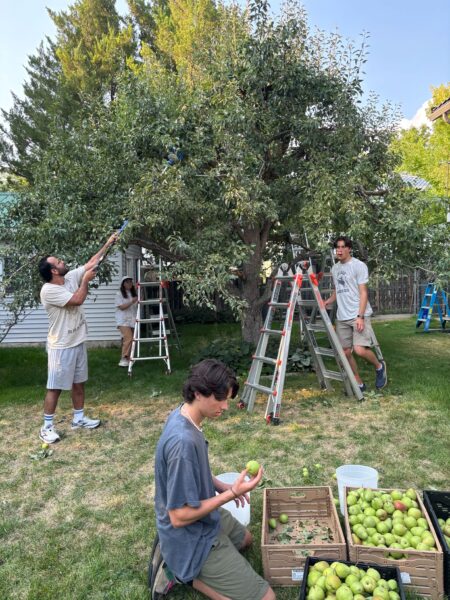
COSAS Harvest Rescue program saves produce around Cache Valley
From the first week of July to the last week in October, the Christensen Office of Service & Sustainability Utah State University Harvest Rescue program saves produce that would be otherwise wasted and redistributes it throughout the community to those who need it. Over 1,000 pounds of food were saved just in July.
The Harvest Rescue program began in 2018 as a fruit preservation project between a professor and intern. Since 2021, sustainable food intern Emma Watts and Student Nutrition Access Center co-director Sarah Moore have been leading the efforts.
“Property owners register their trees and or gardens with us, and we will gather volunteers to come harvest the produce,” Harvest Rescue lead Abigail Doxey wrote in an email to The Utah Statesman. “We do our best to collect most if not all of the produce at each property.”
Higher-quality produce is distributed between SNAC and the Cache Food Pantry, as well as a variety of porch pantries that are supported by Utah Families Feeding Families.
USU Extension uses lesser-quality produce to make fruit leathers, applesauce and other products. Produce not suitable for consumption is used for compost for the Utah Conservation Corps, Student Organic Farm and similar organizations located around campus.
“Harvest Rescue’s main priority and focus is USU students,” Doxey wrote. “So we make an effort to send most of our harvested produce to SNAC. This benefits all the staff and students who use SNAC. It is an amazing experience to deliver food like juicy pears or fresh onions and see the happy faces in SNAC who end up taking some home.”
According to Luke Lehnhof, Harvest Rescue program assistant lead, the program creates healthier food options for students as a large portion of the produce is donated to SNAC.
Lehnhof said fresh produce can be a difficult to obtain at times for students, making the program a great way to provide for those with less food security.
“Not only is USU Harvest Rescue making an amazing difference for those in need, it creates an amazing culture of service,” Doxey wrote. “Many of our volunteers have been recipients of the donated produce and have sacrificed their time to give back.”
The program helps serve the community while providing experience and networking for affiliated volunteers. Volunteers are also able to take home some produce from the gleaning sessions.
“The Harvest Rescue program also provides an amazing opportunity to give back to their community and connect with community members,” Lehnhof wrote in an email to the Statesman.
Those interested in the Harvest Rescue program can get involved by visiting its website usu.edu/service-sustainability/get-involved/cache-gleaning. The website provides a link to register one’s garden or fruit tree, as well as a link to sign up to volunteer for a gleaning session. Additionally, questions can be submitted to its email usuharvestrescue@usu.edu.
“You can also follow us on Instagram @usu_cosas, and you can go to givepulse.com to see our event postings,” Lehnhof wrote.
Doxey emphasized looking into other volunteer programs across campus that promote community and sustainability.
“If food isn’t where your passion is, True Blue Reuse & Repair, Aggies Building Community, Community Rakes & Shovels, and Aggie Blue Bikes are amazing programs as well,” Doxey wrote.
The COSAS website usu.edu/service-sustainability/ contains information about its various programs.
“It is important that students are aware of the Harvest Rescue program so that they can be better connected with the community that they are living in,” Lehnhof wrote. “They are more conscious of the efforts being made and ways they can get involved.”