

Department of Theatre Arts performs modern-day ‘Dracula’
In its season-opening performance, the Utah State University Theatre Arts Department took the stage at the Morgan Theatre to present “Dracula, A Feminist Revenge Fantasy, Really.” by Kate Hamill on Sept. 26.
Loosely based on the “Dracula” novel by Bram Stoker, Hamill’s play explores the nature of predators while adding a modern feminist twist to the classic tale.
Paul Mitri, the play’s director, said they decided to go with Hamill’s version of “Dracula” to give the students an opportunity to perform something unique.
“This version is actually not that different, but the slant of it is more from the female gaze, which is really important,” Mitri said. “It’s hard for students to keep seeing scripts that are always about the female in distress and the men are the ones that are finding the solutions.”
One of the major differences seen in Hamill’s version of “Dracula” is the character of Van Helsing the vampire hunter being portrayed by a woman. Linn Eggett, who is the dramaturg for Dracula, said Van Helsing being a woman created a new dynamic between the vampire hunter and the other female characters.
“The original Van Helsing is this mentor/father figure, and he presents himself as wanting to take care of these women,” Eggett said. “This oftentimes doesn’t do them justice because he’s looking at them as almost children. In this version, we see Van Helsing asking Mina what her opinion is on things — actively advocating for Mina to have a voice and for her to be listened to by men in the show.”
Riley Thompson, who plays Dracula, said this play’s female characters show how much harder women have to work to be treated equally.
“Right when Van Helsing enters in this play, it’s such a shock to everyone that this person with this big reputation, who is known for their intelligence, is a woman,” Thompson said. “It really showcases how women have to fight so much more just so they aren’t completely overlooked. In the play, every idea that the female characters have is kind of discarded, and in the end, their ideas and persistence resolve the entire issue in itself. I think it’s really important to recognize how this play showcases the idea that we need to listen more and have the confidence to persist with our ideas.”
In Hamill’s version, Dracula is still the main villain, but Eggett said he represents an issue much bigger than just one person.
“Hamill references the #MeToo movement from the mid-2010s — specifically the Harvey Weinstein case — as being a big inspiration for how she wrote Dracula,” Eggett said. “It’s a normal thing for powerful men to be able to get whatever they want in this genre. Men in power use situations to manipulate women into being beholden to them. We see this idea through Dracula and see that it’s not unusual. He is not unique in the fact that he used his power to get everyone in his life to be beholden to him. There is this larger idea that he’s not a vampire. He’s just a man. He’s a man that you could meet in the streets. It’s a man that could be your boss.”
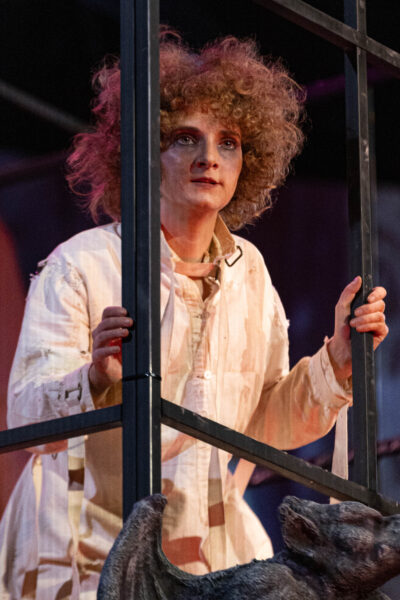 JACK LEWIS BURTON
 Esther Barnes, playing Renfield, stares into the audience at the Morgan Theatre on Sept. 25.
Mitri said one of the major messages in the play is the idea that there are unnoticed dangers all around us.
“There are a lot of ideas that Kate Hamill is working with in this play, and one of them that we are trying to point out is this idea that there are monsters among us and it’s hard to tell the difference when they look just like us,” Mitri said. “When push comes to shove, are you going to be the hunted or the hunter?”
Thompson said he feels the play empowers women to stand up for themselves.
“I think it is very empowering to women, specifically in that they hold so much more power than we give them credit for,” he said. “There’s a scene in ‘Dracula’ where our character Mina finally allows herself that freedom and independence and grants herself permission to access that power. She gives herself a voice and a say in what is actually happening.”
Mitri said it’s important more modern-based plays continue to be written in the future.
“For so many years, the playwrights, the directors and many of the characters have mainly been white cisgendered people, and while that’s certainly a slice of representation for the population, there are many, many other voices out there, and I think that we should make an effort to uplift all of them,” Mitri said.
USU theater will perform “Dracula” through Oct. 4. Those who wish to attend can find more information at artsci.usu.edu/theatre-arts/productions/dracula.