

Students support NASA Artemis mission with moon landing research
In a hidden cell tucked between the Utah State University Metal Factory and aviation labs, a faint rumbling can sometimes be heard through the vine-covered walls. Some might mistake this sound for an air conditioning system, but the reality is a bit more out-of-this-world. USU students are working with partners, like NASA, to test rockets.
When humans return to the moon for the first time since 1972 as part of NASA’s Artemis program, astronauts will land on lunar regolith: a sharp, sticky, electrically-charged dust unlike most substances that exist on Earth. The Plume-Surface Interaction Project aims to understand how deceleration landing gear will interact with moon dust. Students in USU’s Propulsion Research Laboratory are lending a hand in motor design under the guidance of Stephen Whitmore.
Jared Coen and Ava Wilkey are graduate research assistants pursuing master’s degrees in aerospace engineering.
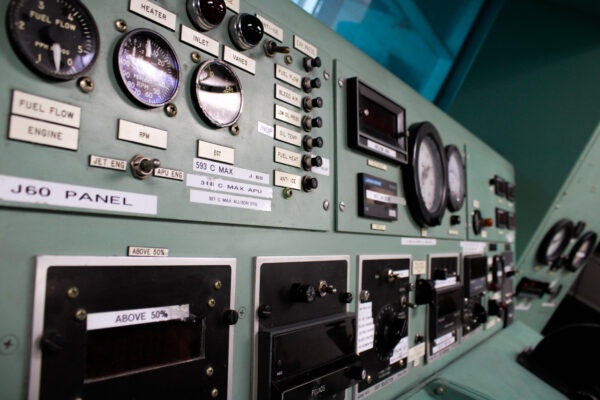
A control planel as seen in the Propulsion Research Lab on Sept. 25.
“The main purpose of the PSI program is primarily safety for astronauts who are landing down on the Artemis mission,” Coen said. “We’re going to be landing on the moon at different places that we didn’t land before.”
The Artemis astronauts will touch down near the moon’s South Pole. Due to the intense angle of the sun in this area, the bottoms of some deep craters haven’t been exposed to light in billions of years.
“If you imagine an air hose on dust, it’s going to make a big old dust cloud, but now that this dust cloud is charged one way next to this other cloud charged the other way, we just don’t know what it’s going to do,” Coen said. “Fortunately with NASA, that’s an unacceptable risk factor.”
Doing extensive testing on the landing gear with simulated lunar regolith will decrease the chances of an unknown variable harming the astronauts or damaging hardware. Coen said it’s safer to learn about new reactions in a controlled environment on Earth rather than on the moon, millions of miles away.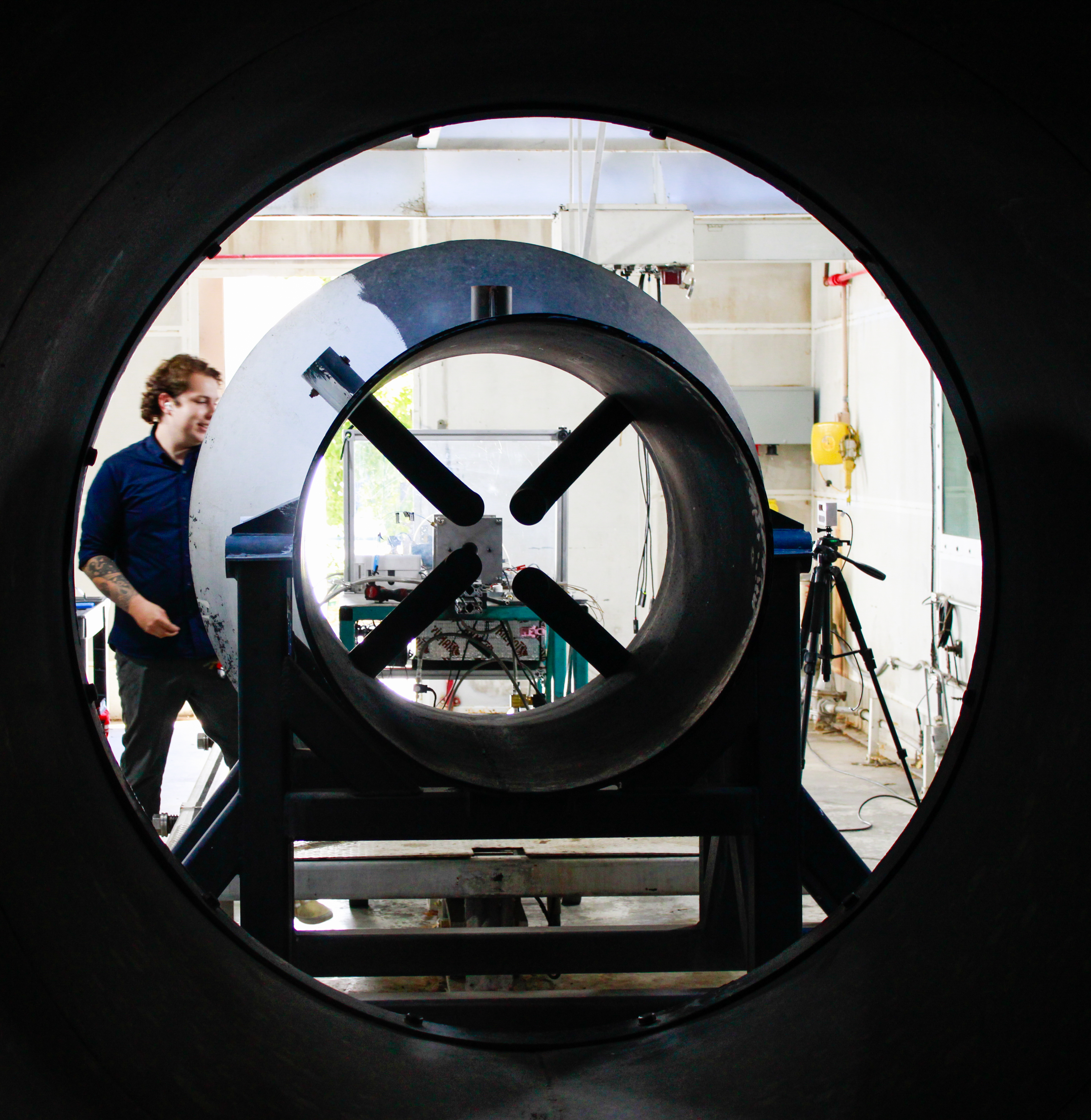
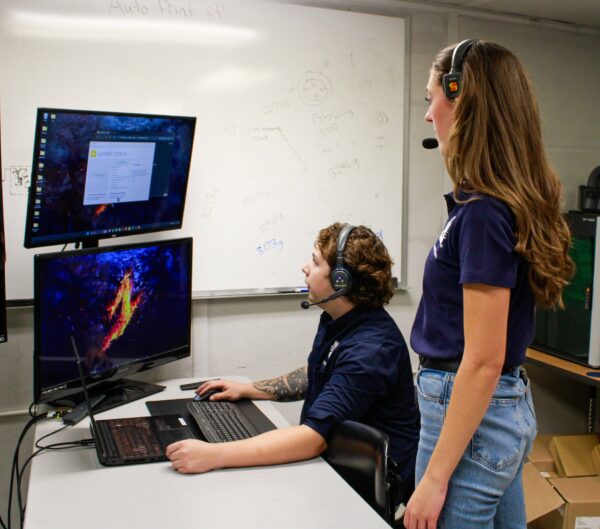
Jared Coen and Ava Wilkey prepare for a plume test in the Propulsion Research Lab on Sept. 25.
According to Coen, the ultimate goal of Artemis is to create a base on the moon . This would simplify solar system travel, make on-site lunar research possible, allow the construction of spaceships in a low gravity environment and more.
“Some of the work that we’re going to be doing is not going to be implemented until 20 years from now,” Coen said. “That’s part of the research. We’re doing this stuff right now so that eventually, when the technology is caught up, people can reference what we do in our thesis.”
The students used 3D-printed Acrylonitrile Butadiene Styrene, or ABS, solid plastic fuel for their tests, which according to Wilkey, is the same plastic used to make LEGOs.
“I can’t believe that I have this position and that I have this opportunity to assist in something that’s so big,” Wilkey said.
According to Coen, the environment of the lab has pushed him to grow and figure out his own solutions to big problems.
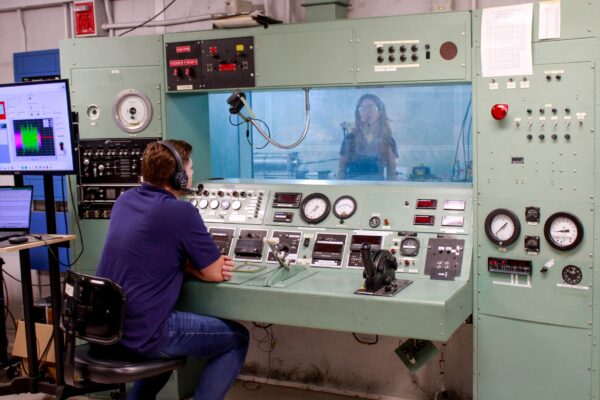
Jaron Dowdy looks at Ava Wilkey through a screen in the Propulsion Research Lab on Sept. 25.
“I got to step up to the plate — it’s very motivating,” Coen said. “We are such a small section of what’s going on in the Artemis mission. But it’s universities like us and small teams that are working towards these split-apart problems that slowly come into this large picture. Even though we might be that little, tiny part of it, it makes it very easy to get up in the morning.”
According to Wilkey, the lab has been receiving positive press coverage, which she hopes will get more people interested and involved in their work.
“We’re an engineering school, and we have a really good aerospace program, so I think it’s good to get the people that are involved in that also involved in aerospace and rocketry,” Wilkey said.
According to Wilkey, time in the lab has helped her understand her coursework better with a confidence building, hands-on approach.
“The class is very numerical, and it’s hard to visualize what’s going on,” Wilkey said. “It’s nice to just go across the street to the lab to work, and you see it happening in real life. You recognize the stuff from class, and you’re like, ‘I know what’s going on here, and I know what I’m talking about.’”
The PRL lab works on projects from many partners, not just NASA. On Sept. 25, students performed a routine test of a rocket plume for one of these partners.
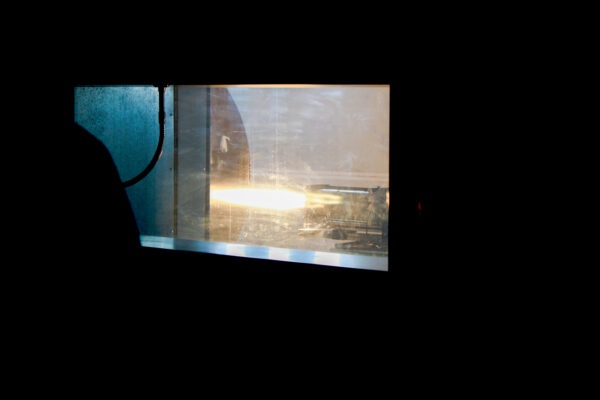
A test plume fires off in the Propulsion Research Lab on Sept. 25.
The lab is equipped with artifacts recycled from the Air Force for testing. When blasting propulsion rockets, the exhaust plume is forced into a large tube where the students and staff can watch from behind the safety of a clear wall.
With eager onlookers ready to see a fiery test and partner companies waiting for results, the pressure can be high, according to Jaron Dowdy, an undergraduate student in aerospace engineering. As the only undergraduate working in the lab, Dowdy said it was a great opportunity — he has even been put in charge of his own team.
“We get a lot of people who want to come work here and have to be turned away because we don’t have endless positions to accommodate everybody,” Dowdy said. “That’s why I’m especially lucky, being an undergrad.”
Dowdy’s passion for space science blossomed early during his childhood.
“I’ve been interested in aerospace for a really long time — before I even knew that I wanted to go into engineering, I was a huge space nerd who would watch all those space physics YouTube channels,” Dowdy said.
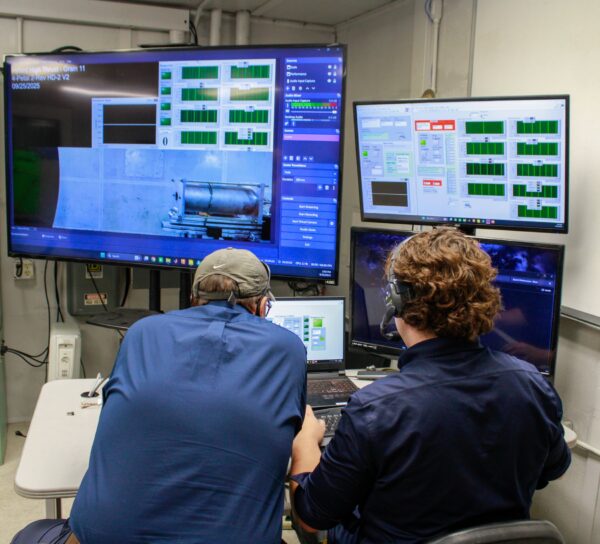
Stephen Whitmore and Jared Coen prepare for a plume test in the Propulsion Research Lab on Sept. 25.
Josh Sorenson, a master’s student working on his thesis in hypersonics, said he first became interested in space during elementary school, when a NASA employee came to talk to his class about his work with New Horizons, a flyby mission used to study Pluto. Sorenson kept a New Horizons poster on his wall for years.
“I’ve always wanted to work on something that would be impactful for space research,” Sorenson said. “With our program that we finished up with NASA, that was that opportunity to play a part in their overall big programs and missions.”
Sorenson said he contributed to the testing and optimization of their hybrid rocket design. The USU rocket will not fly to the moon, but the data collected from these students’ work will be valuable in preparing the Artemis gear.
Kurt Olsen, a Ph.D. student in aerospace engineering, researches propulsion and guidance control. He enjoys working with the PRL lab because it encourages him to overcome challenges in creative and unique ways.
“Some of the projects I work on are really the first of their kind,” Olsen said. “We’re solving problems that no one’s solved before — or at least in ways people haven’t solved them before.”