

Utah State Wildfire Club looks over Green Canyon fire remains
This year, the Utah State University Wildland Fire Club has taken trips to observe conservatism in Yellowstone National Park and the origin of fires in Green Canyon. The reason behind the trip to Green Canyon was to identify the point of origin of a fire because that affects how firefighters will react to putting out the flame.
“Every year, there’s typically a fire or two that occurs along the Wasatch Front,” said Bradley Washa, wildland fire science assistant professor at USU. “Concern for those fires [is] that a lot of times, those are human-caused or have some human element to them. They’re not natural ignitions, and those fires are typically burning in light, flashy fuels, so they burn really fast.”
If the fire is started naturally — through lightning, for example — the firefighters will let it burn to help keep the land in a natural cycle to allow native plants the chance to grow as well as for forests to develop further. If the fire is caused by humans, it is the obligation of the fire department to put it out right away.
“Property is huge,” said Kyle Hamilton, club president. “People’s entire homes can be at risk. That’s becoming an increasingly larger issue with building into the wildland. We’ve seen a lot of shifts over time with larger fires. More of them can be harder to control over time.”
As Utah becomes more populated, people are building their homes close to the WUI, the wildland-urban interface.
“There’s a ton in Utah, but all over the country people [are] building houses farther and farther into what has traditionally been wild lands unmanaged, like high fire-risk areas,” Hamilton said.
The suspected cause of the fire in Green Canyon was an issue with the utility pole of Rocky Mountain Power and their transmission station, where charred grass, shrubs and the poles are. “Right underneath there was some charred grass, twigs and leaf litter,” Hamilton said. “It looks like it lit up right under one of the utility poles and started spreading up on the slope of Green Canyon.”
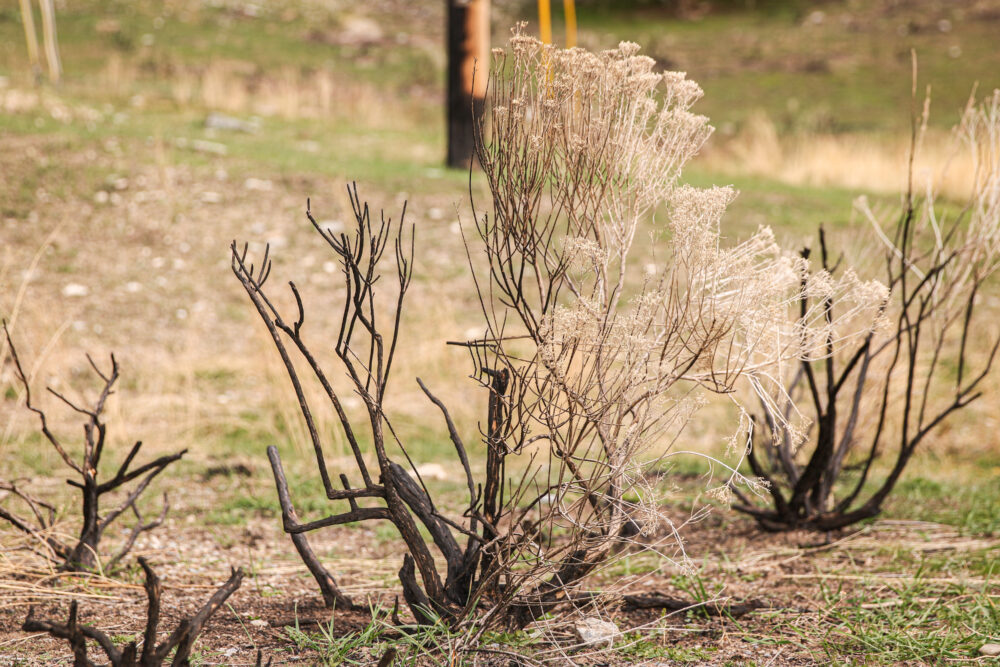
Charred shrubs at the location of a fire that burned close to Green Canyon earlier this fire season as seen on Nov. 7.
Hamilton, Chris Archibald and some more members of the club are all red carded, which means they are certified to work on wildfire incidents as firefighters. Others are working toward their certification.
“I was on an initial attack engine crew out in the west desert and got a lot of good experience,” Archibald said. “For all the fires I was on, which was eight, the management practice was immediate suppression.”
Many members of the club are in ecological majors, but anyone can join.
“I originally heard about the fire club [at] the day on the Quad at the beginning of the semester,” Hamilton said. “The old fire club president, Jake Lancaster, was super friendly and invited me to come learn about it and participate. Just being in that world of outdoor natural resources work led me into it. I think the ecological science side of fire is really interesting.”
The club began in 2018 as a way to create connections for students interested in wildlife and resources.
“I’m in the college of natural resources, so it sounded like a good opportunity for getting good experience for natural resource management and making connections with people,” Archibald said.
Undergraduate and graduate students participate with professors such as Corey Ransom, who specializes in invasive weeds prevalent in Utah like cheatgrass and rye. These have a high fuel index because they dry out quickly and outcompete the native grasses.
“In the case of cheatgrass, look at using chemical treatments, or if you’re a homeowner, going out there and cutting that grass. Cheatgrass is kind of unique,” Washa said. “It’s what’s called a cool-season grass; it carpets the landscape.”
Other solutions to combating these grasses include using goats and sheep to graze and try to prevent fuels for fires.
Looking at Green Canyon now, there are still burnt shrubs and trees so one can see where the fire spread up the slope before it was under control. There were no casualties or harmed property.
“The priority is always safety. Human lives first,” Hamilton said.