

USUSA VP reinstated to office
Editor’s note: Following the public conduct trial of Po’okela Yamakoshi-Sing, USUSA Logan vice president, on Nov. 5, the decision was put in place by USUSA to use the word “hearing” instead of “trial” when referring to the presentations in front of a hearing board. For consistency in reporting, the word “trial” will be used in this article. This is not a reflection of USUSA’s language choice nor the nature of the event.
USUSA Logan Vice President Po’okela Yamakoshi-Sing was reinstated to his position on Dec. 4 following an appeal from his original public conduct trial. The first trial on Nov. 5 removed Yamakoshi-Sing due to his public intoxication at the Utah State University event the Howl and lying to police officers, counts that violate the Article V of the USU Student Code.
His appeal was heard by student hearing board members Priya Corley, AJ Brannan, Kylie Peasley and Gracie Kay as well as student chair Kate Robison, and the decision to reinstate him and place him on probation was moved after a private vote 3-2.
Yamakoshi-Sing appealed on the following grounds: His appeals before his original trial date — to extend the time he had to prepare beyond one day and to remove two members of the hearing board with whom he felt he had a conflict of interest — were denied, and he believed there was inconsistency in the treatment of his trial and that of USUSA Athletics and Campus Recreation Executive Director Ben Burdette.
Burdette’s trial took place on Nov. 12, five days after the original scheduled time. The decision to move it back was addressed in his trial: The original date was on a Friday, and campus resources to help students with mental health such as CAPS would not be open over the weekend.
Colin Hastings, USUSA student advocate vice president, explained in a written statement to The Utah Statesman why Yamakoshi-Sing’s original appeals were denied.
“Hearing Board bylaws state that a trial must take place within ten days of a complaint, and his extension exceeded that timeline, and his reasoning for the extension did not fall under extenuating circumstances,” Hastings wrote. “His request to remove both [hearing board members] was looked into by myself and several members of the faculty, however we found no conflict of interest, and did not believe that his reasoning met the threshold for removal.”
Yamakoshi-Sing felt there was inconsistency in treatment of him and Burdette in their respective trials beyond the date change. Burdette’s trial was initiated after his alleged failure to uphold an MOU, a memorandum of agreement, that he signed after misconduct in his position. His trial resulted in a 15-week probation.
“My request is to be treated with the same fairness and consistency that others have been shown,” Yamakoshi-Sing said in the trial. “My violation was the first offense. He broke that MOU — breached a formal agreement.”
The trial began with remarks from the claimant, USUSA President Brandon Sorensen.
Sorensen outlined the same argument he made in the original trial, showing the board the police report that documented Yamakoshi-Sing’s intoxication and providing misinformation.
“His character is not on trial. His effort is not on trial. What’s on trial is his eligibility for office,” Sorensen said. “A person may be well-liked and still violate policy. A person may be effective and still breach contract. A person may perform good work and still go against his qualifications and responsibilities as a leader.”
After Sorensen yielded his time, Yamakoshi-Sing was brought to the stand, where he admitted to the charges against him and outlined his case to instead be put on probation. He explained the police charge against him for a minor in possession, as well as the student code of conduct violation, has allowed him time to reflect and grow. Additionally, he highlighted the grace shown to him in these charges.
“I’m starting to go through a university class. It’s a drug and alcohol reconciliation advisory course — and probation for a year,” Yamakoshi-Sing said. His probation after attending court is six months. “They recognize that young people do make mistakes, and they focus on growth not punishment.”
According to Yamakoshi-Sing, if the other offices were able to recognize his growth and commitment to change, USUSA should too.
“I understand what I did was wrong. I don’t expect to get off very easily,” Yamakoshi-Sing said. “Although, I don’t want my message to be ‘Oh, I drink alcohol underage.’ I want it to be ‘Hey, I do make mistakes. I can be better from that.’”
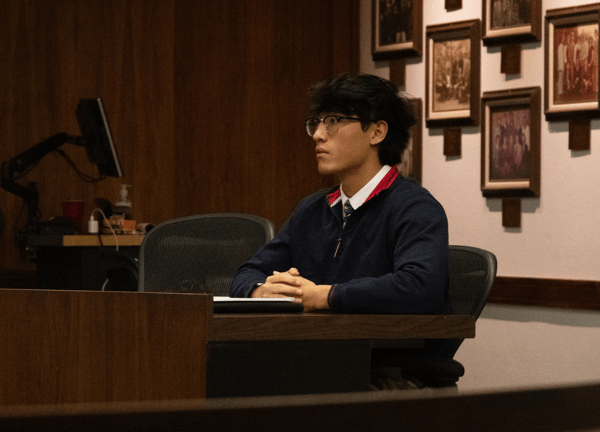
Following the claimant and respondent statements and rebuttals, the hearing board asked questions to both Yamakoshi-Sing and Sorensen to clarify their arguments. Yamakoshi-Sing had other students come with testimonies. These testimonies were scheduled to be heard during the presentation of evidence, but the board moved to hear them following the question portion of the agenda in a 3-2 vote.
USUSA Clubs and Organizations Executive Director Mia Bean spoke first.
“We all have made mistakes … and [Yamakoshi-Sing] has worked hard to overcome what has happened,” Bean said. “He really does care deeply about this position and Utah State, and honestly, I would rather have someone who truly cares about students and making a difference than someone who never makes mistakes and just goes through the motions of the position.”
The second testimony was from Ryley Cottrell, humanities and social sciences senator in the Academic Senate.
“As we saw with Director Burdette’s trial, there is a precedent to do probation instead of automatic removal should you choose to do so,” Cottrell said.
Yamakoshi-Sing’s violation of the USU Student Code resulted in noncompliance with the USUSA Oath of Office, which requires officers to follow these rules. Section 6 of the USUSA Constitution states that “any officer found to be in violation of their Oath of Office by the Hearing Board may be placed on probation.” The hearing board could also determine to remove an officer.
“Losing [Yamakoshi-Sing] as Logan VP would be a detriment to USUSA, and I encourage you as a hearing board to seek actions that combine accountability with opportunities of growth moving forward,” Cottrell said.
The hearing board deliberated for 90 minutes and returned with the decision to reinstate Yamakoshi-Sing and put him on probation. The conditions or length of the probation were not announced.
“We feel like probation was a little too light, but removal was a little too heavy for this situation, so we ultimately decided to go for probation,” Robison said. “It wasn’t an easy decision, and we hope that [Yamakoshi-Sing] will use this as a learning experience to help prevent some of this from happening in the future. We hope that you can use this as a platform to prevent on-campus drinking and bringing drinking into events such as the Howl.”
In a written statement to the Statesman, Yamakoshi-Sing expressed gratitude to the hearing board and those who testified on his behalf.
“Thank you everyone. This past month has been a humbling period of reflection for me. Thank you for your grace and for granting me this second chance,” Yamakoshi-Sing wrote. “I want to be clear: I do not view this reinstatement as a free pass. I made mistakes, and I own them. This process has been a wake-up call, not a vicotry lap. I am returning to office with humility and a renewed commitment to serve every student at Utah State.”