
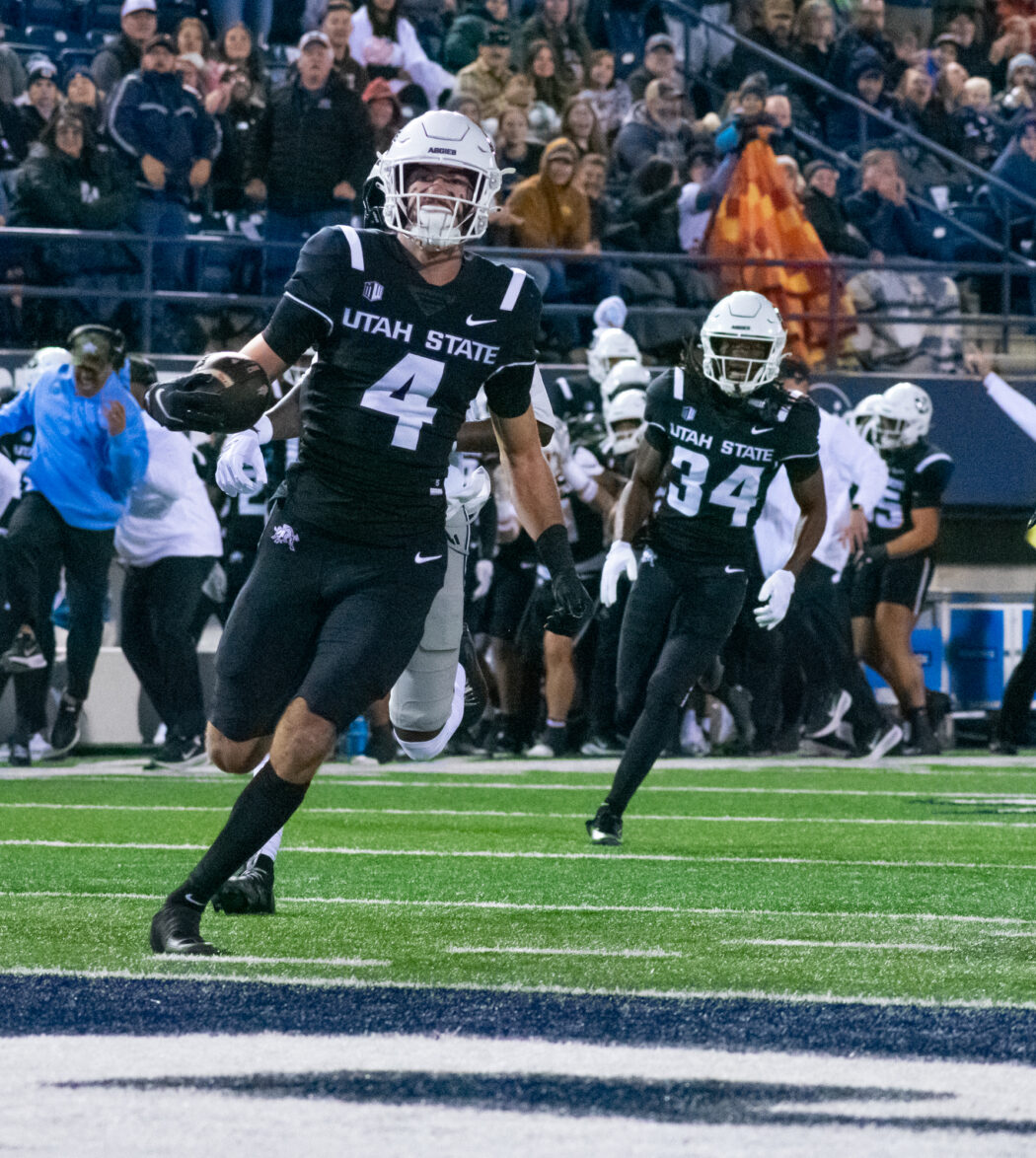
Utah State’s defense finds its footing late in the season
Early in the season, Utah State Football’s defense looked like a unit caught between ideas.
There were flashes — a strong opener against UTEP, timely takeaways against Air Force — but also long stretches where breakdowns overshadowed effort. Explosive offenses exposed communication issues. Drives extended. Red-zone trips almost always ended with points.
Then, slowly, something changed.
It wasn’t one adjustment or one breakout performance. It was a process driven by budding chemistry, clearer roles and a growing confidence in how the defense wanted to play.
“We’re finding our stride, and we’re gaining momentum,” said head coach Bronco Mendenhall. “The production shows that.”
The growing pains
Utah State’s early schedule offered little margin for error. Texas A&M and Vanderbilt — two of the most explosive offenses the Aggies faced all year — punished hesitation and inconsistency. Even in wins, yards piled up, and defensive series rarely ended cleanly.
The defense could generate pressure. They could force turnovers. But they struggled to finish.
Opponents almost never left empty-handed in the red zone, and fourth downs routinely turned into extended drives. The Aggies weren’t being outworked — they were being out-executed in the moments that mattered most.
Defensive coordinator Nick Howell viewed those struggles as part of installing something new.
“I think time just allows you to play better and get more comfortable in the scheme,” Howell said. “The guys have just learned how to really practice physical and tough and get their assignments down.”
A turning point
The loss at New Mexico in late October proved to be a breaking point — not just because it was one of the worst defensive showings this year but because it was one the Aggies felt was avoidable.
“We left it with a bad taste in our mouth,” Howell said. “There were some bye weeks in there where we were able to self-scout and adjust things to fit our guys a little bit more.”
From that point forward, the defense looked different — not necessarily dominant on the stat sheet, but more composed. Drives shortened, windows tightened and opponents had to earn every score.
The numbers reflect that shift. Red-zone success against Utah State dropped from 96% in the first six games to 78% in the last six. Opponents’ fourth-down conversion rate dropped from 69% to just 33% in the second half of the season. It was clear that Utah State became far more effective in the highest-leverage moments
But the more telling change was visual. Defensive backs arrived on time. Linebackers trusted their fits. Safeties communicated rather than reacted.
Stability on the back end
Much of that growth coincided with the return of safety Ike Larsen in Week 6.
His presence allowed Utah State to settle its secondary, giving the Aggies more experience and flexibility. Noah Avinger, who had spent much of the first half of the season playing safety, slid back to corner, and his role expanded.
“It allowed [Avinger] to play corner and Ike to play safety,” Howell said. “That’s another better player on the field and another really good player at corner.”
Avinger’s season became a reflection of the defense’s evolution. Early on, his impact showed up mainly in tackles and interceptions. Later, it appeared in subtler but often more important ways: pass breakups on third down, tackles for loss in the red zone and pressure that forced hurried throws.
With his versatility and week-to-week impact, Avinger earned HERO Sports Group of Five All-American second-team honors.
“Being able to have a player that coach can throw wherever is very helpful,” Avinger said. “That’s what I kind of take pride in as a player. I always tell coach, ‘Anywhere you need me on the defense, I will play for you.’”
Less chaos, more control
Utah State didn’t suddenly become a sack-heavy defense late in the year. In fact, raw sack numbers dipped slightly. But pressure became more consistent and coverage more reliable.
Quarterbacks were forced to throw earlier, and drives stalled in situations where they previously hadn’t.
Games like the road win at Fresno State — where the Aggies shut out the Bulldogs in the second half — highlighted that maturation. The Aggies weren’t just surviving possessions — they were closing them.
“As the weeks went on, we got better and better,” Avinger said. “We had to lock in on the details. If it doesn’t look right in practice, how is it going to look right in the game? That confidence stacks. Once you see it work, you trust it more.”
By season’s end, Utah State’s defense had found its identity.
It was never flashy, nor was it perfect. But it was disciplined, connected and increasingly dependable in pressure situations — the very areas that define postseason football.
As the Aggies prepare for their bowl matchup against Washington State, that growth matters. The Cougars thrive in tight, physical games, where patience and execution decide outcomes.
Utah State’s defense learned those lessons the hard way. Through early setbacks and internal adjustments, their improvement wasn’t about doing more but doing things better.
Now, they enter the postseason knowing exactly who they are — and how they want to play.