

Utah State comes up short against Washington State in Famous Idaho Potato Bowl
The Aggies spent much of their first season under Bronco Mendenhall trying to prove they belonged again on a bigger stage. On the afternoon of Dec. 22 at Albertsons Stadium, they got a clear look at what that stage will demand — and how much ground still remains.
Washington State pulled away in the second half to defeat Utah State 34-21 in the 2025 Famous Idaho Potato Bowl, using explosive passing plays early and a punishing run game late to secure the win.
“We came to win the game,” Mendenhall said. “Fell short. My responsibility is to have the team prepared to play and execute at a level that will hold through the entire game and be strong enough to help us win. I fell short as well.”
The loss closed a season defined by resilience and flashes of progress for a Utah State team that entered the year with a new coaching staff, a largely rebuilt roster and expectations focused more on foundation than finish. It also offered a measuring stick against a Washington State program built with the depth and physicality Utah State will see regularly when it joins the Pac-12.
Utah State’s defense set the tone early, repeatedly disrupting Cougars quarterback Zevi Eckhaus and creating opportunities the offense couldn’t convert.
After forcing a three-and-out on the opening possession, the Aggies benefited from short fields twice in the first quarter following interceptions by safety Ike Larsen and cornerback Dylan Tucker. Larsen’s interception was his first of the season after missing the opening six games due to suspension, and it gave Utah State the ball inside the Cougars’ 15-yard line.
But both chances ended empty — a missed 31-yard field goal and a red-zone interception — as Utah State struggled to find rhythm against Washington State’s disciplined defense.
“We didn’t capitalize on a couple turnovers early on, which I think swung the momentum,” Mendenhall said. “We just ultimately didn’t play consistently enough, really in any phase.”
Washington State struck first on a 41-yard touchdown pass from Eckhaus to Mackenzie Alleyne late in the first quarter, exploiting coverage over the middle — a vulnerability Utah State battled throughout the season. The Cougars leaned heavily on the passing game early, finishing the first quarter with more than 100 passing yards and no rushing yards, a sharp contrast from a team that relied on the run throughout much of the season.
Utah State’s offense, meanwhile, sputtered. Quarterback Bryson Barnes faced constant pressure, was sacked multiple times and completed just 2 passes through much of the first half as the Aggies repeatedly found themselves pinned deep in their own territory. Several promising runs and returns — particularly from Barnes and Javen Jacobs — were negated by penalties, a recurring frustration during the year.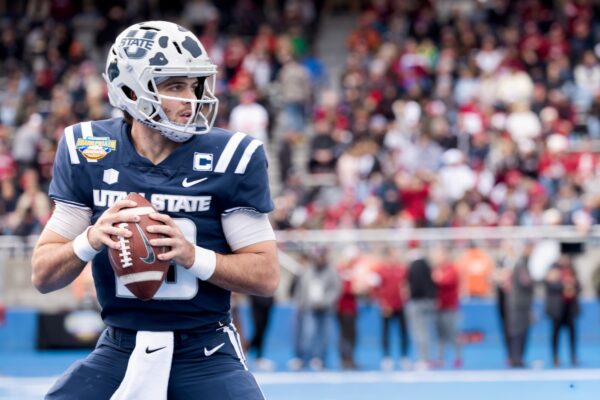
Washington State extended its lead to 14-0 midway through the second quarter on a one-yard touchdown pass to Hudson Cedarland, capping a methodical drive that featured multiple seam completions and edge runs. Eckhaus consistently found space between Utah State’s linebackers and safeties, forcing the Aggies to defend horizontally and vertically.
Utah State’s defense continued to fight, highlighted by linebacker John Miller’s chase-down sack and a goal-line stand on fourth down just before halftime. But the Aggies entered the break still scoreless, managing fewer than 50 total yards of offense in the opening half.
“That’s a strong defense,” Mendenhall said of Washington State. “They were as advertised. They were consistent, they executed and they were better in most circumstances.”
Any hope of a Utah State turnaround hinged on halftime adjustments, but Washington State immediately flipped the script by establishing the run.
Maxwell Woods and Angel Johnson gashed the Aggies on the Cougars’ opening drive of the third quarter, ripping off chunk gains that hadn’t been available earlier. The drive ended with a field goal, but the tone had shifted, and the Aggies felt it.
“The ability to run the football was the difference in the game, particularly in the second half,” Mendenhall said. “We weren’t fitting cleanly, precisely nor consistently, and so you have to give Washington State credit.”
Utah State’s offense continued to struggle until late in the third quarter when Barnes finally found a spark. After a rare deep completion to Brady Boyd and a pass interference call at the goal line, Barnes scored on a two-yard quarterback keeper to cut the deficit to 20-7.
The drive reflected much of Barnes’ season: creativity under pressure, toughness as a runner and flashes of explosiveness despite limited protection up front. Barnes finished the year with one of the most productive quarterback campaigns in program history, often carrying the offense through sheer competitiveness.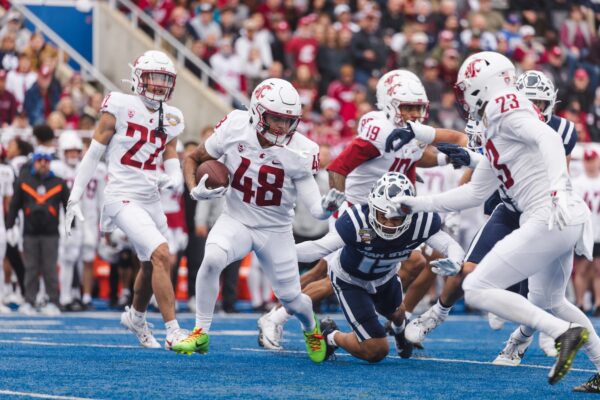
But the momentum was brief. Washington State answered with another deep touchdown pass early in the fourth quarter, a 39-yard strike to Landon Wright that pushed the lead to 27-7 and again exposed the middle of the Aggies’ defense.
Barnes’ afternoon ended midway through the fourth quarter after a hard hit near the head forced him out with a possible concussion. With the Aggies trailing by 13, sixth-year quarterback Jacob Conover was thrust into action.
Conover’s first throw was intercepted, but multiple penalties wiped the play away and gave Utah State new life. He responded by throwing a 21-yard touchdown pass to Boyd and later connected with Jacobs for a 26-yard score in the final minutes.
“You preach always being ready,” Conover said. “That just goes to show the culture coach Mendenhall has established. There’s 100 guys on our team who never quit that fight.”
The Cougars put the game away with a 34-yard keeper by backup quarterback Julian Dugger and controlled the final minutes behind a physical rushing attack that wore down an already thin Utah State defense.
Injuries mounted late — including linebacker Tyree Morris being carted off and lineman Jr Sia limping to the sideline — underscoring the toll of a 13-game season against a deeper opponent.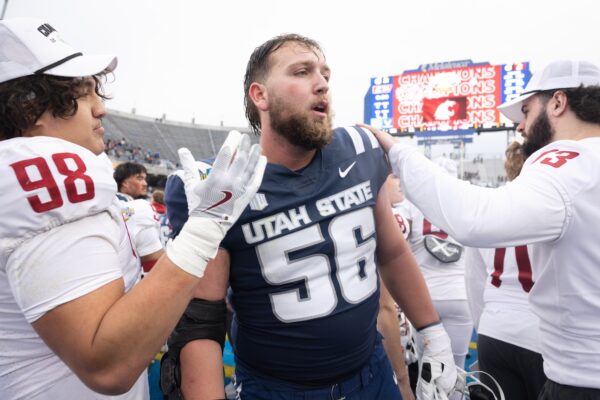
A season of progress
The box score reflected Washington State’s total control — as the Cougars finished with 628 yards of offense — but it didn’t fully capture Utah State’s season-long arc.
The Aggies entered the year aiming for a Mountain West championship, but roster turnover and inconsistency proved too much to overcome. Still, Barnes spearheaded an explosive offense despite constant pressure, while multiple first-year contributors posted career-best campaigns.
Defensively, Utah State improved markedly after midseason losses to Hawaii and New Mexico, becoming more disciplined and confident down the stretch, a trend Miller said defined the group.
“That New Mexico game was a punch in the mouth,” Miller said. “From there, we decided we were going to play good ball and make it look the right way. I’m extremely proud of this group.”
Mendenhall echoed that sentiment, emphasizing the closeness of a team that endured both physical and emotional tolls throughout a 13-game season.
“I’m not sure I’ve ever enjoyed coaching a team as much as this one,” he said earlier in the week. “The unity, the alignment, the effort — just how much fun it is to be with these guys.”
Looking ahead
The loss drops Utah State to 6-7 on the year, but it also closes the Mountain West chapter and opens the door to a new era in the Pac-12. Mendenhall was candid about the work ahead — roster building, execution and consistency — but confident in the foundation his first team established.
“I like the foundation a lot with what we’re launching from,” Mendenhall said. “This was transparency of where we are.”
For seniors like Conover and Miller, the record mattered less than the bonds formed.
“I wouldn’t trade this year for anything,” Conover said. “It’s not a team — it’s a family.”
Utah State left Boise with a loss but also with clarity about the physical standard required, with gaps still to close and the belief that this season, imperfect as it was, set the baseline for what comes next.
*Photos by Omar Saucedo, digital content manager for Creative Hive Group at Boise State Student Media