
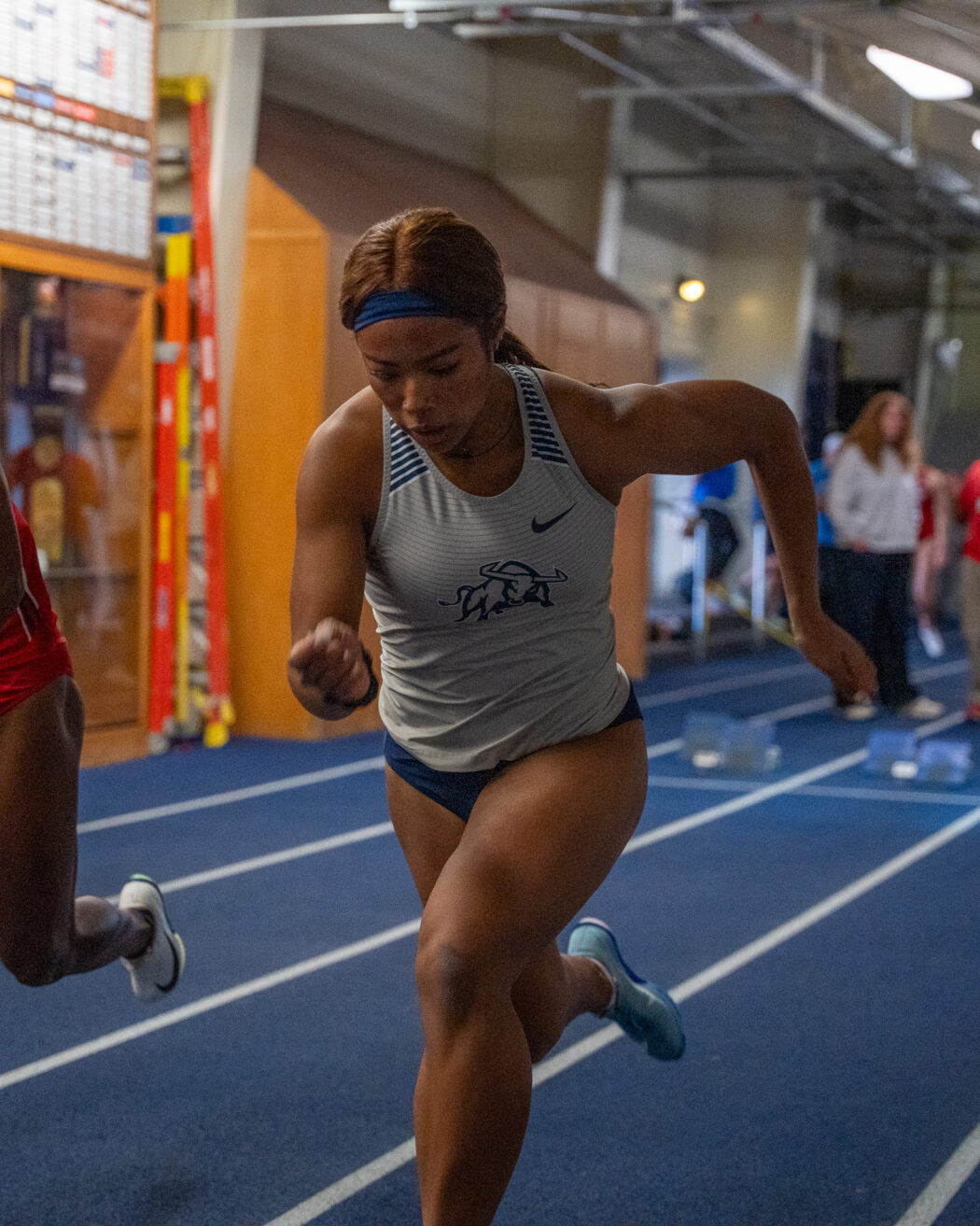
Utah State freshman sprinter Adia Ross breaks school record in collegiate debut
Adia Ross had already traveled thousands of miles to get to Utah State. Breaking a school record in her first collegiate race wasn’t something she expected to happen.
The first-year sprinter from Tokyo, Japan, was competing in her first indoor meet in the United States when she ran the 60-meter dash in 7.48 seconds, breaking a Utah State school record that had stood since 1987.
Ross finished No. 4 overall in the race behind two All-Americans and an NCAA finalist, but the time immediately placed her atop the Aggies’ all-time list.
Despite the historic result, Ross admitted the moment was filled with nerves.
“I felt very intimidated,” she said. “Everybody looked so fast, and I had to remind myself, ‘I deserve to be here. I can compete with these girls.’”
From an early age, she had set her sights on competing collegiately in the U.S., a goal shaped in part by her father, who is American.
“Ever since I was in middle school, I wanted to go to college in the United States,” Ross said. “My father wanted me to come to the States too.”
That plan nearly unraveled during high school. Ross said injuries disrupted her consistency and confidence. At the same time, the financial reality of moving overseas made the decision even more difficult.
“I got injured almost every single season,” she said. “I wasn’t very happy with my results, and I was really about to give up on coming to the States because financially it’s really difficult.”
A scholarship opportunity ultimately made the move possible, and Utah State sprints coach Rodney Burkes played a key role in that decision. Burkes first came across Ross while reviewing international sprint results and videos online.
“I was looking through international meet results, and I came across her on Instagram,” Burkes said. “I was wondering, ‘Is this legit?’ But what stood out was that a lot of the times she ran were into a negative wind.”
Burkes said that detail mattered. In the U.S., headwinds often lead to adjustments or restarts, but Ross consistently produced elite times under difficult conditions.
“Seeing her run that fast into a negative wind, I was like, ‘Man, this girl is pretty special,’” Burkes said.
After connecting with Ross and her family — often through translation apps — Burkes felt confident she could adapt to life and competition in Logan. Ross later visited campus with her uncle, former NFL football player Derek Ross, before committing.
The transition, however, has been significant. Ross said she had not been to the U.S. in nearly a decade before enrolling at Utah State, and adjusting to both the language and culture came quickly.
“English was really difficult at first, especially all the track lingo,” she said. “The culture shock was very big.”
Living in Cache Valley has been a sharp contrast from Tokyo, but it is one Ross said she has grown to appreciate.
“It’s very new coming from a big city,” she said. “I love seeing the mountains and the snow. People are really nice, and everybody’s been so supportive. I feel like a baby sometimes because I don’t understand everything — even the traffic lights — but everyone is really helpful. I love Logan.”
That adjustment extended onto the track. Ross said in Japan, she was often the sprinter her competition feared. At her first collegiate meet, held at BYU, the dynamic felt reversed.
“In Japan, I believe I was the intimidating-looking athlete,” Ross said. “But at BYU, I was the one who felt intimidated.”
Even so, Ross entered the race with specific expectations. She said she was targeting a time in the low 7.4 range, a standard that would qualify for finals and national-level competition in Japan.
“The whole reason I came to the U.S. is to dominate in Japan,” Ross said. “I came here to be great, not good.”
When the results flashed 7.48, Ross said she felt conflicted. The time broke a decades-old school record, but it didn’t meet her personal standard.
“I wasn’t very satisfied,” she said. “Coach Rodney always tells us to chase execution and not the time, and I feel like I chased the time more than the execution.”
Burkes said his perspective entering the meet was different. Rather than focusing on times, he was more interested in how Ross handled the moment.
“With freshmen, especially their first meet, I just want to see how they compete,” Burkes said. “I want to see if they run fast and get comfortable or if they want more.”
Even then, Burkes admitted the result exceeded his expectations.
“If I had to put a time on it, I thought maybe 7.5,” he said. “I wasn’t expecting 7.4 in the first meet. Honestly, I never thought about the time at all.”
When Burkes was told Ross had broken a school record dating back to 1987, his initial reaction was disbelief.
“I thought it was a joke,” he said. “Then they told me it was real, and I was like, ‘Okay, we’re a little ahead of schedule.’”
Ross, however, was less surprised. She admitted she had been tracking Utah State’s school records long before stepping on campus.
“I always look at school records,” she said. “I’ve been looking at it since I committed.”
Despite the early success, neither Ross nor Burkes said they have changed their approach. Ross described the debut as “an okay start,” emphasizing she is more focused on improving execution than celebrating the record. Burkes echoed that sentiment, stressing patience and long-term development.
“She’s already fast,” Burkes said. “You don’t need to do too much. You rush it, you risk injury. We’re just going to let the journey be the journey.”
Ross said being surrounded by experienced teammates has helped her adjust, particularly learning about indoor racing and competing on banked tracks — something she had never done before.
“They teach me everything,” she said. “Living in America, competing indoor, how different it is. Hearing their stories is really exciting.”
Over winter break, Ross returned to Japan and trained with her former high school and club teams. She said training alone was difficult, but the experience reinforced why she chose to take the risk of coming to the U.S.
“I felt like I had to show them that coming to the States and risking it is worth it,” she said. “I don’t want people to think, ‘She didn’t get faster in college, so I won’t go.’ I want them to think, ‘I want to go because she’s doing really well.’”
Looking ahead, Ross said her goals include lowering her times while maintaining strong academics.
“I want to run low 7.4, maybe high 7.3,” she said. “But I don’t want to be distracted by academics or eligibility. I want to maintain a high GPA and make everyone proud.”
For Burkes, the priorities extend beyond the stopwatch.
“Track is a small piece of their life,” he said. “My job is to help her accomplish every goal she has, on and off the track.”
Ross’s record-breaking debut may have made history, but both the athlete and coach see it as a starting point rather than a destination.
“I know I can do better,” Ross said.