

SUU ends Piano Performance Degree, Students Advocate for the Arts
By Payson Davis | Southern Utah University
This story is jointly published as part of the Utah College Media Collaborative, a cross-campus project bringing together emerging journalists from Southern Utah University, the University of Utah, Utah State University and Utah Tech University. The collaborative is an Amplify Utah project with support from PBS Utah and POV.
Dr. Christian Bohnenstengel, piano professor and director of keyboard studies, wasn’t surprised when Southern Utah University announced that the piano performance program would be cut under House Bill 265. Most of his students were graduating, and the number set to take their place was far lower than the school and state legislature preferred.
Even though his job wasn’t in jeopardy, he said it wasn’t easy to accept the fact that many of his classes would be eliminated.
On March 26, 2025, Gov. Spencer Cox signed HB 265, or the Higher Education Strategic Reinvestment Bill, into law. The bill requires all colleges and universities in Utah to submit three-year plans to reduce costs, reallocate funding to programs that promote in-demand jobs and prioritize administrative spending.
The Early Impacts of HB 265
In preparation for the new funding requirements, lawmakers have already cut $60 million from higher education budgets and moved it to a reinvestment fund. The University of Utah, which saw a decrease of $19.6 million, has already eliminated 81 academic programs — including 22 humanities degrees, 16 in Middle East Studies and eight from the College of Fine Arts.
“I think, in the long run, it could be wise to refine education to help people prepare for future careers, but ultimately I disagree with the principles of the bill,” said Topher Hansen, a piano student at SUU. He’s among those who learned last year that they would be the final members of their major.
Due to HB 265’s reallocation of funds, SUU’s Bachelor of Music in Piano Performance was designated to be cut after its current students graduate. Students can still pursue a piano degree through music education, a Bachelor of Arts or the commercial music program, but the loss of the performance degree has left many frustrated.
“If the government is mandating universities to bottleneck educational opportunities into only working-class careers, they are limiting the freedom to pursue happiness,” Hansen said. “College isn’t meant just to produce workers for the country, but artists, philosophers and professionals to increase the quality of the nation. If there are those who wish to teach and learn a subject, let them.”
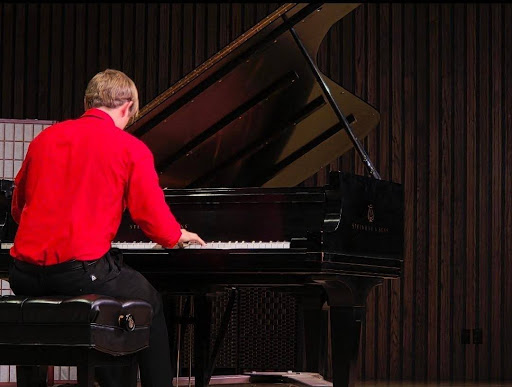
Piano student Topher Hansen plays a piece by Sergei Rachmaninoff at a piano recital. (Payson Davis)
Students React to Cuts
The bill became the year’s talking point among many music students. Like Bohnenstengel, they weren’t surprised by the decision, but many expressed frustration and disappointment.
“It was definitely a big topic of discussion among piano majors,” said an international music student who asked to speak anonymously. “Many people don’t fully understand why we go to school for instrument performance. Many of us double major in other fields while using the degree to keep learning about piano and pursuing our passion.”
The student said the cut hit especially hard, given the recent elimination of the National Endowment for the Arts grants and what they see as a trend of making cuts to the arts.
“We were all upset over the cut,” they said.
“But I keep educating and advocating for piano despite all of that…” they continued. “Piano improves cognitive development in children, the overall IQ of pianists is higher than average, and the instrument rewards discipline while improving academic performance.”
Other students in the program also spoke adamantly about the positive effects music and the piano have on the wider world, rejecting the notion that a piano degree is low-value.
Other students shared concerns about the wider impacts of cutting the arts.
“It’s sad to see artists living off scraps just trying to get by,” Hansen said. “What needs to happen is higher-paying positions for workers in the arts. They may not be as functional as electricians or engineers, but that doesn’t mean there isn’t a market for the arts.”
Students Turn to Activism and Outreach
Even though many students worry their degrees may be next, they continue to champion music in all its forms.
“My advocating works in practical ways,” said the international student. “I perform at local events, I encourage all of the people I know to appreciate music and piano and I tell people to get their kids interested in piano lessons and classical music.”
They explained what their generation stands to gain from music.
“In the age of artificial intelligence, people yearn for something real and meaningful, which is what music can offer them.”
The Resilience of Festival City
Despite its role as a small college town with fledgling markets and infrastructure, Cedar City’s art scene continues to thrive even with these cuts. SUU’s music department, choirs, and commercial music program continue to grow, its stage plays attract huge audiences, and local bands and musicians keep performing.
SUU is the smallest of the six major Utah universities. Cedar City is the least populous with the smallest endowment among them.
However, Cedar City is widely known as Festival City for its farmers’ markets, Tony Award-winning theatre and active arts community. Even as the piano students graduate and the major ends, southern Utah will continue to offer opportunities for creatives and performers.
Payson Davis reported this story as a communication student at Southern Utah University.