

USU Aviation Week highlights program
At Utah State University, Aviation Week offers students and the community a chance to explore one of the university’s fastest-growing programs.
“Aviation Week is a way to showcase aviation at USU: how it started in 1939 with maintenance and how much it’s grown since then,” said Michael Logan, aviation marketing, outreach, and recruiting coordinator.
The weeklong event featured a range of activities designed to highlight aviation education, including a helicopter landing on the Quad, drone demonstrations, simulator tours and a career conference connecting students with industry professionals.
“We’re showcasing all of our programs: fixed-wing training, helicopters, maintenance, air traffic control, management, drones and our jet training program,” Logan said.
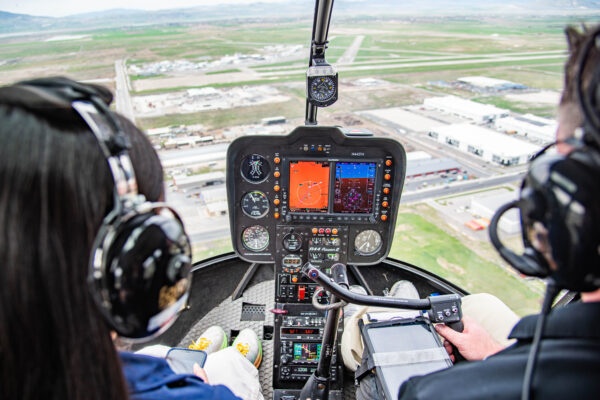
Assistant Helicopter Chief/Flight Manager, Tyler Knudsen, flies to Logan-Cache Airport on March 30.
The idea for Aviation Week originated from a need to raise awareness about a program that has existed for decades but is still unfamiliar to many students and community members.
“Everywhere I went, people would say, ‘Utah State has an aviation program? Is that new?’ And I’d say, ‘No, it’s been here since 1939,’” said Andreas Wesemann, aviation technology associate department head. “We created it as a way to showcase what we do.”
Since its creation, both Aviation Week and the aviation program itself have grown significantly.
“We now have over 800 students in the program,” Wesemann said.
Logan noted that demand continues to rise, particularly for flight training.
“Our fixed-wing program alone has over 600 students, and it’s full,” Logan said.
Events throughout the week are designed not only to inform, but also to give students real-world experience in leadership and organization.
“First and foremost, I want our students to learn leadership, project planning and organization,” Wesemann said. “You’ll see students running these events.”
The week begins with one of its most visible and popular events.
“We kick things off Monday with a helicopter landing on the Quad,” Logan said. “Students can meet the pilots and learn about the program.”
Other highlights included Drone Day, where students demonstrate unmanned aerial systems and showcase their technical skills, as well as a career conference that helped prepare students for entering the workforce.
“Wednesday is a career conference where students meet industry professionals and do mock interviews with airline representatives,” Logan said.
Advancements in technology have also played a major role in the program’s development. During Aviation Week, visitors explored high-tech training tools used by students.
“We now have a 737 simulator and a new air traffic control simulator. It’s amazing technology,” Wesemann said.
Wesemann emphasized that aviation extends far beyond piloting aircraft, offering a wide range of career opportunities.
“Aviation isn’t just flying. It includes drones, maintenance, air traffic control and so many other fields,” Wesemann said.
Students trained in these areas are already finding careers in emerging industries.
“Our students are working for companies like Amazon Prime Air, doing drone delivery, inspections and aerial photography,” Wesemann said.
In addition to showcasing student work and career pathways, Aviation Week also aimed to inspire future students. This year’s featured speaker was Jessica Cox, the world’s only armless pilot.
“She talks about thinking outside the shoe, finding ways to solve problems differently,” Wesemann said.
Organizers said the event serves as both a recruitment tool and a way to build community awareness.
“A lot of people don’t even realize Utah State has an aviation program,” Logan said. “This is one way we get the word out.”
For Wesemann, the impact of Aviation Week goes beyond awareness or enrollment numbers. He said the experience can shape students’ confidence and outlook, regardless of whether they pursue aviation careers.
“Even if aviation isn’t their path, they learn they can do hard things,” Wesemann said.
While Aviation Week lasts only a few days, faculty stress that opportunities to explore aviation are available year-round through tours, camps and hands-on experiences.
“You don’t really understand aviation until you experience it, whether that’s in a simulator or in an aircraft,” Wesemann said. “That can be life changing.”