
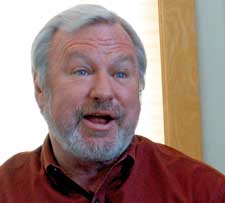
Political science professor Mike Lyons remembered by community
For decades, students filing into political science classrooms at Utah State University came to know one constant: Michael Lyons at the front of the room, ready to challenge them to think more deeply about government and civic life.
Lyons, a longtime professor of political science who began teaching at USU in 1978, died this semester, leaving behind generations of students and colleagues who said his presence defined the department. Though he officially retired in 2024, Lyons returned almost immediately to continue teaching, a decision that reflected his commitment to the classroom.
At the time of his death, Lyons was teaching one course, which the department plans to complete for the semester.
Steve Sharp, an instructor in the USU Department of Political Science, shared an office with Lyons and said his colleague’s dedication to teaching never faded.
“He just loved being here,” Sharp said. “Even after retiring, he came right back because he cared about the students and the work.”
Sharp first encountered Lyons as a student in his congressional simulation class, years before becoming his colleague. That experience, he said, left a lasting impression.
“That class was one of the most impactful things I did as a student,” Sharp said. “It showed me what politics looked like in practice, not just in theory.”
Sharp described Lyons as steady, thoughtful and consistently engaged with both students and faculty.
“You’d hear him talking with students all the time,” Sharp said. “He was always available — always willing to help.”
Damon Cann, a professor of political science, explained that Lyons’ influence extended across the department, particularly through his teaching style and institutional memory.
“He had been here so long that he was part of the foundation of the department,” Cann said. “He understood how things worked, and he cared about maintaining what made the program strong.”
Cann said Lyons balanced high expectations with an approachable demeanor, creating an environment where students felt both challenged and supported.
“He wanted students to take the material seriously, but he also wanted them to succeed and feel like they belonged in the conversation,” Cann said.
For students, Lyons’ impact often went beyond coursework.
“He’s prepared leaders that are all over, in state government, both in administration and in actual office, and in Washington,” Cann said.
Frankie Meehan, a former teaching assistant for Lyons, said his classes emphasized real-world application and critical thinking.
Meehan explained how Lyons helped with her law school application and wrote her a letter of recommendation.
Meehan spoke about how working as his teaching assistant gave insight into Lyons’ commitment behind the scenes.
“He put a lot of effort into making sure students were getting something meaningful out of the class,” Meehan said.
Abbi Zaugg, a current teaching assistant, said Lyons created a classroom environment where students felt comfortable participating, even when topics were complex.
“He made it feel like your ideas mattered,” Zaugg said. “That made a big difference for a lot of students.”
Zaugg noted Lyons’ teaching style encouraged students to think independently while still providing guidance.
“He would challenge you — but in a way that made you want to improve,” Zaugg said.
Colleagues said that balance of rigor and support defined Lyons’ career. Over more than four decades, he taught thousands of students, many of whom went on to careers in law, public service and government.
Lyons taught at USU while both current USU President Brad L. Mortensen and Utah Gov. Spencer Cox went through the department.
Sharp said Lyons’ long tenure also gave him a unique perspective on how the university and its students had changed over time.
“He had seen generations come through, but he treated each group like they were just as important as the last,” Sharp said.
In the days following his death, students and faculty have looked for ways to honor his memory. The university will hold a memorial service on April 25, and students can leave notes for Lyons’ family in the political science office.
Cann said the outpouring of support reflects the impact Lyons had on those around him.
“You can see it in how people are responding,” Cann said. “He mattered to a lot of people.”
For those who knew him best, Lyons’ legacy is rooted in the classroom, where he spent the majority of his career.
“He believed in what he was teaching, and he believed in his students,” Sharp said.
As the department moves forward, colleagues say Lyons’ influence will remain in the culture he helped build and the students he inspired.
“He’s part of this place,” Cann said. “That doesn’t go away.”
As the semester continues and his final class moves forward, colleagues and students alike say that commitment to teaching is how Lyons would have wanted to be remembered.