
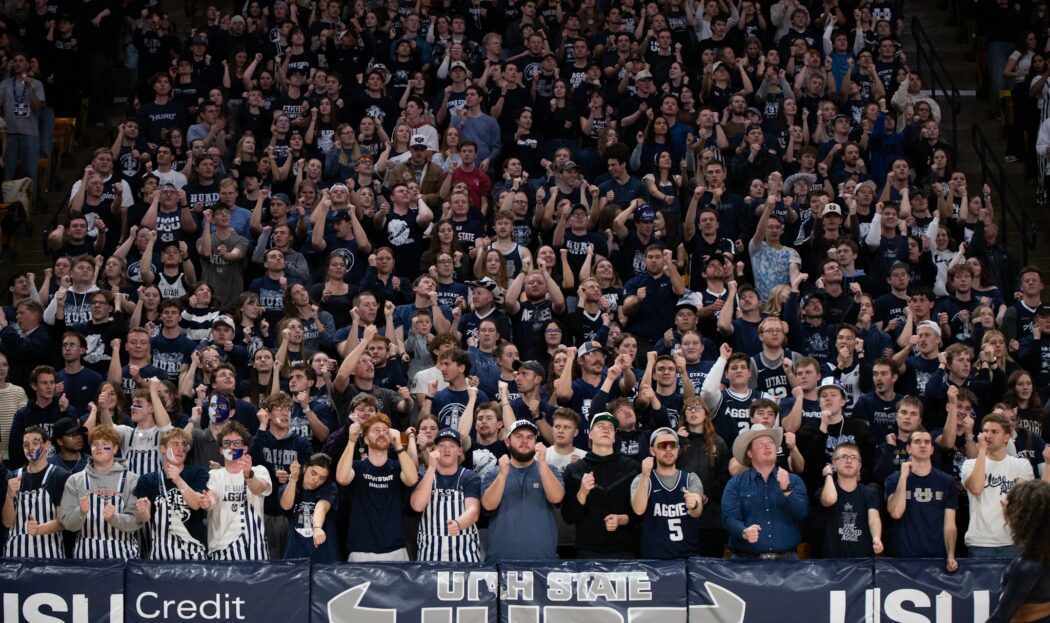
Utah State announces changes to seating in Spectrum
Editor’s note: This is an ongoing story and will be updated as more information is made available. This story was last updated on April 16 at 5:18 p.m.
Utah State University announced changes to the seating chart in the Dee Glen Smith Spectrum on April 13, including changes to the seats occupied by the Utah State student section the HURD. The announcement comes after prior speculations and rumors have circulated about moving the HURD, including potentially splitting it up.
“In partnership with HURD leadership, we reviewed and evaluated multiple options to adjust the seating map at the Dee Glen Smith Spectrum, helping create a new atmosphere that enhances fan experiences and provides additional season-ticket and premium opportunities while ensuring our passionate students remain together and their seats are not reduced,” said USU Vice President and Director of Athletics Cam Walker in a statement. “I’m grateful to everyone involved for their collaboration and effort to make a decision to benefit the future of Utah State basketball as we integrate into the new Pac-12.”
In previous years, the HURD has occupied sections F through L and part of section M, which spans from behind the south basket to just beyond midcourt across from the team benches. Now, students will fill sections C through J, making a straight line of students from the baseline extended, and overflowing into the top of section K. The first 10 rows of sections C and D will remain public seating to comply with Pac-12 guidelines.
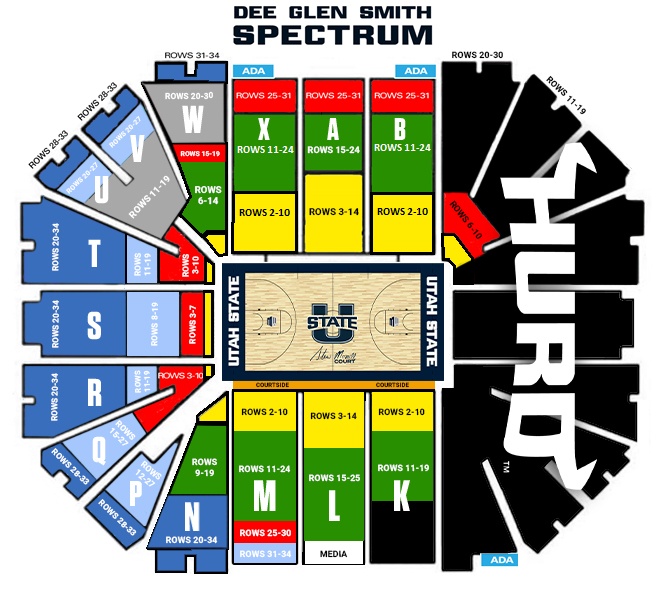
An updated seating chart of the Dee Glen Smith Spectrum, as posted by Utah State Athletics.
The move is to allow additional courtside seats in section K, previously occupied by the students, similar to the courtside seats in section M that were added prior to last season. The media, previously located at the front of section L, will also be relocated to the top rows to allow for additional courtside seats. This move is just the latest in the revenue-generating arms race that has become college athletics.
The primary downside for students is the reduction in front row seats, as the HURD will lose the front row of section K. However, the change increases the total number of seats allocated for students.
“The HURD has established itself as one of the premier student sections in college athletics, setting the standard for energy, unity, and impact. The tradition we’ve built is special, and at its heart are the students. We appreciate Utah State Athletics leadership for working with us and keeping students involved throughout this process,” HURD leadership said in a written statement. “While change isn’t easy, this new layout adds more seats for students, creating even more opportunities to be part of the game day experience. As we move into the Pac-12, we’re confident the HURD will remain elite, rise to every moment and continue to set the standard.”
As Utah State prepares to transition to the Pac-12, it has repeatedly emphasized its intention to explore all possible revenue-generating opportunities. That effort has recently included the launch of the “Show Me” initiative in January and an increase in student fees for athletics.
“Utah State will never be the most well-funded athletic program in the Pac-12,” said President Brad L. Mortensen after the hiring of USU Men’s Basketball coach Ben Jacobson. “But we’re going to look at all of the sources that we have and figure out how to optimize those.”
For Utah State Athletics, that could come in a variety of ways, including the addition of more premium courtside seats in the Spectrum.
“We’ll figure out what can we do a little bit differently with how we use our venues in addition to athletics events. How do we gain more philanthropic support? How do we work with corporate sponsors in more creative ways?” Mortensen said. “There’s a lot of examples about that happening right now, and we’ll continue to try to leverage all those resources.”
After the announcement, USUSA Athletics & Campus Recreation Executive Director Ben Burdette joined The Statesman Sports Desk on Aggie Radio to discuss the change. A part of Burdette’s responsibilities includes overseeing the HURD and included discussion with Utah State Athletics about the seating changes.
“The athletics department approached the HURD a while ago and was like, ‘hey, we’re exploring options to increase revenue,’ and, obviously, with the student section taking up as much space as it does in the Spectrum, it was their first target,” Burdette said. “We’re very grateful that they involved us in the process. We’ve seen in previous years under other administration where they don’t involve us, and it goes poorly, so we’re very glad that they involved us.”
According to Burdette, the decision ultimately came down to splitting the HURD into two separate sections, one under each basket, or moving them like they did. For Burdette and USUSA leadership, splitting the students was viewed as the worst option.
“[The change] I think is a lot better than splitting,” Burdette said. “Change is hard, and it’ll be interesting to see how it plays out in the upcoming season, but I think it was best-case-scenario with the options that were presented.”
Burdette also said that remaining the same was never an option, as the priority was opening up sideline seats to increase revenue through premium seating.
This announcement comes shortly after the initial student fee increase was reduced by the Utah State Board of Higher Education, a decrease that Burdette said affected the decision to change seating.
“It would’ve been a different story had the Board of Higher Education allocated our athletics fee a little differently,” Burdette said. “That changed the amount of revenue that they were going to get from students, and so after that revenue source fell through, they needed to open up different options, which ultimately came down to the student section.”
While the announcement has been met by mixed reviews and sentiments from students and fans, the pursuit of additional revenue affects more than just men’s basketball. Non-revenue sports rely
on revenue generated by men’s basketball and football to subsidize operations, and now to subsidize athlete compensation.
I don’t like it. I would not mess with it. That’s where every other school in the country puts their students. There is a reason the Spectrum is special, and I don’t think it’s just because our students have more well developed vocal cords. I think it’s because they occupy sideline sections right to the floor, which is pretty unique. Also, putting them on the floor, puts them into the game, and putting them into the game incentivizes them to dress uniquely, create signs, have chants and yell at the players. etc. It’s a “calling.” Removing them could have unintended consequences, especially with the next generations of student fans. I can’t see this new seating arrangement creating the same feel and impact. Nobody likes to play in the Spectrum. Why? It’s not because of the general public fans., which are good, but they are not the reason. I just think the AD is playing with fire here. I get we need the money, but I don’t think we’ll ever have enough and if we start messing with the special sauce, then what makes us any different than any other school? It won’t be the money. I know it’s not just this, but it’s a big piece of it in my view. I am shocked the HURD approved this, or perhaps it was a “we are doing this with or without you” type of deal.