

Forecasting team puts USU on national stage
Every two weeks, a new city. Every day, a new forecast. For the Utah State University forecasting team, that challenge led to a top 20 national ranking.
The USU team placed No. 16 nationwide for its forecasting skills. Jon Meyer, an assistant research professor with the university, aids and advises the students who compete in the forecasting challenges.
“The Weather Challenge is a national forecasting contest that has existed for 21 years now,” Meyer said. “The idea is to give students an experience of operational forecasting.”
Meyer commended three students for their efforts in this year’s competitions: Catherine Smith, Bradley Vernon and Tim Wright.
Smith is a senior undergraduate pursuing a degree in climate science. She was awarded the USU Forecaster of the Year award in 2025. This is the second year she has led the climate science program’s ranking.
“Every city has its own challenge, its own little unique aspects about it, which makes forecasting completely different everywhere you go,” Smith said. “You have to be in tune with model biases because they all have them. You have to figure out the topography of the area, where the station itself is located, because that all influences what the station records.”
Smith sees value in the intricacies of forecasting and wants to pursue a career in that field.
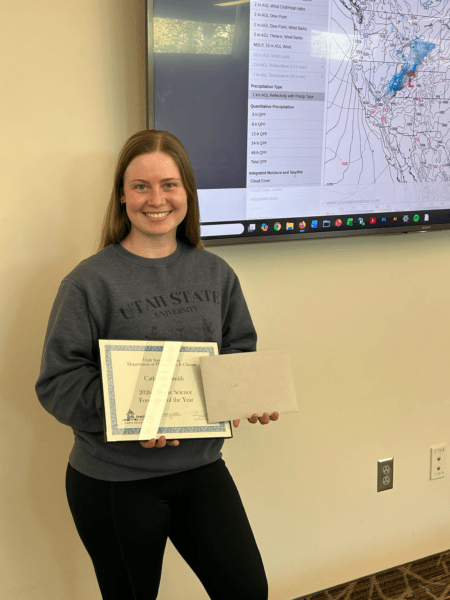 Submitted by Jon Meyer
 Catherine Smith poses with her 2026 Climate Science Forecaster of the Year award.
“There are 15,000 elements that we’re trying to consider, and even just a few of them doing the opposite of what we thought they were going to do could change the forecast completely,” Smith said. “I like the intricacy of it all — just trying to understand a system that is so much bigger than ourselves and yet plays such a big role in our day-to-day lives as well.”
In his first year pursuing a doctorate, Vernon is also studying climate science. This year on the forecasting team, he was the first and only USU student to be a city winner for the competitions.
During the forecasting contests, participants are expected to forecast a new city every two weeks, four days per week. Vernon won the Juneau, Alaska challenge. In this competition, he used an AI software he personally developed for the first time.
“I was very excited with how the model was working. It’s a pretty simple model. It’s a neural network that uses existing forecast information, which then gives you the information that you want for the competition,” Vernon said. “I think a lot of people misunderstand AI. It’s not like I went out and asked ChatGPT. It was just a simple model that I built, but it was fun to mess around with that.”
Wright is a coach and a competitor for the forecasting team. He is a doctoral candidate in the process of finalizing his dissertation, also focusing on climate science.
For Wright, his interest in climate science started back home in California.
“It all started back when I was a kid growing up in California,” Wright said. “There was a strong El Nino, and we had a lot of big storms, lots of flooding, and it really made an impression on me — seeing people having to take a canoe to the grocery store because many things were flooded. It happens repeatedly, so it just kind of stuck.”
Wright is a leader on the team and ended up ranking in the top 5% of forecasters in the nation.
“It’s a good exercise in understanding the fundamental principles that affect the weather conditions because that’s what weather forecasters are ultimately trying to do, and this is the perfect practice for it,” Wright said. “We get a mix of understanding how the numerical weather models work, understanding how the local geographic features affect the weather and then also understanding that the sensing equipment itself may not be perfect, and we do account for that.”
Wright was full of advice to share at the weekly weather discussions the team would have in preparation for their contests. He was right alongside Meyer.
“Forecasting is not quite like riding a bike to where you can’t just pick it up randomly to be a good, responsible weather forecaster,” Meyer said. “It takes dedication to keeping your finger on the pulse of daily weather patterns, how things are changing and how the forecast models are evolving.”
Meyer shared his pride and joy in the team and the growth he has seen in the climate science program.
“We were very proud this year to finish 16th in the country as a team overall. That speaks to the dedication our students have because they are not trained operational meteorologists, but the rest of the country’s programs are primarily those types of students,” Meyer said. “I felt good about that and how well the team performed. Hopefully, this is a springboard and gains us some momentum in the program we can use to grow participation for people to have fun with it.”