

Low-head dams present dangerous currents for recreationists; researchers develop software toolbox to analyze risk
In an environment where outdoor and water recreation is highly popularized, researchers say it is crucial for individuals to be aware of possible risks and take action to prioritize their safety and the safety of others.
Dangerous currents created by low-head dams, typically under 15-25 feet tall, have caused nearly 1,000 drownings in the United States since the 1970s, prompting researchers to develop new software designed to help recreationists evaluate river safety.
With more than 20,000 low-head dams across the country, many of which are located near popular recreation areas, researchers say improving awareness and safety tools could help prevent future tragedies on U.S. rivers.
“We don’t want to wait until someone loses their life at a structure to know that it’s dangerous,” said Brian Crookston, professor in the Civil and Environmental Engineering Department at Utah State University.
During the past 20 years, there have been three fatalities on the Jordan River between Utah Lake and the Great Salt Lake.
“Two of those fatalities occurred at the Winchester Street crossing at about 70th South,” said Rollin Hotchkiss, a professor at Brigham Young University in civil and construction engineering who is researching low-head dams. “At that location, there was a water drop of 18 inches, and a couple went over that in a two-person inflatable kayak, capsized and drowned. You can stand up in that water, but if you’re thrown out of a canoe, the turbulence during higher flows will just kill you.”
Since then, that 18-inch drop has been replaced with a series of rock weirs, stone barriers across a waterway with the purpose of controlling erosion, reducing water velocity and managing sediment.
Another major concern with low-head dams is the ability of aquatic organisms to freely move upstream and downstream. Aquatic organisms include anything that lives in the water but are generally identified most easily as fish.
“A low-head dam represents a barrier to the ability of fish to move upstream, and if that species of fish migrates upstream, for example, to spawn, then the spawning opportunities are limited,” Hotchkiss said.
Hotchkiss said in order to understand what alternatives would be reasonable and effective for low-head dams, it first must be understood why they are in place.
“The reason is you want to raise the water level upstream to a constant and reliable elevation so you can divert water out of the river with a canal or a pipe,” Hotchkiss said. “If we don’t have a low-head dam there, the water level in the river will constantly rise and fall, leaving the diversion works high and dry.”
However, many low-head dams are no longer used for their original purpose. According to Hotchkiss, it is estimated that many low-head dams in the United States have been reported as no longer serving their initial function of raising water levels for diversion.
“So, the first thing we can do is ask, ‘Is the low-head dam still required?’” Hotchkiss said.
If the low-head dam is not still required, it then raises the follow-up question of who will pay for its removal. Removal of these dams can cost between $250,000 to $500,000.
This high cost requires funding that is not always easy to obtain. In fact, as concerns across multiple areas continue to grow, allocating financial resources has become an increasingly difficult issue.
“It’s easier to get funding to remove the low-head dam to provide additional fish habitat than it is to get funding to improve public safety,” Hotchkiss said.
Because of this, Hotchkiss has taken on the role of principal investigator on a project with the U.S. Department of Homeland Security and the Federal Emergency Management Agency, where he has worked with Crookston to develop a software toolbox and help minimize the deaths that are a result of dangerous currents at low-head dams.
“These fatalities need not occur,” Hotchkiss said. “They don’t have to happen. They are completely avoidable.”
Hotchkiss and Crookston were able to connect with other individuals across the country with a similar drive to create safer river environments. They are advocating with FEMA and DHS, which have helped with the funding for their research.
“Trying to advocate for safety has led to signage, and then it’s led to some research,” Crookston said. “Now we’ve actually, separate from this project, developed a nationwide inventory of all the structures where this might be a possible problem.”
This research has led to state safety programs, parks and recreation initiatives and the development of a software toolbox.
The purpose of this toolbox is to provide a two-step process of testing procedures for recreationalists to analyze the risks of a dam, which would give them an idea of whether or not it is safe to recreate in that area.
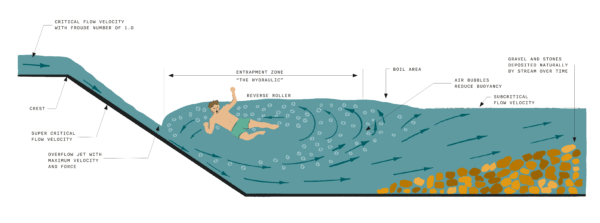 Illustration by Kamrin McNeill
 The first step, designed by Hotchkiss, would allow users to look at a map of the U.S., enlarge it, and select a low-head dam they are interested in. It would then allow users to run a testing procedure and get an idea of the dam’s safety based on the results.
If the results turn up inconclusive or if there are warnings, the user can then move on to step two for further analysis.
The second step, developed by Crookston, is a computationally advanced toolbox of educational materials that allows individuals to use their favorite piece of software and perform the analysis they want to do.
“It will be public access, so anyone can go into this website,” Crookston said. “There’s going to be some guidance materials that walk someone through everything from conceptualizing to using the tool to the data that you would need to how you collect the fuel data to how you put together your model for the toolbox.”
There will also be training videos and PDFs that can aid users in understanding what the toolbox is and how to properly utilize it.
The toolbox is expected to be complete and available to the public in about a year.
“We hope that our work catches the attention of state legislators who, while providing additional funding to their state dam safety programs, can actually begin to focus on low-head dam removal for these dangerous locations,” Hotchkiss said.