
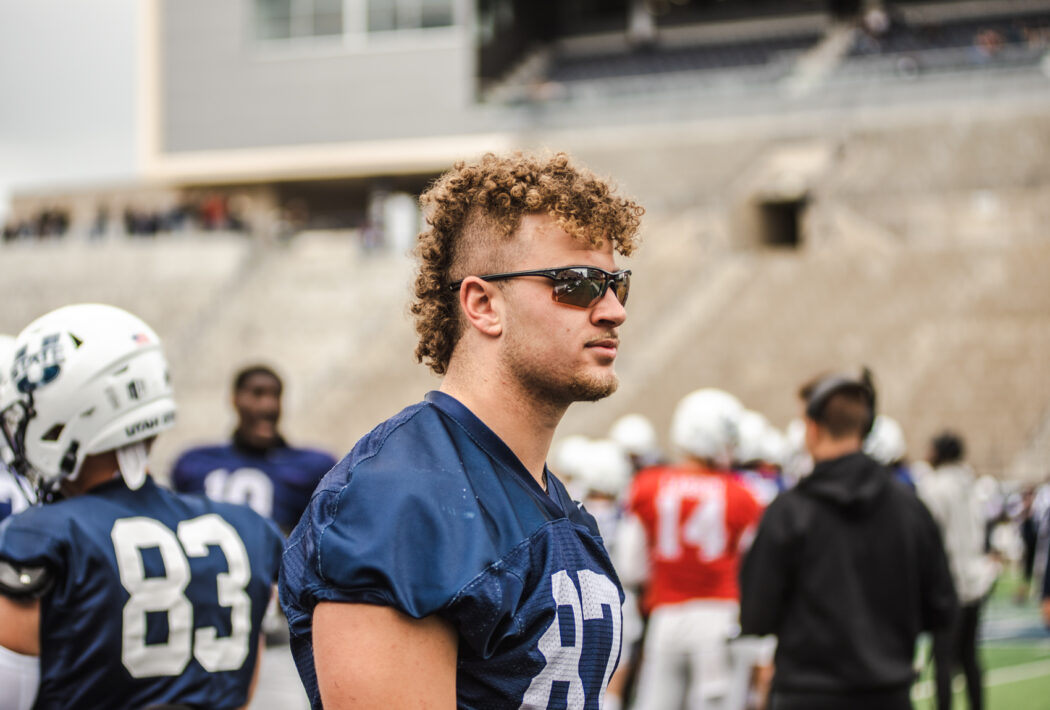
After six years at Utah State, Broc Lane sets his sights on the NFL
In the modern landscape of college athletics, loyalty is a rare currency. With the transfer portal offering a quick exit and coaching carousels spinning faster than ever, seeing a player stay in one uniform for more than four years is an anomaly. For Broc Lane, the decision to remain a Utah State University Aggie through three eras of head coaches and countless roster shifts wasn’t just about football. It was about the community he found.
Now, as the Chandler, Arizona native prepares for a potential career in the NFL, he looks back on a legacy defined by consistency, academic rigor and a “full circle” connection with his final head coach.
When Bronco Mendenhall accepted the head coaching position at Utah State, he wasn’t just inheriting a roster. He was inheriting a player he had known since that player was a teenager. The connection between the two is a rare bit in college sports. Back in 2020, Lane was the freshman dorm roommate of Mendenhall’s son Breaker Mendenhall.
At the time, Bronco Mendenhall was coaching at the University of Virginia. Through his son, he began to hear stories of a tight end in Logan. Years later, while coaching at the University of New Mexico, Mendenhall found himself on the opposite sideline, game-planning against the very athlete he had heard so much about as a parent.
“I learned about Broc, really as a parent of a son who’s playing on Utah State’s team,” Mendenhall said. “Never in a million years did I imagine that I would now be coaching at Utah State at some point and that Broc would still be here.”
Mendenhall described Lane as an “exceptional human being” and a “foundational element” for any program. To the coach, Lane represents the bridge between the program’s past and the disciplined culture Mendenhall is currently establishing in Cache Valley.
Lane’s journey began in 2020, a year defined by the global pandemic and massive shifts in the NCAA. While many of his peers sought new opportunities elsewhere as coaches came and went, Lane stayed put.
“It’s been a lot,” Lane said, reflecting on the various head coaches who ran the program differently. “Some people don’t like the culture change, but I enjoyed all the different players I got to meet and get to be a part of.”
His time on the field was not without its trials. Lane battled through numerous injuries. However, his commitment to showing up never wavered. Kendra Gilmore, the head football athletic trainer at USU, witnessed this resilience firsthand.
“Broc is one of those guys who works hard every day,” Gilmore said. “He faced a lot of adversity in his time that I’ve known him here, and he handled it so well. Even if he couldn’t do what the team was doing, he would always show up and root for them, cheer for them and do what he could.”
For Gilmore, Lane wasn’t just another student-athlete on the training table. He was a mentor to the younger tight ends and a constant source of support for the staff.
“He made a difference in my life,” Gilmore said. “He is part of what makes me want to do what I want to do, which is to work with athletes like him and people like him.”
The “student” half of the student-athlete equation was something Lane took just as seriously as his routes on the gridiron. After majoring in exercise science for his undergraduate degree, Lane pushed himself further by pursuing a Master of Business Administration. The transition from undergraduate studies to a master’s program while playing Division I football was a significant hurdle. Lane said while his undergrad years felt manageable, the master’s program required a total shift in discipline.
“It was tough balancing both,” Lane said. “I went from doing maybe an hour or two of school a week to doing an hour or two of school a day, which was definitely a little bit of a shock for me.”
Whether Lane was in the film room or the library, he was focused on being a well-rounded representative of the university. When asked why he chose Utah State in the first place, Lane points to the very thing that keeps many people in Logan: the pace of life. Coming from the fast-paced environment of Arizona, the mountains offered a sanctuary.
“I just love the small town,” Lane said. “I love the mountains right on me, feeling all mellow up there. It was a spot where I could just focus on school and football and not have too many distractions.”
That focus has led him to his current “Plan A,” training for a shot at the NFL. As he awaits invitations for tryouts, he remains the same fiery competitor Mendenhall describes, yet he is grounded by the degrees he worked so hard to earn.
“I’m working for that opportunity and praying that it works out,” Lane said.
As Mendenhall looks to the future of Utah State football, he said he sees Lane as the blueprint. He wants players who represent the values of Cache Valley, players who are tough, physical and sportsmanlike, but above all, grateful.
“Broc has the character, he has the talent, he has the experience,” Mendenhall said. “But more importantly, he’s the type of person that you’d like to have as a foundational element when you’re building a program.”
Lane’s legacy at Utah State is not just written in the stat books, but in the culture he helped sustain through half a decade of change. He leaves Logan as a two-time graduate, a mentor and a loyal Aggie who truly “left it all on the field.”
“I was really lucky and fortunate to be his coach,” Mendenhall said.