
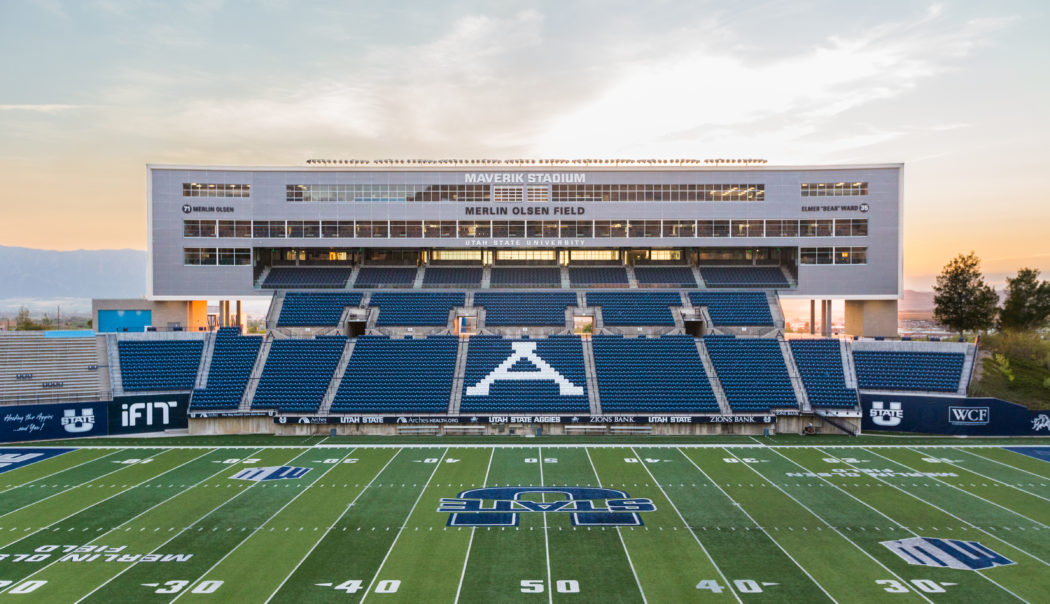
Utah State announces football stadium renaming
Utah State University Athletics and Utah State Vice President and Director of Athletics Cameron Walker announced changes to the naming and partnership surrounding Utah State’s football stadium on Monday.
The stadium, currently known as Maverik Stadium, will be renamed Jim Laub Family Stadium starting Jan. 1, 2027, in recognition of the Laub family’s continued commitments to USU athletics.
“It was important for us as we looked for a new name to find a name that truly represented our past, present and future. No one has had more impact on Aggie athletics throughout our history than Jim and Carol Laub,” Walker said. “Their continued support has provided us an opportunity to not only be in the Pac-12, but to rise as a leader in this new conference.”
Utah State’s stadium opened in 1968 and was originally known as Romney Stadium, with the addition of the naming of Merlin Olsen Field in 2009. The stadium was officially renamed to Maverik Stadium in 2016, in partnership with the convenience store and petroleum retailer Maverik.
The partnership between Maverik and Utah State will run through the end of the year.
“Maverik came in at a very important time to help make significant stadium renovations a reality, and we are incredibly grateful for them stepping in at that time,” Walker said. “Since that time, Maverik has been committed to this department, to this university and committed to Cache Valley in ways that far exceeded any formal agreement.”
Utah State announced the changes to the stadium name at the West Stadium Center on Monday, with many notable Aggie alum and former coaches in attendance, including Jim and Carol Laub, Matt Wells, Chuck Bell, Craig Smith, Stan Albrecht, Randy and Becky Spetman, Scott and Jody Barnes, and others.
“I have another special group here with me that — they’re extra special, and Cam alluded to them, kind of the legends of Utah State University,” Laub said. “If there was a Mount Rushmore for USU athletics, every one of these people would be on it.”
The stadium name change in the Laub family’s honor does not come with additional stipulations or donations beyond the contributions already made by the Laub family.
“We’re excited for this next chapter and having partners who are committed for the long haul to be champions at USU isn’t just meaningful — it’s essential,” Utah State University President Brad L. Mortensen said. “It’s a fitting tribute to people who have given so much to make Utah State University stronger and who have done it above all because they believe in what this place can be.”
Utah State’s partnership with Maverik was formed in 2015, with the agreement originally extending through December 31, 2037. According to Walker, Maverik initiated the conversation surrounding the early termination of the deal in the spring, with current renaming plans taking shape over the summer.
The $6.3 million for 20 years, a $315,000 annual value, is significantly lower than other comparable stadium naming agreements at the time, as evident by Boise State University’s 2014 partnership with Albertsons that pays the Broncos $12.5 million over 15 years for the naming rights to Albertsons Stadium, an annual payout of $833,333.
“At that time, I think that Maverik deal was exactly what was needed to get this project for the space we’re sitting in now over the finish line, and so you make those deals to see a project to completion,” Walker said. “I think at that time, it was probably a great deal. I do think in 2026 it’s not at market rate and probably made sense for both of us to look at an adjustment.”
The most recent stadium agreement within the new Pac-12 was made by Texas State University, which agreed to a $23 million, 15-year deal with University Federal Credit Union in 2024.
While the renaming of the stadium will not directly bring in additional income for USU athletics, the ending of the corporate agreement with Maverik opens the doors to additional sponsorship opportunities the department intends to take advantage of.
Previously, many public spaces donning the Maverik name were not able to have additional corporate sponsors. With the removal of Maverik as a partner, additional sponsorships and logos can be added to additional elements such as the playing surface, scoreboards, signage and other previously off-limit spaces.
“There’re just numerous ways where that can be expanded upon. As you walk out right now, it says, ‘Thank you for visiting Maverik Stadium.’ … In the future, that’ll say, ‘Thank you for visiting Jim Laub Family Stadium,’” Walker said. “There could then be a corporate logo underneath that as a sponsorship, so it just opens up a whole variety of sponsors and assets that we haven’t had available to us up until now.”
While additional sponsorships have not been solidified, Walker and the athletics department have initiated conversations with additional partners regarding potential agreements.