Column: Utah State’s offense has serious problems
We are now six weeks into the 2026 football season, and Utah State Football’s offense still cannot seem to sort itself out. Even in their recent win over Washington State University, the offense still couldn’t move the ball downfield, scoring only once when the team started outside the WSU 40-yard line and only gaining 236 yards of total offense. It’s no secret this offense is struggling, so let’s take a look at why this offense seems to be having so many issues.
As of week six of the college football season, USU currently sits at the bottom of the Pac-12 in points per game, rushing yards and rushing yards per game. USU just barely beats out WSU and San Diego State University for passing yards per game, which in turn helps them just barely squeeze by both teams for total yards per game. Keep in mind, just last year this team sat in third place out of twelve teams in the Mountain West in total yards per game, third in passing yards and second in points per game.
What happened in the past year that has made our offense fall so far from where it was? In my mind, we need to look at two main issues: first is the new coaching staff, and second is the quarterback room.
Last year, the Aggie offense was led by offensive coordinator Kevin McGiven, who left in the offseason to join the University of Utah. This year, the Utes’ offense is top ten in the nation in both total yards per game and points per game. To replace him, head coach Bronco Mendenhall brought in his longtime offensive coordinator Robert Anae.
Anae has proven in his 18 years as an offensive coordinator that he knows how to put together not only a competitive offense, but a seriously lethal one. During his time with Mendenhall at the University of Virginia, Anae helped assemble a top five offensive unit in 2021, averaging 515 yards per game, with 396 of those yards coming through the air. While at Brigham Young University, Anae’s offense developed the three all-time leading rushers in BYU’s history.
More recently, in 2024, he helped North Carolina State University finish the season with a 9-4 record and finish the season ranked. Despite his past success, this USU offense feels stale and uncompetitive — perhaps the issue lies within the personnel USU has to work with this year.
Heading into the season, the Utah State coaching staff named McCae Hillstead as the starting quarterback and were seemingly all in on shaping the offense around him. That plan lasted roughly three quarters of football before he was benched for a career backup, Grady Brosterhous, who, in four years of college football prior, had never started a game.
In Hillstead’s limited appearances with the team, he threw four interceptions and only two touchdowns, with the biggest passing play with him at the helm being only a 25-yard completion. Brosterhous, on the other hand, currently has six interceptions. Brosterhous has the 21st-worst completion percentage out of 157 eligible quarterbacks, and Hillstead sits dead last in that category at the end of week six.
The truth is, the Aggies are stuck between a rock and a hard place with quarterbacks. Brosterhous is clearly the better option, but he is still not the guy an offense should be trying to build around.
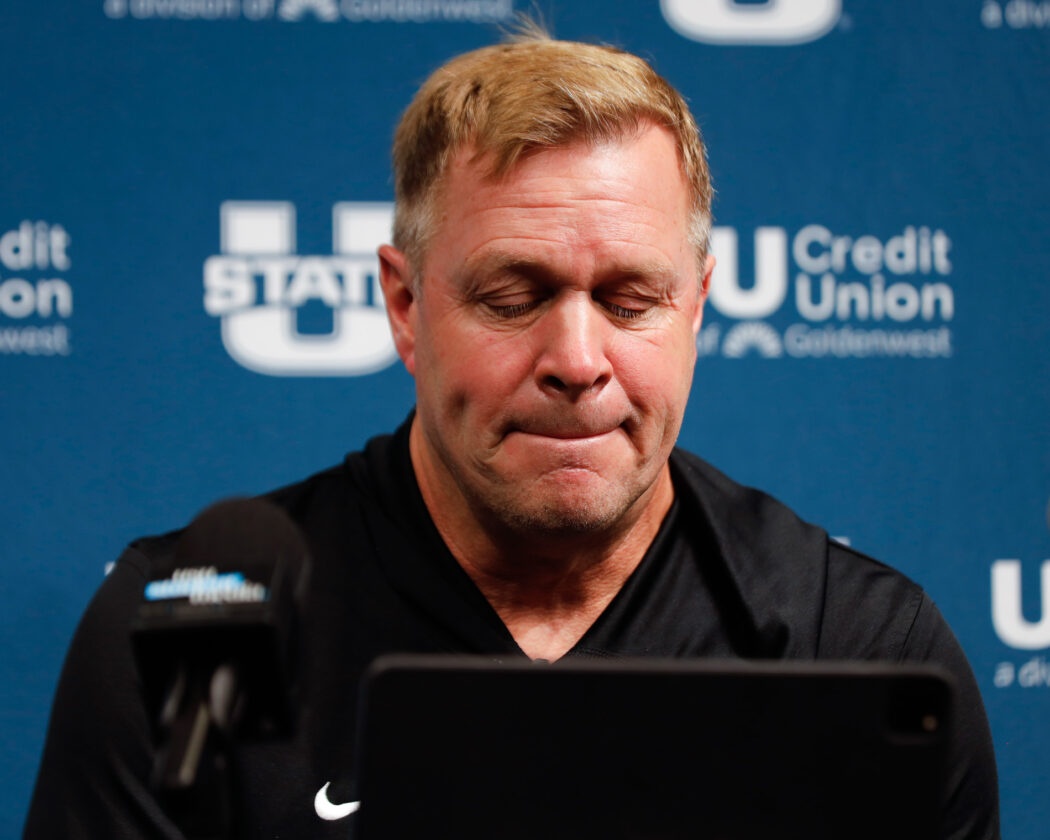
On a somewhat positive note, the run game for USU has finally woken up in the past two games, with running back Javon Jacobs finally becoming a key piece of the offense. His slow start wasn’t because he struggled to run the ball, but because the offense simply didn’t give him the ball. After a strong start against Idaho State University, Jacobs only had a combined 11 rushing attempts in weeks two and three. The change came following the loss against the University of Utah, where in the postgame press conference Mendenhall was clear about the issues surrounding the run game and classified it as non-existent.
The lack of a run game could make sense if they had a potent pass offense, but in that span, they only averaged 163 passing yards. Instead, the offense has continually called design quarterback runs for Brosterhous, who is only averaging 2.8 yards per carry this season. To me, that doesn’t seem like a winning strategy.
The run game has not been helped by the offensive line, which currently is tied for 7th most sacks allowed this season with 19. In addition, it feels like every time the Aggies do finally get the ball moving, a procedural penalty brings the ball back and completely stalls the offense.
The truth is USU’s offense seems to be a hopeless case this season. The team lacks the talent in arguably the most important position to compete and has a coaching staff that can’t seem to adjust to what they are seeing on the field. Luckily, they have a defense that can help them remain competitive among the other bottom dwellers of the Pac-12, but a postseason appearance feels like it’s beyond this team’s grasp.
With that being said, it is still too early to write off this season, but unless we see a major turnaround from our quarterbacks, I can’t see this team improving beyond where it currently sits.
At least we get to watch Eli Wood make some of the craziest catches every week — that’s a positive, right?
You must be logged in to post a comment.
There are no comments
Add yours