
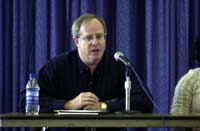
Affirmative action topic of heated debate at Black Out Loud forum
Concerns about race relations and affirmative action at Utah State University were addressed Thursday morning by a panel of local experts who agreed the issues were complex, with no black and white answers.
Sponsored by the Black Student Union, the Black Out Loud forum coincides with Black History Month and was aimed at educating the student body about these issues, Safiyyah Ballard, the event’s organizer, said.
“Incidents like the College Republicans’ diversity scholarship and the affirmative action bake sale angered me,” she said. “But I wanted to do something proactive. I realized I was not as educated as I needed to be.”
Director of Admissions Jimmy Moore also said the events frustrated him. Moore has worked in the Admissions Office for 14 years and said he doesn’t know of any scholarship that has been awarded based on race.
“I don’t think we’ve ever awarded a scholarship based on race,” he said. “Sometimes it frustrates me because what we’re actually doing in our office is not what we’re perceived as doing.”
Representing the university’s Affirmative Action Office, acting director Dave Ottley said USU does not use quotas in either student enrollment or faculty hiring.
“Utah State has no quotas,” Ottley said. “We’ve never had quotas. The only time the word ‘quota’ is used is to say that quotas are illegal.”
Ottley said the responsibility of the Affirmative Action Office is to seek out qualified minority applicants for a position. Once those applicants have their names in the pool, Ottley said, the Affirmative Action Office steps back and the Equal Opportunity Office steps in to ensure the hiring is not based on race, gender, religion, national origin, age or veteran status.
Admission to the university was granted to about 500 students of color last year, of which 256 enrolled, Moore said. That enrollment percentage is slightly lower than surrounding institutions such as Weber State University and the University of Utah, he said.
Moore said demographics played a likely roll in that number being lower. Students who need to work more to afford college often prefer to stay closer to home, he said.
“A lot of these students are first-generation college students,” Moore said. “We have a vested interest in targeting those students and helping them understand the admissions process. We have an even stronger interest in retaining and graduating those students.”
Moore said retention and graduation rates of minority students are slightly higher than the university-wide retention rate, according to the latest reports. Still, Moore said the large difference in numbers has to be taken into consideration. With only about 10 people sitting in attendance Thursday morning, Susan Mannon, an assistant professor of sociology, said she was disappointed in the turnout.
“I’m absolutely flabbergasted at what I’m seeing before me,” she said. “If we were at any other college, there would be an enormous crowd here.”
Mannon said social activism is an important part of the college experience, but said it’s a part that often gets overlooked.
“It’s a part of life that is outside of resume building and I think that part is crucial,” she said. “Unless we’re engaging the higher issues, we’re living a purposeless life.”
Director of Multicultural Student Services Moises Diaz said that while USU is “a largely homogenous” campus, race relations will improve once people “start seeing a commonality and a human connection” in others.
The event was part of Black History Week at USU. Friday, another event the Black Student Union will host is a soul food dinner in the TSC Ballroom. Tickets are $10 per person.
“The importance of Black History Month is just to never forget,” Ballard said. “Our history has been a struggle in the United States and it continues to be a struggle. It just has a different name.”
-acf@cc.usu.edu

Susan Mannon, an assistant professor of sociology
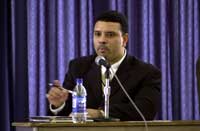
Moises Diaz, Director of Multicultural Student Services
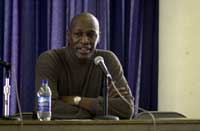
Jimmy Moore, Director of Admissions
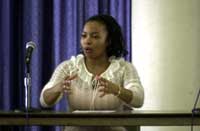
Safiyyah Ballard, event organizer