

USU’s African American Read-In grows through Black History Month
The group that fills the Mehdi Heravi Global Teaching and Learning Center every Thursday in February includes professors of veterinary medicine, sociology and English. What brings them together is a book. Faculty don’t usually sit beside students as equals. At Utah State University’s African American Read-In, that’s exactly the point.
Members of the Utah State University English Department have gathered faculty, students and staff alike to read and discuss African American literature together. This year’s choice is Percival Everett’s “James,” a retelling of Mark Twain’s “The Adventures of Huckleberry Finn” from Jim’s perspective, which won the National Book Award in 2024.
“It’s not set in our contemporary time, but it is incredibly relevant to what’s going on now,” said Adena Rivera-Dundas, assistant professor of English at USU and event organizer. “And it’s a fun book to read.”
The African American Read-In started three years ago when Rivera-Dundas and senior lecturer of English Cree Taylor were both teaching “Sing, Unburied, Sing” by Jesmyn Ward. They decided to bring the book to the USU community. The following year, the group read James Baldwin’s “Giovanni’s Room.” Each book has been carefully selected for its literary merit and ability to spark deep, meaningful conversations, according to Rivera-Dundas.
 Emma Hatch
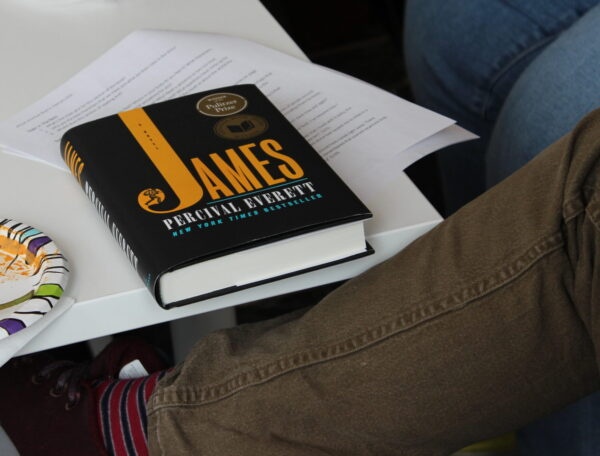
 “James” by Percival Everett sits on a table with a packet of discussion questions.
“The emphasis has been on either older or newer classics of American literature that are excellent works and have messaging that sparks interesting conversation,” Rivera-Dundas said.
According to the reading group, “James” has felt timely. The novel follows Jim, called James in Everett’s novel, the enslaved man from Twain’s original, and reframes a highly debated text in American education.
“Having a read-in specific to African American literature ensures that there is a voice and a perspective that we at USU are honoring and remaining accountable to,” Rivera-Dundas said.
Twain’s “Huckleberry Finn” has long been criticized for its racist portrayal of Jim despite abolitionist intentions. According to Rivera-Dundas, Everett’s retelling humanizes a character the original dehumanized.
“If we’re going to teach ‘Huckleberry Finn’ in schools, having a counter-narrative can be really helpful so it’s not the one story that exists,” Rivera-Dundas said.
Due to the book’s language, the group established “norms” at the start, including an agreement not to read slurs aloud, even though some appear in the text. A librarian in attendance raised connections to banned books, their debates and the current political climate. This sparked one of the session’s open conversations the group tries to facilitate.
The Feb. 12 session drew faculty and staff from English, sociology, veterinary medicine and advising, filling the Mehdi Heravi Global Teaching and Learning Center with an open, unhurried discussion, according to Rivera-Dundas. When silence fell in the room, no one rushed to try to fill it.
Christy Glass, a sociology professor who has attended the read-in since the first year at USU, said the event is unlike anything else on campus.
“There are no other opportunities for me to sit in a group of staff and students — people I’ve never met — and have a book bring us together,” Glass said. “Each year, we build this little community.”
Glass made sure to mention Rivera- Dundas’ guided reading approach and how it transformed how she engages with literature.
“[Rivera-Dundas] taught me how to read,” Glass said. “She taught me to slow down and pay attention to how what I’m reading makes me feel. It’s changed what books I read, and it’s changed how I read them.”
This year, through the portrayal of James, the discussion has surrounded how he navigates two distinct identities: the performance he gives for white audiences and who he truly is when alone.
“The author shows us Jim in the front stage when he’s in front of a white audience, compared to who James is in the backstage when he’s alone or with other enslaved people,” Glass said. “That masterful weaving has been so insightful for thinking about racism broadly and slavery specifically.”
Even though the room was filled mostly with faculty at past events, Rivera-Dundas said students are especially welcome.
“The folks who come are goofy, eager dorks who love books and love talking to people,” she said. “There is absolutely no barrier to entry. Anybody can come at any time, for any length of time, having not done the reading at all, and we will be happy they’re here.”
Glass echoed a similar sentiment.
“When someone says, ‘I’m a student,’ my heart explodes with excitement,” Glass said. “I am a student too. I’m not a scholar of African American literature. I’m just there to learn and think together.”
The reading guide and the handout have received strong positive feedback, making the text accessible to those newer to literary discussion.
Rivera-Dundas hopes participants leave with more than a good read.
“I hope people take away a curiosity about narratives we take for granted,” she said. “Gaining fluency with talking about race is hard and scary for a lot of people, and the only way to get better is to practice.”
The remaining sessions will be on Thursdays at 11:30 a.m. for the remainder of February in the Mehdi Heravi Global Teaching and Learning Center. No prior attendance or reading is required.
“I would love it if people became friends,” Rivera-Dundas said. “Building connection through reading is kind of my whole life.”