
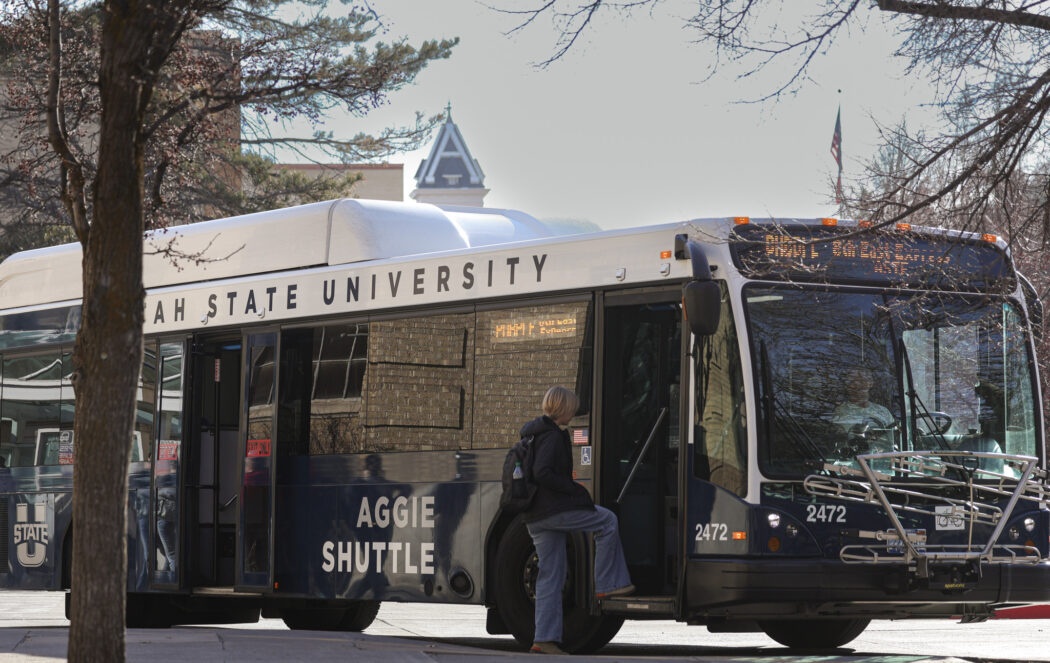
Aggie Shuttle starts trial period for late night rides
Those living off campus who find themselves studying on campus after dark may soon have a more reliable way home. The university has launched a trial period for late-night Aggie Shuttle services, testing the feasibility of extending transportation hours until midnight to address growing student safety concerns and academic needs.
The initiative, a collaboration between USUSA and USU Parking & Transportation Services, aims to bridge the gap between when current shuttle services end and when campus facilities close. Currently, shuttle services conclude at 10 p.m., leaving students who study at the Merrill-Cazier Library until its midnight closing time without a campus-sponsored transit option.
Tracy Hulse, director of Parking & Transportation Services, said the trial is a direct response to student feedback and safety priorities.
“We want to do everything we can to help students who have to get from one place to another across campus late at night and in the dark,” Hulse said. “We want to do our best to help keep them safe”.
The trial period is scheduled to take place over at least two weeks, with one week in February and another in either March or April. Hulse explained this timing allows the department to test the service under different weather conditions before potentially implementing it full-time at the beginning of the fall 2026 semester.
While some students expressed concern regarding potential fee increases, USUSA Logan Vice President Po’okela Yamakoshi-Sing, whose committee spearheaded the initiative, said a recent survey showed more than 95% of student respondents requested the extension.
“We had overwhelming support in a potential $2-$3 increase in tuition and fees,” Yamakoshi-Sin wrote in an email to the Utah Statesman. “Students understand that to receive more support, they must help support that cause”.
However, Hulse clarified the current trial is being funded through existing budgets and student fees already collected for the current year. He noted a recent rate increase approved by the student fee board did not factor in nighttime driving, and the department does not plan to increase fees further if the late-night service becomes permanent.
“The cost is really going to be minimal,” Hulse said. “It’s a couple of hours extra per night for a part-time driver and a little bit extra gas. It’s not as if we’re having to hire a bunch of new people and buy a new bus”.
Beyond traditional fixed routes, the university is exploring innovative technology to make the service more efficient. One option being tested is a “request a ride” feature through the Passio GO! app. This would allow students at the library or other strategic locations to scan a QR code to summon a shuttle, rather than having buses run empty loops around campus.
The success of the trial will be determined largely by ridership numbers. Hulse estimated if the shuttle transports 30 to 40 people per night, the extension would likely be considered worth the investment.
Yamakoshi-Sing emphasized the move is part of adapting to a growing campus culture.
“Getting to and off campus should not be a problem regarding education,” Yamakoshi-Sing wrote. “Students studying at the library shouldn’t be worried about how they’re going to get home or how far the walk is because of how cold or harsh our environment can be sometimes.”
You must be logged in to post a comment.
There are no comments
Add yours