
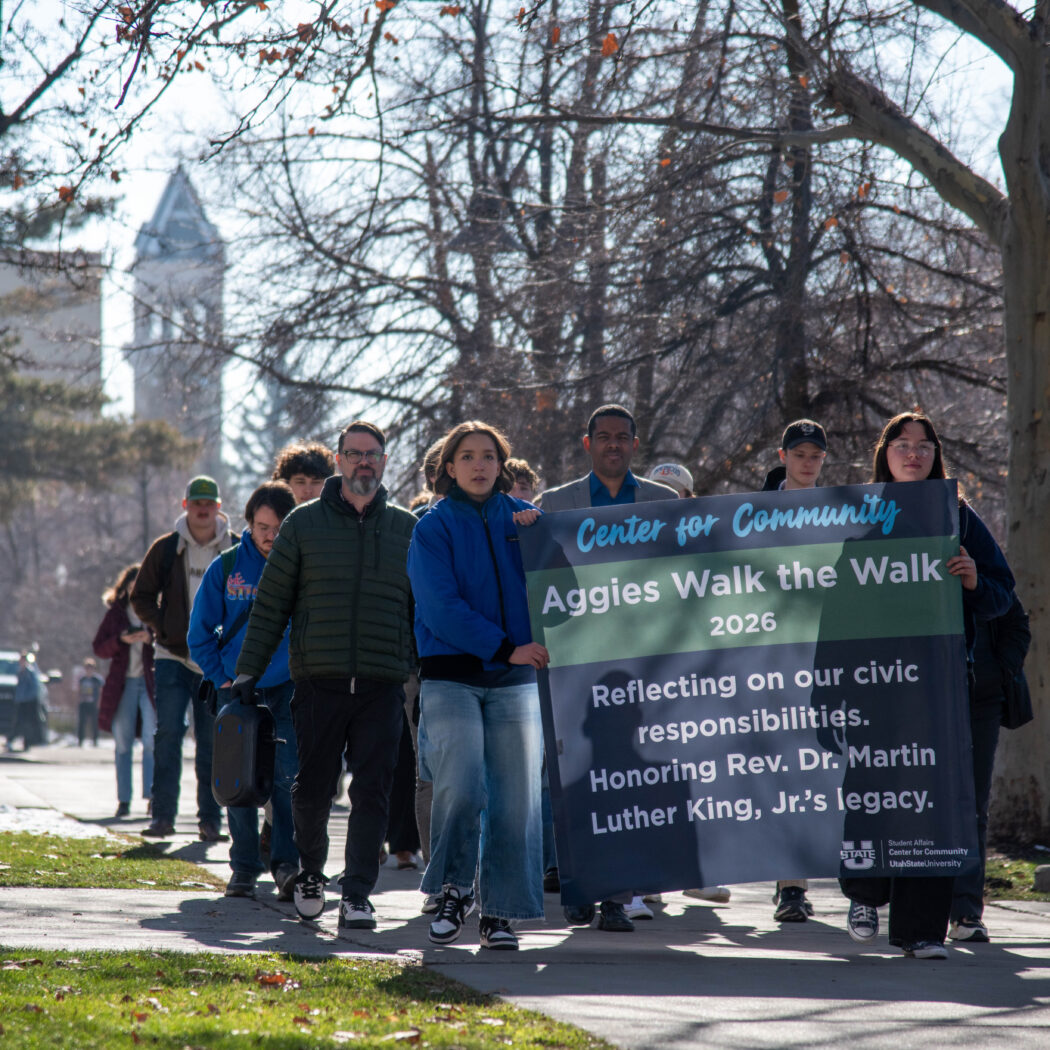
Aggies ‘Walk the Walk’ for MLK Jr. Day
Aggies spent a “day on” learning about service opportunities and community engagement during Utah State University’s third annual Martin Luther King Jr. Day “Walk the Walk” celebration.
“Martin Luther King Day is a National Day of Service, and the tagline is a ‘day on, not a day off,’” said Kate Stephens, director of the USU Center for Community Engagement and co-coordinator of the event. “We thought, ‘This is perfect, let’s merge these two events.’”
The Center for Community, who oversaw the walk portion of the event, joined forces with the CCE this year to incorporate a new Community Service Fair into the festivities. Students and staff were invited to get together in the TSC lounge to explore booths from local and national service organizations before participating in the reflective walk around campus.
“Walk the walk events honor Dr. Martin Luther King Jr. because that’s what he did — he walked with the people,” said Shelly Ortiz, the executive director of the Center for Community. “It’s designed to spark meaningful thoughts about civic responsibilities, both individually and collectively, to support the well-being of our local and global community.”
A variety of different local and national nonprofits whose values align with King and his legacy were invited to share volunteer opportunities and resources with attendees, including CAPSA, Comfort Zone Camp, the Public and School Partnership and others.
Megan Davenport, a representative from Cache Refugee and Immigrant Connection, ran one of the booths at the event.
“I think Martin Luther King Jr. was all about advocating and standing up for what’s right, and at CRIC, we do a lot of advocating for our own clients,” Davenport said. “The refugee and immigrant communities are more of a minority up here in Cache Valley, and making sure that our whole vision is community for everyone and making sure that anyone who comes here feels like this is their community as well.”
Event attendee and USU student Jacob Schwartz said he was impressed to see the diversity of volunteer opportunities available to him and his peers at the service fair.
“I think everyone here is here for a reason — to get an education for ourselves — but we can also turn outwards to focus on the world around us because I’m sure everybody wants to make the world a better place, but the question is how,” Schwartz said. “Luckily we have organizations that are already starting on that process so you don’t have to do it by yourself.”
Schwartz said service opportunities like those offered at the fair help students translate King’s vision into action by addressing modern challenges in their own communities.
“The world is not the same as it was when Martin Luther King was around, but there are still plenty of problems we can work on solving,” Schwartz said.
The walk itself began at the TSC before making its way up through Aggie Boulevard to the USU Credit Union for a moment of reflection. The group then continued on to the Merrill-Cazier Library for closing remarks.
Along the way, guest speakers each took a moment to talk about King and what society can learn from his legacy. One of those speakers was Sidi Becar Meyara, assistant professor of communication and media at USU with a background in postcolonial theory and rhetoric.
“When one looks at Martin Luther King’s speech on fostering a sense of beloved community, one can see that this is not only about America but about the world, and for us to see each other as ‘brothers under God, he would say,” Meyara said in an interview with The Utah Statesman.
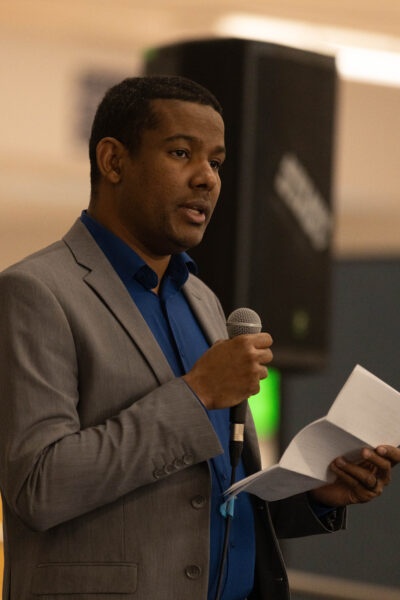 JACK LEWIS BURTON
 Assistant Professor Sidi Becar Meyara speaks at the Aggies Walk the Walk event, in the TSC International Lounge on Jan. 15.
While students reflected on how service fits into their own lives, Meyara encouraged attendees to think about King’s legacy on a broader, global scale.
“The invitation here is for us to see ourselves as interconnected and that the challenges we face are not necessarily unique to us,” Meyara said. “How do we work for justice and freedom and do it in a manner that is productive and recognizes the humanity in the other?”
Meyara emphasized everyone has the capacity to serve and learn from the past in their own way.
“The work to promote the justice of freedom is not easy, so how can we continue to pay attention to systems that have marginalized or excluded some and to continue to work toward a just society for everybody?” Meyara said. “Everyone from their own position and depending on their abilities should make the effort they’re able to find ways to be a positive presence in their own communities by learning about the challenges the community faces.”