
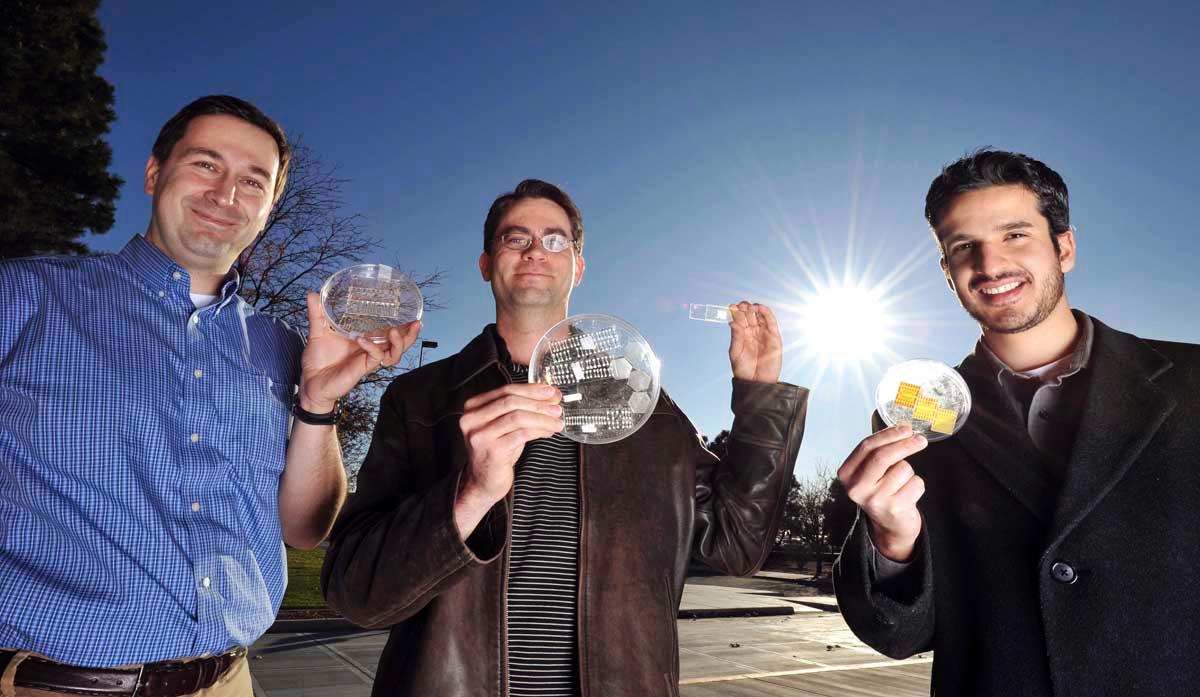
Alumnus breaks scientific ground
For some students, the idea of being accepted into a renowned university, receiving distinguished awards or attaining significant accomplishments may seem out of reach. For USU alumnus Greg Nielson, all these things have become a reality. According to Popular Science Magazine, Nielson is one of the 10 most brilliant, creative and groundbreaking young scientists in the country.
A native of Bountiful, Utah, Nielson graduated from Viewmont High School in 1992 and attended a year of college at USU before serving an LDS mission in Wisconsin. During the summer before his senior year in high school, he was able to participate in the Engineering State program at USU, where he was first exposed to engineering and some of the opportunities it had to offer.
“It helped me to think,” he said. “I had a good time.”
In 1998, Nielson got his bachelor’s degree from USU, majoring in mechanical engineering with a minor in computer science. He was an honors program graduate, peer advisor and also worked in the Space Dynamics Lab as a research assistant. Before graduating he participated in two internship opportunities, both at Sandia Labs, where he currently works and performs his research.
“The faculty and other professors were great,” he said. “They gave me some perspective on things. I had lots of experiences that gave me a good background, as well as opportunities that helped me to grow.”
Nielson said his time at Utah State had an impact on him and helped to form him for the future.
“You can’t really separate yourself from your college experience,” Nielson said. “It was a very formative time. USU will always be a part of me because of that.”
After graduating, Nielson went on to attend the Massachusetts Institute of Technology. He spent six years there and received his masters and doctorate degrees, both through the department of mechanical engineering. He said he had a very broad experience at MIT and did his Ph.D. work in optical micro and nanotechnology, exploring how light interacts with mechanical devices.
Nielson began working at Sandia Labs in 2004, having been selected through the prestigious Truman Fellows Program, which gave him employment and funding for his own research ideas. He currently continues his work at Sandia Labs as a Principal Member of Technical Staff, working on research and development projects and leading a team of 30 researchers.
The work of Nielson and his staff received the R&D 100 Award, a prestigious award for new technology developed. The award is known as the “Oscars of Innovation,” according to R&D Magazine.
Nielson is best known for his work in photovoltaic technology, specifically his work with solar energy cells. This work involves scaling down the size of solar cells to the size of glitter, giving them the nickname “glitter cells.” According to Nielson, sizing down the cells improves the performance and reduces cost. “Things just behave differently when they’re small,” he said. “Solar cells perform better.”
Nielson discovered 40-50% of the cost of traditional solar cells was spent on silicon. By reducing the
amount of silicon by a factor or 10 to 1000, the cost of the solar cell is significantly reduced. The cells are ten times thinner, yet produce the same amount of electricity.
“What used to be the largest cost has essentially become zero,” he said.
Nielson and his research team have discovered between 15 and 20 scaling benefits from having reduced the size of these solar cells, some benefits more subtle than others. Positive scaling effects include reduced thickness and cost through the use of less silicon, increased efficiency, durability and flexibility. This allows the cells the potential to be used outside of the typical flat-panel construction. Nielson said they could even be used to mold around tents or clothing, allowing electronic devices to be powered in environments not formerly possible.
Nielson said his background in other disciplines, such as micro-electrical mechanical systems, has been extremely helpful in his research and by using these disciplines to make solar cells, they have been able to demonstrate things that no other photovoltaic technology can provide. By combining other materials, Nielson said he and his team are surpassing the efficiencies of regular photovoltaic technology.
“We hope to double the efficiency of today’s module while still keeping costs down,” he said.
For his work with these “glitter cells,” Nielson was recently selected by Popular Science Magazine as one of the Brilliant 10, or one of the top ten most brilliant young innovators in the United States. Nielson said he was pleasantly surprised by the award, and he had enjoyed reading the magazine as a child.
Nielson advised students at Utah State to get involved and expose themselves to opportunities, as well as to believe in themselves and what they can accomplish. One of his favorite plays is “Man of La Mancha,” due to one of its themes involving the ability to achieve more than thought possible, simply by trying.
“I thought that some universities could be out of my reach, like MIT,” he said. “By getting involved with internships and professors, my eyes were opened to the opportunities available. People would be surprised at what they can actually accomplish – don’t discount yourself.”
Nielson said although he picked the more challenging of the paths before him, he was glad he did.
“I didn’t know if I’d be successful, but the most exciting and rewarding thing I’ve done has been going out and trying” he said.
– cale.w.p@aggiemail.usu.edu