
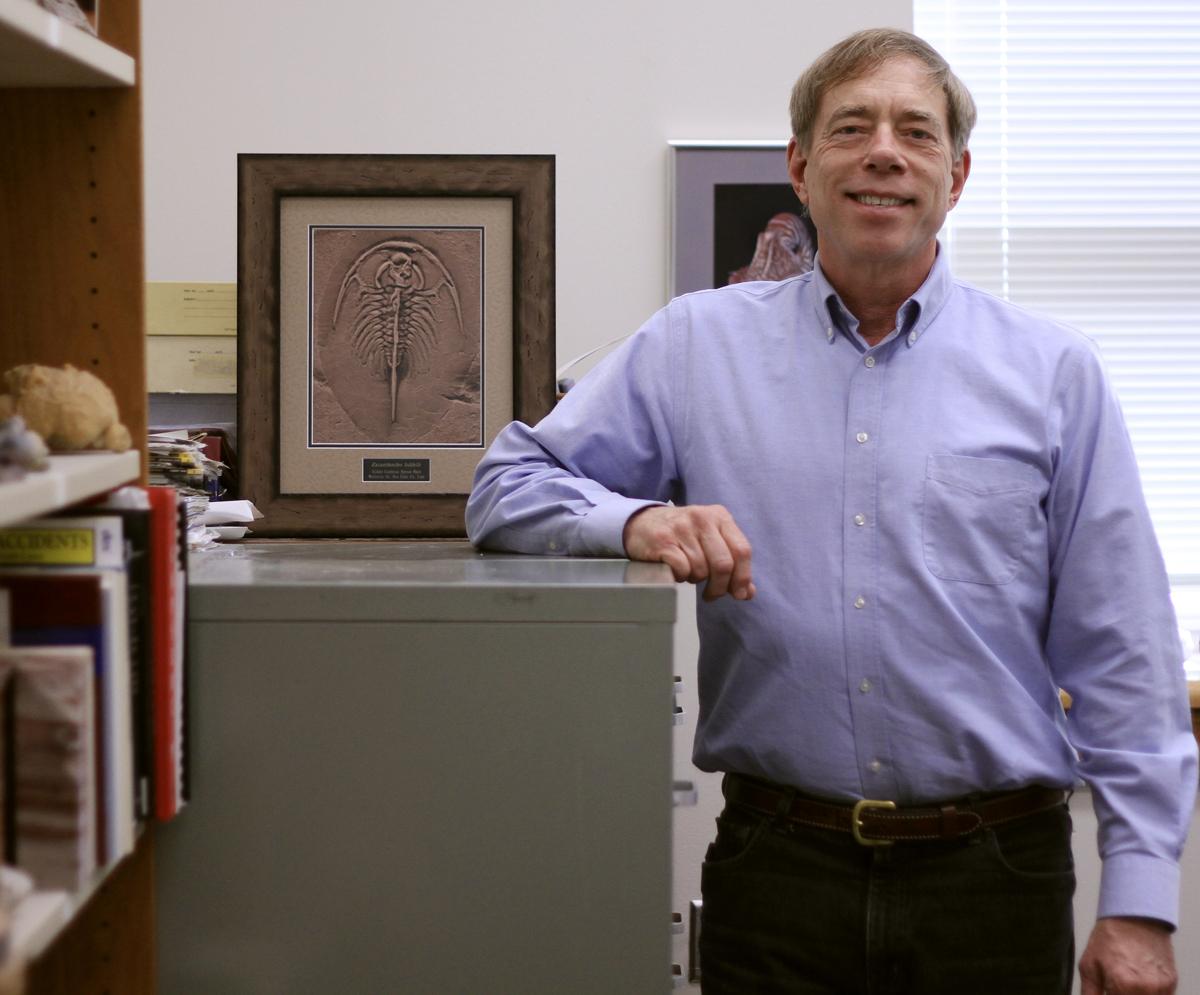
Ancient species named after geology professor
A new species of trilobite was recently named after a professor at USU in recognition of his decades of work in geology.
Liddell said he had nothing to do with the decision to name the new trilobite after himself. He said a professor at the University of Kansas came across this new specimen and decided to name it in recognition of the work Liddell and his students have done.
“I had heard rumors from this person, who had said that I might have a surprise coming for me,” Liddell said. “Then I found out when I got married last October and the faculty gave me a framed photograph of the specimen at the reception.”
“It’s a very cool trilobite because it has a lot of spikes coming off the sides of the lobes and spikes that poke directly off the back,” said Michael Strange, an undergraduate geology student. Strange has been working with Liddell since summer 2011.
“The reason they named it after me is because for the last decade, or more, my students and I have worked on rocks from this age — and the fossils from a particular group of rocks called the Spence shale, which is found in the (Bear River) Mountains and in the Wellsville Mountains,” Liddell said.
“Trilobites are extinct creatures that are related to crabs, lobsters — things like that,” said Dave Liddell, head of the geology department, whose namesake was given to the new species. “They have these three lobes, thus trilobite — three-lobed animals.”
This newly discovered species of trilobite, “zacanthoides liddelli,” is a fossilized, prehistoric trilobal creature with a row of spines down its back.
This particular trilobite species is found in northern Utah and southern Idaho. Liddell said it was found in rocks about 500 million years old.
“That’s way before Lake Bonneville, when oceans covered Utah,” Liddell said. “Looking at the rocks during the Cambrian Era is really fascinating, because it’s like having a time machine. 500 million years ago, this was a shallow tropical ocean but now we’re 5,000 feet above sea level. Strange said this is an exciting period in time to work on this subject matter. He also said he enjoys his collaboration with Liddell, because they feed off each other’s enthusiasm.
“In the formation we are working in, there’s roughly 30 to 35 species of trilobites, but that’s just in a 5 million-year time frame. But, overall, there’s a lot of trilobites, because it’s a really diverse class,” Strange said.
Though he realizes bringing the trilobite into a coffee shop won’t earn him a free beverage, Liddell said he is proud of the work because it shows what he and his students have accomplished together.
– cnmoffitt413@gmail.com