
Author Examines Link Between Dylan and Zen
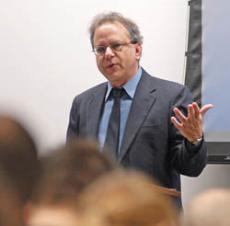
In addition to being a folk music visionary, Bob Dylan may also be a modern-day Zen master, said Steven Heine in a lecture given as part of a new series presented by the USU religious studies program Friday.
In his lecture “Bargainin’ for Salvation: Bob Dylan Zen Master?”, Heine, who is the author of the book “White Collar Zen,” specifically addressed Dylan’s affinities with Zen Buddhism and said while Dylan and his lyrics are often Zen-like, Dylan has never actually claimed to be a Zen master.
“I prefer to leave it with a question mark,” Heine said. “I don’t want to put him in a box.”
Heine, a professor of religious studies at Florida International University, is recognized as one of the foremost Zen scholars in the world and said he has spent years exploring the relationship between Dylan and Zen.
“There is one way to describe his work,” Heine said. “Enigmatic. His whole career is cryptic, that’s what makes him so intriguing.
Dylan’s ideologies can often be seen in his music, Heine said. Dylan, who was raised Jewish, embraced fundamental Christianity in his early career, which Heine said is evident in songs like “Man in the Long Black Coat.”
“Bob Dylan is particularly known for a career that goes from one extreme to another,” Heine said, who noted that Dylan has seemed to reach a level of enlightenment from straddling two different ideologies – duality and non-duality.
Heine described duality as having one single truth and looking to a specific higher power for answers, while non-duality is the Buddhist idea that there is not one truth, only multiple, relative truths.
On a time line of Dylan’s life and music career, Heine pointed out that although he had many personae throughout his life, Dylan focused all his energy on each one.
“When he goes to a viewpoint, he embraces it totally,” Heine said.
One linking factor between every stage in his music career, he also said, is that Dylan was continually searching for truth.
“Regardless of which ideology he is embracing at the time,” Heine said,” he is seeking authenticity and autonomy.”
In order to follow Dylan’s progression across religious viewpoints, Heine said one can first connect Dylan and blues music.
“There is a sense of self-discipline and very few words,” he said.
Heine said from there it was a natural progression into Zen Buddhism, which Heine said is known for it’s anti-structural behavior.
“The spirit of Dylan and Zen is to question the questioner and overturn traditional ideas,” Heine said.
Heine said Dylan was also influenced by his beat friends, like Alan Ginsberg, who practiced Zen Buddhism. As Dylan embraced a Zen-like way of thinking, it became an interpretation tool in his music, Heine said. Heine quoted the Zen Buddhist adage, “words as a tool to go beyond words,” as a way to explain how Dylan used his music to transcend boundaries of thought.
“Dylan and Zen point to an intuitive, experimental level of understanding,” Heine said.
He said in his recent years, Dylan’s music is evidence he has reached a middle ground.
“I don’t want to say it’s a perfect middle way, there’s still movement back and forth,” Heine said. “He has found peace of mind though.”
Heine said while the question still remains if Dylan is a true Zen master, it is certain he holds many of the ideals and continues to strive for truth and knowledge.
“Dylan once said, ‘Keep a good head and a light bulb,'” Heine said. “And I think that sums him up. To think and look for look for illumination … It’s the exploring that’s important.”
-amanda.m@aggiemail.usu.edu