
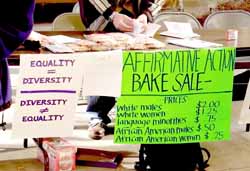
Bake sale cooks up controversy on campus
A bake sale sponsored by the College Republicans of Utah State University has the campus in an uproar.
Which is exactly what the organization intended, according to the event organizers.
The College Republicans set up a table on the Taggart Student Center patio Tuesday with a sign listing prices for cookies: $2 for white males, $1.25 for white women, 75 cents for language minorities, 50 cents for African-American males and 25 cents for African-American women. The sale was intended to criticize the effects of affirmative action, organizers said.
“We wanted to ruffle some feathers, get people thinking about affirmative action and what it really does,” said Jared Westbroek, a co-organizer and author of the pamphlet handed out at the table. “We feel [affirmative action] actually harms minorities by giving them a sense of inferiority that they can’t accomplish anything without institutional help.”
But not everyone who saw the display was happy with it.
“People are coming out of the woodwork to me saying how offended they were,” said Braden Jenkins, a senior in marketing and co-president of Academic Scholars, a program for multicultural students. “I respect that they took a stance, but the way they went about it was wrong.”
Leticia Neal, anthropology club president and senior in history and anthropology, said the College Republicans were seeking out minorities to hand pamphlets to.
“It was deliberately done to incite or raise anger,” Neal said. “It wasn’t put together to be an open discussion, it was put together to inflame. Which makes me question why they’re going to do it.”
Neal said the event came across with a racist slant. Westbroek and fellow organizers Tom Robins and Woodson Witt all said they did not hear any College Republicans making racist comments.
“I personally never heard any statements like that. That is not something that we meant to do,” Westbroek said. “As an organization, if that was happening to anybody, we apologize – that was not sanctioned. We were out there just trying to prove a point that affirmative action is a color-conscious program that harms America.”
Robins, the state chairman of College Republicans, said he would assume one or two offensive things were said, and if so, he sincerely apologized.
“I was called an ‘a-hole’ three times by three different people,” Robins said. “Am I demanding an apology? [Being offensive] wasn’t our intent, if [an offensive thing] was said, which I don’t know that it was.”
Edith Rodriguez, a senior in interdisciplinary studies, said she was upset when someone handed her a pamphlet and told her to educate herself.
“People are so close-minded,” Rodriguez said. “It was overdone, the way they were stopping people.”
Witt said the College Republicans strove to be professional and mature, while many who spoke to them reacted with emotion.
“A lot of times people allow their emotions to get involved, and as soon as they do that, they put up a wall,” Witt said. “You allow no room to learn and to even try to understand the other point of view.”
The bake sale organizers said they were pleased with the success of the event. About 30 cookies were sold, 1,300 pamphlets were handed out and eight or nine people volunteered money to the cause, organizers said.
Juan Franco, vice president of Student Services, said it sounded to him like people were offended, although he didn’t think that was the intent of the College Republicans.
“What I’m hoping is that something good will come of this,” Franco said. “It’s always appropriate to express views – that’s what universities are for. Hopefully, we can use this to create some good discussion.”
A good discussion is now in the works, said Angie Hammond, Associated Students of USU diversity vice president. She said a debate is being planned for spring semester to give each side a chance to share their views.
“I think [the College Republicans] have sparked something we can take as an educational opportunity once all the emotion has died down,” Hammond said. “I applaud them for coming up with this.”
Hammond said she felt the College Republicans were professional and politically correct.
“Being a minority, I could have felt attacked and had all these emotions running,” she said. “I didn’t feel they were anti-diversity at all. They had a point they were trying to prove.”
Jenkins said he didn’t think people, especially at USU, appreciated diversity.
“[The College Republicans] wanted a colorblind society,” he said. “I agree with that for the most part, but the fact is that I am different … they don’t see the need to have different things around them.”
Robins said he would guess USU has more people than any other state school who have spent significant time in foreign countries or culturally diverse areas of the United States, thanks in large part to the returned missionaries of The Church of Jesus Christ of Latter-day Saints.
Witt said diversity encompasses more than just racial categories.
“Is diversity skin color? No, it’s not, it’s different beliefs, cultural feelings, religions, education, background,” Witt said. “That’s diversity. We definitely aren’t anti-diversity.”
Robins said it was a coincidence that the sale was held the same day as the USU Diversity Award ceremony. The sale date was determined by the people who schedule events on the patio, he said.
Hammond invited the sale organizers to come speak with the keynote speaker of the Diversity Award ceremony, William B. Harvey, vice president and director of the Office of Minorities in Higher Education. The discussion was civilized, she said, although Jenkins said he was upset about the College Republicans’ behavior at the meeting.
The affirmative action bake sale is not a new idea. Many campuses have hosted one since a student group at UCLA, the Bruin Republicans, did. That first sale received attention from national conservative Rush Limbaugh.
“It was a perfect parody of affirmative action,” Limbaugh posted on his Web site, www.rushlimbaugh.com. “I’m always saying that good comedy and satire only work if there’s an element of truth in it, and this nails it.”
Michael Krueger, executive director of the College Republican National Committee, said this type of bake sale is common, and that they are “absolutely” effective.
“They prove a very valid point about the true effect of the current system in America,” Krueger said.
Affirmative action has been a hot topic of debate in the nation since a recent U.S. Supreme Court ruling stated that a University of Michigan law school policy giving race a role in its admissions process does not violate the U.S. Constitution. The court also struck down another Michigan policy that gave significant weight to race in a point system for the admission of undergraduates.
President Kermit L. Hall told The Salt Lake Tribune in June that the ruling would have little or no effect on USU.
“The court has given proponents of affirmative action a reason to move forward and critics a signal that the court is not going to accept – on constitutional grounds – just any system of selection based on race,” Hall told the Tribune.
That same ambiguity can be seen on USU’s campus as well.
Witt said affirmative action was a necessary movement in the ’60s because racial discrimination did exist.
“But we feel that the civil rights movement has been turned upside down on its head,” Witt said.
College Republican Spencer Lloyd, said affirmative action used to be to help the disadvantaged, but is now based on skin.
Jenkins said, “[Afirmative action] is a vehicle in place to increase diversity. It’s a necessary evil, although I’d like to get rid of it. It’s the lesser of two evils. It’s not perfect.”
Neal said affirmative action has greatly helped women and minorities.
Robins used the metaphor that parents should not spank their children to teach them hitting is wrong.
“If you want to say racism is wrong, being racist through affirmative action isn’t going to solve it,” he said. “Two wrongs don’t make a right.”
-heidithue@cc.usu.edu