
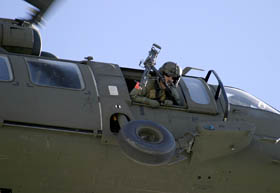
Black Hawks drop troops on campus
Two black hawk helicopters and about 20 guardsmen from the Utah National Guard participated with the Utah State University Police in a drill near the Stan Laub Athletic Training Center on USU campus Tuesday afternoon.
The drill began at about 1:15 p.m. and took under four hours to complete. Guardsmen from the 145th Artillery Batallion, from Riverton, Utah, were called out to respond to a “credible threat” to the Poisonous Plants Lab building on USU’s campus.
The drill was made as real to life as possible, guardsmen not even knowing about the operation until Tuesday morning when they received their call to duty. The drill was organized to help local law enforcement and the National Guard learn to work with each other.
“I was getting off at the 600 South on-ramp on my way to work when I got the call,” Capt. Devlin of the 145th Batallion, said. “I got into work and told my boss, ‘See you later on – hopefully later this week.'”
The National Guard contacted the USU Police last week wanting to practice an operation on campus, Lt. Steve Milne of USU Police said, allowing them to choose the kind of situation the National Guard would respond to. Because of the concern that might come with helicopters and guardsmen in full army fatigue on central campus the second day of classes, campus police decided to look at campus locations further away, Milne said.
The Space Dynamics Laboratory was originally considered because of its status as a federal building, Milne said, but other activities at the SDL relocated the drill to the Poisonous Plants Lab, also a federal building, under construction near the Stan Laub Athletic Training Center.
“When they’re here on site, they are under our direction – they don’t take over,” said USU Police Sgt. Lynn Wright. “They’re testing their readiness and how quickly they can deploy, and it gives us a chance to see how well can we communicate with army personnel in a situation like this.”
The kinds of situations where the guard would need to be called in would be extreme, Wright said. All of the valley’s resources must be in use before the guard can be called in, for example mass flooding or multiple bombing sites, Wright said.
“If we’re overwhelmed and need more law enforcement for certain situations, if we had a riot, the call has to come through the county to the governor to release the National Guard. It’s a pretty complex process,” Wright said.
Devlin, who has been a member of the National Guard for 18 years, said the short notice of the drill adds to the authenticity of the experience.
“It’s invaluable because as the National Guard you never know when you could be called out. I could be sitting in my office in Salt Lake City,” he said. “They don’t tell me where I’m going. That’s the way it’s going to happen. If you know in advance the training value goes down a little bit. The best training is the one that is most life-like.”
The drill run Tuesday was a response to a mock bomb threat. Guardsmen secured a perimeter around the facility and began searching vehicles that came through the area. At the end of the drill, a vehicle matching the description of the “suspects” was driven into the area and guardsmen took appropriate action.
Milne said although these types of scenarios are unlikely to occur, preparation is critical to smooth crisis control if something were to happen. Sgt. Shane Session, USU Police, said there are several federal buildings on campus that may be possible targets to many “extreme organizations.”
“It gives a chance to troubleshoot. We’re learning already from our side certain pieces of equipment we need,” Wright said. “What worked, what didn’t work, what can we improve on and what equipment do we need so when something does happen we don’t look like a three-ring circus.”
For the National Guard it was a chance to monitor their abilities.
“There’s been hiccups in the process but that’s what we’re here to do. We’re here to identify just as many problems so in the future it gets better and better,” Devlin said.
Any process where you walk away knowing what to improve is a success, Devlin said.
After Tuesday’s drill, Devlin said he is confident in USU’s ability to handle a large incident.
“I feel they are very prepared. We have some of the best law enforcement in Utah. When we trained for the Olympics all the law enforcement were very professional, very prepared,” he said.
Regarding USU’s preparedness, Devlin said, “I have no doubt they are well suited to respond to any emergency.”
The 145th Batallion has between 300 and 400 members and is one of the first responders for in-state security situations, Cadet Brandon Morris said.
In June, the Batallion was called out to defend a powerplant in Delta, Utah. Ideally, the national guard aims to be on the ground assisting within four hours of receiving a call and will remain to assist at the discretion of the governor, Morris said.
Other mock disasters have taken place on USU campus before including one that took place in August involving a mock bus roll-over and a simulated earthquake last spring that was coordinated with the Red Cross.
-bnelson@cc.usu.edu