
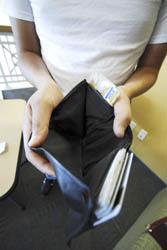
Bottom of the barrel
Debt. Just saying the word can make a person cringe. The idea of going into debt for anything is scary for anyone. But sometimes, if handled properly, debt can be a good thing.
Not just any kind of debt, though. Consumer debt and credit card debt are never good things.
“They’re probably the worst kind of debt you can get into,” said Judy LeCheminant, director of the Financial Aid Office.
Many students however, do have credit cards. Jean Lown, a professor in the family, consumer and human development department who teaches advanced Family Finance, said credit cards are good, and in this day and age, a necessity. Often, things can’t be purchased without a credit card, for example, a plane ticket or hotel rooms. But it is important to remember that they need to be used responsibly.
USU student Tyrell Peterson a sophomore in business administration has a credit card. He only uses it for things like putting gas in his car or for an oil change, and he pays back the full amount each month.
“That’s how I expect to build my credit,” he said. But it isn’t just about building credit. It is about staying out of debt. Lown says carrying a balance on a credit card is the worst thing a person could do.
“You might, five years in the future, still be paying for that pizza you bought,” she said. It’s not easy to recognize how much you are really paying for something when you carry a balance like that because they don’t send you a notice that says the dress you originally bought for $69.95 has finally been paid off after you’ve made hundreds of dollars in payments.
“It doesn’t make sense,” she emphatically said.
On the other hand, if handled properly and used moderately, student loans can be good debt.
“Some people can’t afford to go to school without them,” said LeCheminant. The key to student loans is to use them moderately, only take out as much as is needed, use them only for school and for consumers to live within their means.
“By and large, most of the students do a pretty good job of that,” she said, then noting there are two extremes she sees at USU. There are either the students who take out as little as they possibly can, and then there are those who take as much as the loaner is willing to give them. The important thing to remember, she says, is that it doesn’t go away.
Lown believes that students are so concerned about debt that many don’t get loans when perhaps they should. Sometimes these students end up taking much longer to graduate, they are working extra hours to pay for school and, as a result, miss out on extracurricular activities or fall asleep in class and don’t get anything out of it anyway. Work becomes more of a priority than school, but it shouldn’t be that way, she emphasized.
“Paying for college is an investment in your future,” she said.
LeCheminant doesn’t think it matters whether a person works to pay for school or gets student loans, as long as they are used wisely, but a student shouldn’t choose not to go to school just to avoid the debt. Like Lown, she says it is an investment in the future and a little bit of debt from student loans is worth being able to get an education.
Peterson is one of the students who doesn’t have student loans and works to pay for school and other living expenses. Even though he doesn’t have loans, he says there is nothing wrong with other students who get them.
“I think it’s a good idea if you need them to get through school because getting through school is a priority,” he said.
What is most important is to properly manage the debt that does come from the student loans. LeCheminant and Lown both said that it needs to be used only for school-related expenses like tuition, rent and books. Using them to support a lifestyle is what leads to more debt than is necessary and manageable.
The Financial Aid Office requires loan counseling before students can get a loan, and they have counselors to help students with any questions or problems.
Lown says students just need to look ahead into the future and see how much they will be paying off and what their expected income will be, which will help them look realistically at what the burden will be.
“It should be a requirement for every student to take Alena Johnson’s Family Finance class,” she said, because it teaches students how to not only manage their finances and credit, but to plan and prepare for the future as well. She said there are so many students who come to her finance classes and wish they had known some of the information before they got into debt.
kathrynkemp@cc.usu.edu