

‘Bringing War Home’ project preserves personal war stories through artifacts
A project at Utah State University is preserving personal stories of war by documenting artifacts and the memories connected to them.
The project “Bringing War Home” invites community members to share objects related to wartime experiences and record the stories behind them. Instead of collecting the items, researchers photograph the artifacts and archive the stories in a digital database.
The project is co-directed by Molly Boeka Cannon, assistant professor of anthropology at USU, and USU professor of history, culture and ideas Susan Grayzel.
Cannon said the project focuses on documenting both the objects and the personal meaning attached to them.
“We didn’t take the objects, but we just documented the objects and their stories, which was the really important part — not just the objects themselves but what they mean to everybody,” Cannon said.
The idea for the project grew out of a mini roadshow event connected to a class about the end of World War I. Community members brought artifacts and shared their stories, revealing a strong interest in preserving personal histories.
“We had such a great experience, and the community was really engaged and interested, so we thought, ‘Well, there’s real interest here,’” Cannon said.
With funding from the National Endowment for the Humanities, the team expanded the project into a statewide initiative. Between 2022-24, organizers hosted 11 roadshow events across Utah, where people could bring in war-related artifacts and share their stories.
The project has documented more than 260 objects and stories from participants. The information is preserved in a digital archive and will also appear in a traveling exhibition, visiting museums around the state.
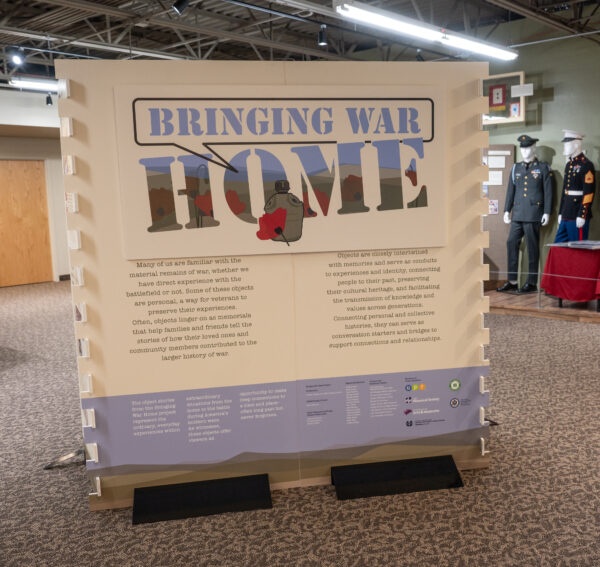 Rylee Patterson
 The entrance sign to the “Bringing War Home” exhibit in the Hyrum City museum as seen on April 15.
“It’s a different set of stories, working with military families and veterans, that I haven’t had much experience with before,” Cannon said. “Still, it’s been just incredibly rewarding and a great experience to connect our students.”
Cannon said the exhibit is meant to help visitors recognize how personal stories connect to larger historical experiences.
“I hope what they take away is that they can see their connection to this history — that this is a collective history,” Cannon said. “We all have these family stories that are important for us to understand the American experience.”
Students at Utah State have also played a major role in organizing the project and documenting artifacts.
Jayne Anderson, a senior anthropology major, became involved through a museum studies course connected to the project.
“We learned about how to make an exhibit in general, then how to make an event of bringing people in with objects,” Anderson said. “Then we learned how to take photographs of the objects, record stories about the objects and put them together for people to see.”
Anderson said some of the most powerful artifacts she’s seen are personal letters written during wartime.
“Some of my very favorites have been letters that people have sent,” Anderson said. “Reading those words and seeing the dates really kind of puts you into that area of, ‘Oh, people are timeless.’”
Anderson said many participants appreciate having a space where they can share stories connected to wartime experiences and document them.
“The reaction from the community has been very positive,” Anderson said. “A lot of them have felt more comfortable speaking about it with us.”
Anderson described hearing those stories as “heartbreakingly beautiful,” saying many participants had not previously shared their experiences publicly.
The project has also created unexpected connections between people.
While presenting this research, Anderson showed a photograph of her grandfather from his time in the military. Another veteran recognized the battalion and shared memories of serving in the same area.
“This man was able to give us a little bit more of, ‘Oh yeah, your grandfather was an amazing man. This is what I remember of him,’” Anderson said.
For Cannon, moments like these highlight the importance of preserving personal stories.
“It’s really about what it means to be a human during conflict,” Cannon said. “What does that mean for families as well as those who are serving on the front lines?”