
Bug Club explores USU’s giant collection of insects
There are between three and four million bugs in the Biology and Natural Resources Building at Utah State University, ranging from the smallest aphid to fist-sized beetles.
While the thought of that many insects in one place makes some people sick others are anxious to see more.
“I’m really interested in the weird things like centipedes, spiders and scorpions, all the creepy-crawly ones that other people don’t like,” Quint Englant, a senior studying biology, said. “I don’t really like or care about butterflies.”
Fortunately there’s a place for people like Englant – USU’s new entomology club. The club offers a chance for those interested in learning more about entomology, the study of insects, to meet others with the same passions.
“We don’t just want entomologists,” the club’s new president Kim Huntzinger, a grad student in entomology explained. “We want everyone with an interest in insects to be involved.”
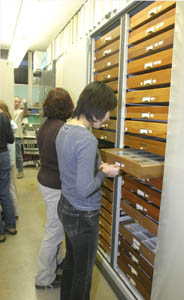
Insect enthusiasts of all ages came to the entomology club’s first activity this Tuesday evening. The meeting began with the official selection of officers for the new organization before adjourning for a tour of USU’s prize insect collection.
The tour was lead by Colin Brammer, a graduate student studying for his doctorate specializing in flies. Before turning his guests loose to look at the collection’s specimens, Brammer told a bit of the history of the collection.
He explained that the collection that contains more than two million different specimens started back after the turn of the last century. Since USU was then purely an agricultural college, the collection only consisted of a couple of cabinets full of farm pests that was stored in Old Main.
The head of the department at that time was a man by the name of George Knowlton. While primarily an agriculturalist, Knowlton was an extreme bug lover. Brammer told the club members stories of how Knowlton would collect so many new specimens that his students would have to sneak in after hours and throw away ones that he had already mounted just to keep the department supplied with pins.
Since then the collection has done nothing but grow until it has reached its current size where in nearly fills all of Room 240 in the BNR building. Huge cabinets filled with countless drawers, each with as many mounted insects as it can hold, fill the room and make up the collection.
Brammer gives close to 100 tours a year of the collection, including many outreach programs in which he takes what he has deemed the “Oh My” collection out to various grade schools to try and get kids interested in biology and hooked on bugs.
“We call it the ‘Oh My’ collection because if has all the really big exotic insects in it and whenever the kids look at they always say, “Oh my, that is so cool!” Brammer said. “Kids are the best because their parents haven’t instilled that fear in them yet so they’re real interested.”
Brammer’s responsibilities include more than just giving tours, he’s also responsible for a large part of the identifying of the many specimens that haven’t been looked at since they were mounted.
James Pitts, a professor in the department and one of only six in the world who specialize in spider wasps, said the identification process is one of the parts of his job.
“It’s kind of an investigation. A lot of detective work is involved,” he said.
Just down the hall in Room 244 is the Logan Bee Lab. This lab focuses entirely on bees and houses more than a million specimens.
“It’s a world class collection,” Terry Griswold, a research entomologist at the lab, said. “It’s one of the top 10 in the world.”
The lab was founded in the late 1940s as part of an alfalfa seed production unit but through the work of Griswold and many others had grown.
Despite the university’s large collections there hasn’t been an entomology society on campus until this year.
“It was needed. We don’t have an entomology program here at USU but there’s a lot of research going on in the field here,” Huntzinger said.
“We want people to have some interaction with insects and realized that they’re not ‘icky’ but actually cool.”
Anyone interested in joining the entomology club can contact Huntzinger at khuntzinger@biology.usu.edu. The collection is open to any interested visitors to come and enjoy.
-steveshinney@cc.usu.edu
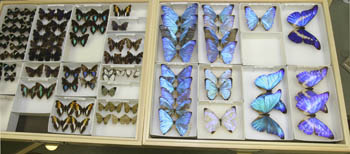
Butterfiles from around the world are amoung more two million speciments in the USU insect collection located in BNR 240. (Photo by Becky Blankenship)