
Bush’s initiative spurs on Space Dynamics Lab
President George W. Bush made an announcement to the nation that outlined a new, improved plan for space exploration three weeks ago. This announcement has proven to affect not only NASA and its space exploration, but Utah State University’s own Space Dynamics Lab (SDL).
The president’s announcement will not, according to SDL scientist Gail Bingham, affect the funding provided for the programs at the SDL, but it will affect the priority placed on them.
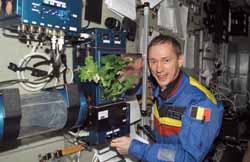
The SDL has made endless contributions to space exploration, including a joint project with the Russian Institute of Biomedical Problems that developed a way to grow plants in space. This enables astronauts to add fresh-grown vegetables to their diet. Bingham has been involved in this particular program for 10 years, and says that, among other foods, they have been able to grow wheat from seed to seed.
Bingham said SDL is also “testing the effects living in a closed environment has on people.” One of the ways they are accomplishing this is by studying the logs of astronauts who have spent time in space.
“Two centuries ago, Meriwether Lewis and William Clark left St. Louis to explore the new lands acquired in the Louisiana Purchase,” Bush said in a press conference held on Jan. 14. “They made that journey in the spirit of discovery to learn the potential of the vast new territory and to chart the way for others to follow. America has ventured forth into space for the same reasons. We’ve undertaken space travel because the desire to explore and understand is part of our character.”
Bush’s new plan includes completing the International Space Station by the year 2010 and using the existing shuttle to help finish the assembly of the ISS. The shuttle, which has flown more than 100 missions already, will be retired in 2010. Bush’s plan will also allow NASA to develop a new spacecraft by 2008 which will be used to “ferry astronauts and scientists to the space station after the shuttle is retired,” Bush said.
Bush plans to use the moon as “the launching point for missions beyond” by 2020. Bush believes that establishing a space station on the moon will allow for further space exploration by cutting the costs; astronauts leaving from the moon will be able to travel farther for an equal, if not cheaper, cost.
Although the effect Bush’s new plan will have on USU is questionable, there is no question about the enormity of USU’s impact on the completion of his plan.
“Mankind is drawn to the heavens for the same reason we were once drawn into unknown lands and across the open sea,” Bush said. “We choose to explore space because doing so improves our lives and lifts our national spirit. So let us continue the journey.”
-sophisan@cc.usu.edu
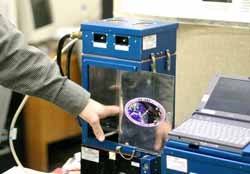
Mizuna, a lettuce-like plant, grows in space in a device known as Lada, which was developed by the Space Dynamics Lab at USU. (Photo by John Zsiray)