

Cache County Sheriff hosts Q&A to discuss ICE in Cache Valley
Cache County Sheriff Chad Jensen and Logan City Police Chief Jeff Simmons met with members of the Cache Valley community at the Logan Library to discuss immigration control and U.S. Immigration and Customs Enforcement’s relationship with Cache County.
On July 31, Cache County entered the 287(g) program, establishing a formal relationship with ICE.
Several attendees of the Q&A on Oct. 30 expressed concern about the county’s relationship with ICE. Public comments reflected appreciation for local law enforcement but fear of federal overreach and concern for friends and family.
Jensen emphasized the agreement would not majorly change existing procedures. The 287(g) program includes three models, and Jensen chose the least invasive, the Warrant Service Officer agreement.
Under this model, immigration status is checked only after an individual is booked in jail, a process already required by state law. If the individual is unable to prove legal residency, ICE has 48 hours to decide whether they should be held. So far, ICE has put a hold on seven individuals and arrested two in Cache County.
The agreement also authorizes a small number of deputies to access federal immigration databases and verify an individual’s status once they complete a training. So far, no deputies have been asked to complete the required training.
Jensen said signing the agreement demonstrated “a level of cooperation” that has strengthened the department’s relationship with ICE. This year, ICE notified him both times they entered the county to make arrests — something he noted hadn’t always happened in the past.
Many attendees voiced concerns the agreement could lead to ICE overreach, but Jensen does not plan to extend the county’s current agreement with ICE.
“You have my word. It’ll never go past what we’re doing right now,” Jensen said.
He added if ICE agents were to break the law, he would arrest them just like anyone else.
Nicole Allen, a professor at Utah State University, is one of the representatives working with Raíces Cache Valley, a local immigration support group that helped facilitate the Q&A. She noted this has been a time of significant stress for members of the immigrant community. Allen believes fear kept many people from attending the Q&A, so they collected questions both before and during the event and plan to release a report.
“Some people know that they’re in the system. They’re doing exactly what they should be doing. They still wake up every day fearful that a parking ticket or a noise complaint, which we know happened down in Salt Lake City, will wind them up in ICE detention,” Allen said.
Allen said people generally trust local law enforcement but are afraid of the federal government. She thinks statements, like Jensen’s promise to hold ICE accountable if they broke the law, do a lot to reassure the community.
“Logan City Police and most city departments around the state are operating exactly as we have. Despite what happens at the national level, our focus is on public safety,” Simmons said.
Logan City Police does not have the authority to enforce immigration law, and Simmons said officers will not ask for immigration documents during traffic stops or participate in immigration sweeps.
“The most important thing to know is that we want victims and witnesses of crimes to be safe when they call Logan City PD,” Simmons said. “Your immigration status will not be asked for or shared.”
Jensen also listed public safety as his top priority, saying Cache County deputies will never ask for immigration status on the side of the road or in someone’s home.
“I don’t want anybody in our community to ever feel that they can’t report a crime or not feel safe because of their immigration status,” he said.
Jensen believes most detainees will not be held by ICE due to the lack of jail capacity in Utah. As of six months ago, he estimated there were only 300 beds available in jails statewide, meaning that so far, ICE has chosen only to pursue individuals who pose a genuine threat to public safety. However, ICE has the authority to operate anywhere in the county, including on Utah State campus.
Several attendees said police policies and promises have not always matched their personal experiences. Several mentioned problems with the county sheriff’s blotter and the difficulty of finding people after they have been arrested.
Allen said there is an informal network that shares information when someone in the community has been detained by ICE.
“One of the things that we try to do is just figure out where these people are. This summer, we knew that there was a person who was detained, but for 48 hours, we weren’t able to find them. I called the county sheriff’s office. I spent quite a bit of time talking with them, and they just didn’t show up,” Allen said after the event.
Both Jensen and Simmons encouraged residents to bring their testimonies and concerns to their departments.
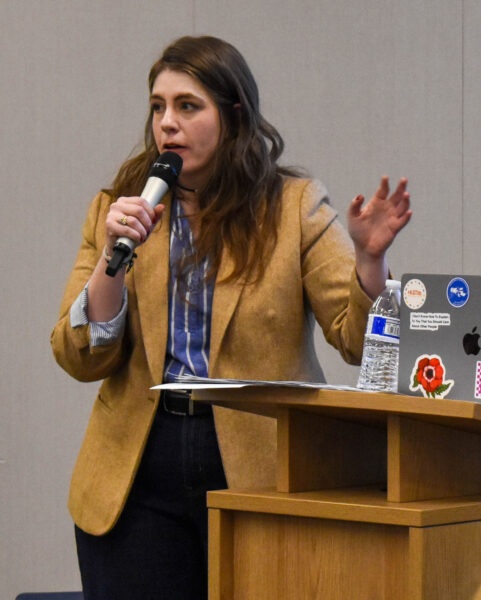
During ICE Q&A at the Logan Library, Nicole Allen talks, Oct. 30. (Alyssa Cook)
“If somebody feels like a policy was not followed, contact me directly,” Jensen said.
Jensen and Simmons asked citizens to contact their offices directly if an officer asks a question about immigration status during something like a routine traffic stop. Members of Logan City Police wear body cameras, and Simmons said if a complaint is filed shortly after an incident, the department is happy to review the footage.
Allen also encouraged attendees to reach out to their city council representatives who can act as mediators.
“We love law enforcement. We value the job that you do,” a member of the audience shared. “You do a fantastic job, but the current administration’s tactics is besmirching the beauty of law enforcement. That is not who you are. You are ‘protect and serve.’ You’re not ‘intimidate and terrorize.’”
The individual urged police leaders to speak out against intimidation tactics happening elsewhere, saying such actions do not represent true law enforcement in the U.S.
Allen said the open Q&A was unusual and open dialogue of that level isn’t happening in other parts of the state like Utah County.
She encourages members of the community to get involved, attend meetings, join email lists and connect with local organizations like Raíces or Our Community – Cache Valley.
“If you see someone being detained or picked up, keep your distance, comply with state law, but record it and try to reach out to some folks like us who will be able to get it in the network where people need that information,” Allen said.
The American Civil Liberties Union will be hosting a presentation on immigration and civil rights on Nov. 20.
A copy of the 287(g) agreement can be found at ice.gov/doclib/287gMOA/CacheCountySOUT_WSO_MOA_080425.pdf