
Column: Cameras and cadets at Escape and Evasion
Red Bull, Nerds Gummy Clusters and even homemade banana bread — these are the basic necessities cadets carried on their backs from the hours of 8 p.m.–2 a.m. this past Sept. 12–13 that would later be used to avoid them getting caught at this year’s annual Escape and Evasion.
Escape and Evasion, or E&E, is an annual overnight event hosted by USU’s Detachment 860. I, Malory Rau, news editor of The Utah Statesman, was joined by three other members of USU Student Media to take a closer look at a night with the Air Force ROTC.
This year’s E&E had cadets from not only USU but also the University of Utah, Brigham Young University, University of Wyoming, Montana State University, University of Colorado Boulder and Colorado Springs, Colorado School of Mines and Metropolitan State University of Denver.
There were 172 participating enrolled in the general military course, or GMC, and 40 enrolled in the professional officer course, or POC, and cadre, who are instructors and/or officers. All of the top three teams were from the U, and the winning team scored 110 points.
Per last years coverage, I had some knowledge going into this year’s E&E, but instead of participating as an underclassman in the GMC, we were brought in to assist those enrolled in the POC.
The role of the POC is to catch the GMC as they try to complete their objectives for the night. The four of us from student media were split into two groups of two: one group stationary at an objective location and the other two left to roam.
Briggs Rober, Bluelight Media live video manager, and I were paired with two of the POC from BYU. One might say we were in enemy territory at this point.
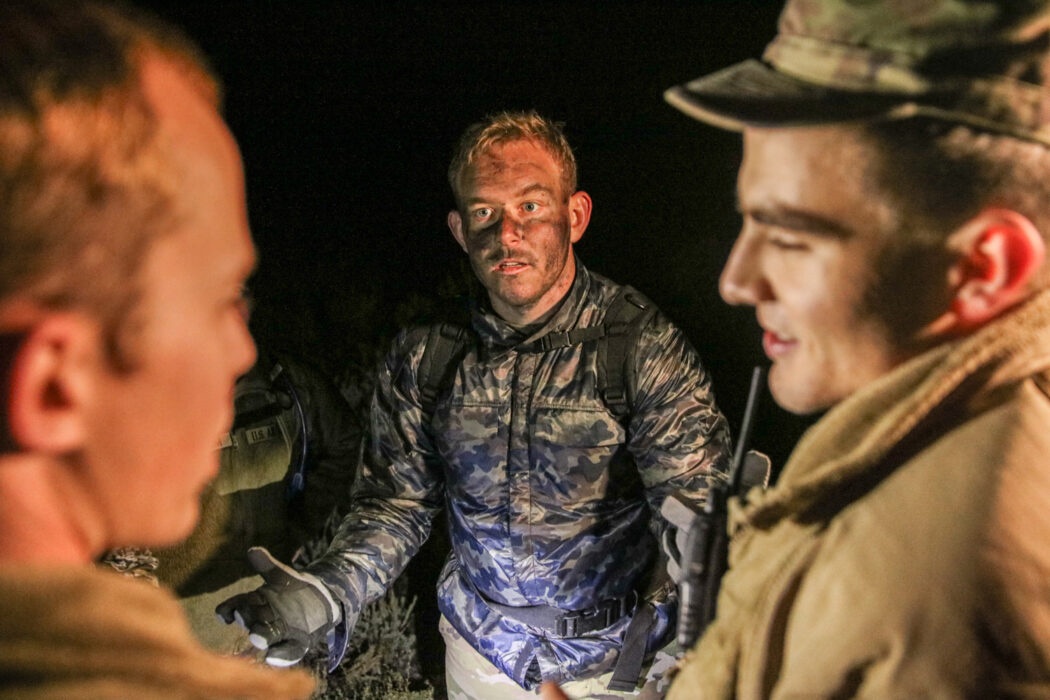
We followed the two cadets up and down the road as we looked for GMC. The goal was to listen and look for movement. We would sometimes also turn our flashlights off in order not to make our presence known to the GMC.
We caught many groups throughout the night, and each group was ready to negotiate and bribe their way out of getting marked down on their score sheet for getting caught. The four of us feasted on various Red Bulls, candies and Gushers, and I ended the night with a whole box of Cheez-Its to take home.
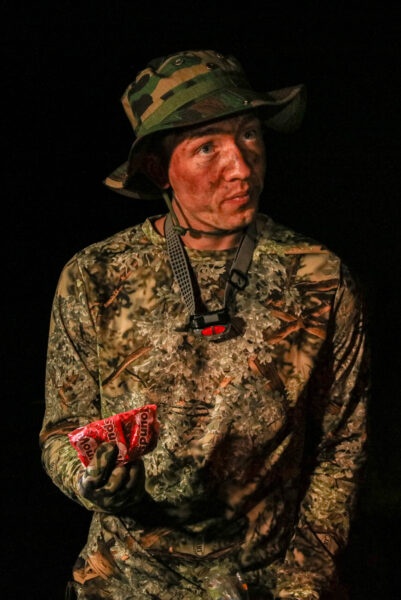
A cadet negotiates a points deal with a patrol person during Escape and Evade on Sept. 12.
The role of the press in the event came as a shock to a lot of the participants. Once caught, cadets would often exclaim, “Why is there a camera?” or “What is a journalist doing here?” Some felt unbothered by our presence, while others found it added to the mental challenges of the evening. It seemed GMC was only prepared for the action portion of the common phrase “lights, camera, action” when it came to E&E.
When found, some cadets would often ask for help or encouragement from the POC. The POC, acting as upperclassmen, would often give words of encouragement after all the bribing and capturing was said and done.
There was one notable injury throughout the night. A group of cadets we later caught had suffered from various bee stings, and another cadet had a close call with a barbed wire fence but was uninjured.
Assisting as POC made us walk 18,000 steps that evening in just looking for GMC alone. Our media team arrived back at Logan at 3:30 that morning while cadets were asked to camp the night and then visited by helicopters in the morning for a demonstration.
With now two E&Es under my belt as someone who never thought twice to enlist in any branch of the military, I will once again express my sentiment for not only my appreciation for the role of the media in warfare journalism but also the dire need for it.
I would like to think our presence as media not only served us in growing in our fields and understanding the need for coverage in these settings but also served the cadets in adding to the extremely real scenarios that are happening outside the safety of an overnight exercise in Temple Fork.