

Celebrating 100 years of Black History Month
Editor’s note: This article has been updated to reflect accurate information and correct an error by The Utah Statesman.
For many students and staff at Utah State University, Black History Month isn’t just a holiday. It’s a chance to build community, celebrate culture and reflect on the impact of Black history in the United States.
Throughout February, the USU Black Student Union, in collaboration with the Center for Community, will host events highlighting the art, music and storytelling that emerged from pivotal moments throughout Black History to celebrate the 100th year of Black History Month.
“Our biggest goal is just creating a sense of community,” said Lexi Blackwell, vice president of BSU. “Especially where we attend a predominantly white institution, there’s not a lot of places where you could feel, I guess, at home, or necessarily comfortable. We want to make Black Student Union a place where you can feel like you’re at home.”
Blackwell said she sees the BSU as more than just an organization but as a support system. Whether students need help navigating classes or simply finding someone who understands their experiences, she said the group strives to lift Aggies up in any way they can.
“I love knowing that I have a place that I can go to — a place where I can be myself, and a place where I feel the most comfortable I’ve ever felt,” Blackwell said.
One of this month’s featured events run by the BSU is “Soul Food: 1940s Night in Harlem.” According to Blackwell, this event draws inspiration from the Harlem Renaissance, a cultural movement that reshaped American art, literature and music.
“We chose the theme 1940s Harlem, specifically because of the Harlem Renaissance and how that had a huge effect on Black culture and the jazz movement,” Blackwell said. “It was a very pinnacle time in Black history, and it still has effects to this day on music and culture and even outfits and art.”
This celebration will include live performers, interactive games like Kahoot and educational opportunities designed to connect past and present. Organizers hope attendees leave with a deeper understanding of how Black history continues to shape everyday life.
“I hope that people can take away how much Black culture has influenced how we operate as a society,” Blackwell said. “Being able to connect the dots on where things that happened during the 1940s Harlem, for example, affects how we act as college students, or how we dress, or where musical influences come from.”
The Center for Community hosted a Black History Month celebration on Feb. 11 in the TSC. The event included live performances from the Cache Valley Interfaith Choir, traditional soul food hoecake refreshments and educational tabling from university organizations.
“Campus communities are a place for people to learn and to reflect,” said Shelly Ortiz, director of the Center for Community. “This is a chance for us to engage, connect with each other and build our communities.”
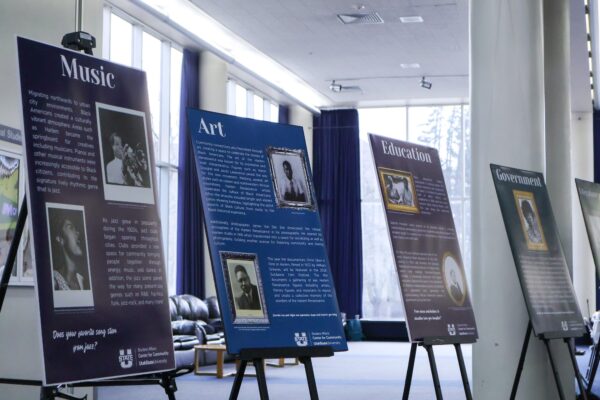
Attendees had the opportunity to learn from and reflect on key figures from Black history, an aspect of the event that highlights “A Century of Black History Commemorations,” the theme for this year’s Black History Month.
 Sydnie Fonoti
 Displays at the Black History Month celebration in the Taggart Student Center on Feb. 11.
“We wanted to do a lot of education around the Great Migration and how it brought Black Americans from the rural South into urban areas, where they created community and started to build creativity,” Ortiz said.
Ortiz said celebrating traditions like these at USU is important because Black History Month itself started as a grassroots effort in educational spaces like college campuses.
“It started from a lot of grassroots initiatives, through educators and students, and then grew into community celebrations,” Ortiz said. “From that community celebration, it eventually became federally recognized.”
Attendees at the event spoke on how it offered both cultural insight and personal reflection.
“I thought it was interesting to see the intersection of culture,” said Olin Harrison Anguiano, USU student.
He added attending cultural events like these and learning about Black history benefits everyone.
“I think all cultures have a lot to share with us, and by learning from Black history, we can move forward as a group, as a country, as a people, better in the future,” Anguiano said. “Our history does dictate a lot of where we’re going, and we shouldn’t forget our history.”
Blackwell shared a similar sentiment, saying that continuing to learn about Black history is essential.
“I think it is so important because without Black history, we are erased as people and we are left behind,” Blackwell said. “Having America be built on the backs of Black people and enslaved people, without acknowledging that history, we completely ignore how we were created in the first place. The continuance of learning and remembering that we’re all people, and we all have histories, we all have cultures, and it’s very important.”
According to Blackwell, this learning can be done by anyone, and it can start small.
“It’s honestly as easy as a quick Google search,” Blackwell said. “Just something you’re curious about, whether it be something with hair or why people do a certain thing. Reading is a great way to inform yourself on Black culture. Just read.”
You must be logged in to post a comment.
There are no comments
Add yours