
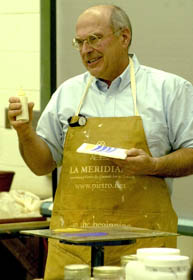
Clay molder models love of pottery
Ceramic artist Walter Ostrom came to USU to share his unique work and demonstrate the techniques he uses.
Orstrom met with students in ceramics classes and did workshops Tuesday and Thursday. He also gave a public lecture Tuesday night at the Eccles Conference Center.
Ostrom got a MFA and is now a professor of ceramics at the Nova Scotia School of Art and Design. He is an honorary professor of ceramics at the Jingdezhen Ceramic Institute in Jingdezhen, China.
Ostrom creates many unique pieces, and is known for his work using a low-fire maiolica technique.
During his public lecture, Ostrom showed slides of his work and of his studio in Nova Scotia.
He brought some of his work from Nova Scotia to fire at USU. He said USU has its own particular kind of firing and ceramics.
“I really believe in your studio, you can do anything you want,” Ostrom said.
Ostrom talked about utilitarian pottery, which is pottery that is meant to be used.
“Pottery has always acted to enhance the space in which we live,” Ostrom said.
After he learned how to make pottery that wasn’t round, he began creating different kinds of pottery.
“Last week was the first time I made a round thing in 35 years,” Ostrom said.
Ostrom talked about some of the people who have inspired his pottery, including his wife who encouraged him to make pottery for flowers. He has made a lot of basket-shaped pieces to hold flowers.
Ostrom knows a lot about the history of pottery, and he uses some ideas from ancient pottery to create his own work.
He modeled one piece after a Dutch pot that had a separate holder for each flower.
Ostrom has used fish in the design of some of his pottery. He said a friend asked him to make a wedding gift and he made a pot of two fish joined together. He said in China, a pair of fish is a traditional present for people getting married.
In his workshop, Ostrom showed different ways of glazing and different types of glaze. He said students should practice glazing with water because the water shows where it will drip.
“You’re going to learn with water how to do it best,” Ostrom said.
Ostrom said never to use your good piece as a test piece when glazing.
He showed many different colors of glaze.
“If you add copper, they’re going to cease to be one-dimensional,” Ostrom said of the color of glaze.
Ostrom’s work has been shown in many collections all over the world including Beijing, London, Ottawa, Boston, and New York.
He is the last artist, of the Visiting Artist Program at USU, who will visit this semester. Guest artists are selected on the basis of their national and international reputations and their art, and they represent a diversity of backgrounds.
-sdobson@cc.usu.edu