

Collaboration takes center stage as Art Song Competition awards scholarship money
The sounds of singers warming up their voices drifted into the lobby of the Russell/Wanlass Performance Hall before Utah State University’s Art Song Competition, where both vocalists and pianists competed for six scholarships in a collaboration between the USU Music Department’s voice and piano areas.
The competition, held on Feb. 9, struck a shift in the music department’s traditional aria competition to focus on art song: vocal pieces that combine poetry and piano in a classical shared performance.
Auriana Smith, a first-year vocal performance major, won $500 for her performance of “Après un rêve” by Gabriel Fauré, a French art song about longing for a wisp in time or a vanished dream. Ginny Bastian, a sophomore pianist, won $500 for her accompaniment of “Verborgenheit” by Hugo Wolf.
Second and third places also were awarded scholarships in both voice and piano categories.
“I honestly feel so surprised,” Smith said after the results were announced. “It’s so nice to notice all the hard work that you’re doing.”
The performance competition was a collaboration between both USU’s voice and piano departments with both matching scholarship funds.
“Because of the collaborative nature of art song between the singer and the pianist, we’ve been working very closely with the piano department this year,” said Thomas Glenn, area coordinator and assistant professor in voice at USU.
Performing pieces in French, German and English, seven singers competed. Staff pianist Dallas Aksoy accompanied four singers who didn’t have their own collaborative pianists, while three student pianists competed alongside their vocal partners.
Not only did they award a first, second and third in both vocal and pianist categories, but an audience favorite was also awarded. Smith won audience favorite along with first place in the vocal category.
“I just love listening to everybody’s repertoire,” Smith said. “That’s the biggest prize for me — just seeing everybody sharing their talents.”
Art song is different from opera in its intimacy. Instead of arias extracted from larger operatic works, art songs are freestanding pieces that set famous poems, specifically ones from the 19th century, to music for voice and piano.
“Any time someone is standing in front of you singing is an event where they show vulnerability,” Glenn said. “In that moment, they have a choice to either be scared, nervous, afraid or to share the deepest feelings of their heart, and if they choose the latter, it deeply affects the audience.”
Smith chose her French piece specifically for its emotional depth. The poem describes waking up from a delightful dream of a loved one and pleading for the night to return so they might relive the dream.
“There’s a lot of longing in the song,” Smith said. “It’s really pretty, and I just really love French art songs.”
Backstage before the competition, competitors spent their time encouraging each other through breaks in warming up their voices. Glenn moved between students as a vocal coach, offering last-minute advice and words of encouragement.
“We’re really just here for the opportunity to perform,” said Eleanor Christensen, a soprano who performed Schubert’s “Ganymed” in German. “Everybody likes to support each other. That’s really cool.”
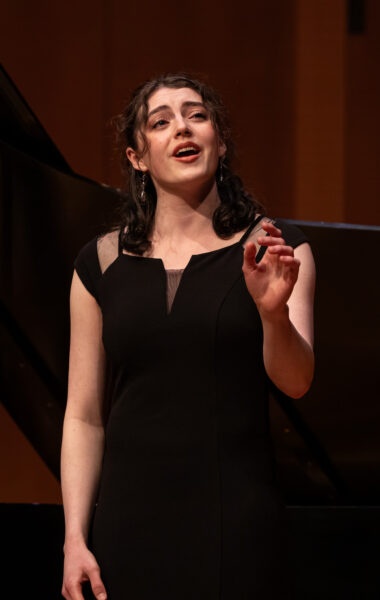 Sydnie Fonoti
 Auriana Smith performs “Après un rêve” by Gabriel Faure.
The supportive atmosphere reflects the close relationships within the music program at USU. Students take classes together and perform frequently in master classes and recitals.
Bastian, who came to USU from Maryland, said she chose the university partly because of the community she found during auditions.
“I really loved the vibe here,” Bastian said. “Great faculty, great student connection.”
The competition serves a more sizable mission: creating interest in classical singing among voice majors in a region where musical theater dominates.
“In Utah or the Intermountain Region, music theater is king,” Glenn said. “Classical singing is often stereotyped or marginalized or thought of as old.”
Glenn argued classical technique provides a foundation for any genre from rock to pop to musical theater that no other approach offers, teaching singers to project in large spaces without microphones.
“If they have a classical technique, it helps them to sing anything better,” Glenn said. “Breath support, resonance, vowel equalization — singing into a large space without a microphone is something that doesn’t happen in other genres.”
The competition was part of Songfest 2025-26, a year-long series of events promoting classical song funded by a grant called the Visiting Artists & Scholars Series. The series also brought lead singer David Adam Moore from New York to perform a fully memorized and staged hour-long song cycle.
For competitors like Kae Ra Davis, a junior vocal performance major, moments like these make pursuing music worth it.
“It’s really hard sometimes to pursue your passion, but I don’t think I would want to do literally anything else,” Davis said. “Moments like this, surrounded by your awesome friends and colleagues, and get to share music and make it together — it’s something that I cherish and I love.”
You must be logged in to post a comment.
There are no comments
Add yours