
Coloring inside the lines the first step in artist’s evolution
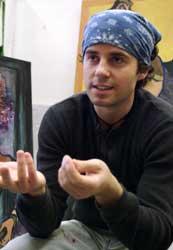
For not being able to color inside the lines in kindergarten, Chad Crane has come a long way. The art major, who is in his senior year at Utah State University, recently had his art work displayed at Borders.
As an artist who uses mixed mediums and incorporates print-making techniques into his paintings, Crane uses words such as agressive, self-expression and untraditional to describe his art.
As a child, Crane said he was more content to make trains with crayons rather than color with them. In kindergarten, he had what he described as a “dramatic experience” when he was coloring a rooster.
“The teacher just flat out told me, ‘You’re coloring outside the lines,'” Crane said. “You’re the worst colorer in the class.”
The teacher’s comments upset Crane so much he set the crayon down, closed his eyes and told himself that he was going to color inside the lines.
“It was just pure determination,” Crane said. “I remember opening my eyes and doing it. I realized that it was something that I could do. Ever since then, I have been drawing and coloring.”
Crane said as he evolved as an artist, he has seen the transition from being fascinated with the ability to reproduce an image to using artwork as a form of expression.
“I’m not so much interested in the actual reproduction of images as I am self expression,” said Crane. “It’s mostly just about a creative outlet.”
Crane’s abstract style of painting deserves more than just a casual glance. Each piece tells its own story. He said depictions of people may have exaggerated features to tell how the person is feeling while animals may have an aggressive edge or end up with parts of the artist in them.
“When I begin to draw, I naturally lean toward abstracting something,” Crane said. “I guess it comes down to not wanting to reproduce what I see and transfer that onto paper, but interpret it.”
Crane, who is from Morgan, Utah, turned toward abstract drawing when he was in high school. He said he would draw his friends as they were sitting around playing Nintendo.
Crane said he realized that it was OK that he not reproduce images, but instead draw his interpretation of the subject.
Even now, Crane said he starts his drawing by using a reference but then creates an abstraction from it.
While it is easy for the average person to discredit an abstract drawing as something a child could do, and tempting to say anyone can splatter paint on a canvas, Crane said there is a lot more to it.
“There is still design, there’s still shape, line quality, texture, layers, depth – all the same principles to work with,” Crane said. “It doesn’t matter if your image is representational or abstracted, if it’s interesting is what is important.”
Paintings can take anywhere from 15 minutes to several weeks to finish, Crane said. He tries to allow a certain amount of spontaneity into his work, he said, while trying to meet what he envisioned in his mind.
Often times, he said paintings will start out with spray paint against the canvas. From there, Crane said he adds a layer of acrylic-based gesso. Out of the textures and natural shapes created, Crane picks out the images he sees in the canvas and builds upon them.
“I sit there and look at it for a while,” Crane said. “I start to see things and start pushing the things that I see.”
Much of Crane’s artwork is an expression of himself, he said, and he found it advantageous to go from painting human figures to animals.
“When you do a portrait, people immediately begin to wonder, ‘Who is she?'” Crane said. “They may not relate to her; she doesn’t mean anything.”
By allowing the interpretation of the animal imagery to speak about him, Crane said it allows the narrative to be interpreted on a much deeper level. The observer can look past identifying the person and instead look deeper into the imagery, he said.
Plans to display his art work in galleries are starting to take shape as Crane said he has begun to sell some of his artwork.
“I might just take a year and produce art and see what happens as I try to send my images to galleries, see what kind of response I get,” he said.
Although it is a tough market in Logan, Crane said he has received a response from people who show interest even though his “abstract kind of agressive images like this that aren’t traditional elk bugling in the wild.”
While plans for graduate school and perhaps a career in teaching are in his future, Crane said he wants to see where his art work will take him as he continues to produce and sell art branded with his mark.
“I’ve found that the more you try, the better off you are,” he said. “You just have to expect a certain amount of rejection and a certain amount of success.”
Chad Crane’s portfolio can be viewed online at www.chadcrane.com
-ashleykarras@cc.usu.edu
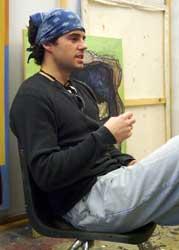
Chad Crane explains how he creates his paintings. Crane can spend up to several weeks on a piece.