
Column: The meaning of K’é, USU’s 48th Pow Wow strengthens community
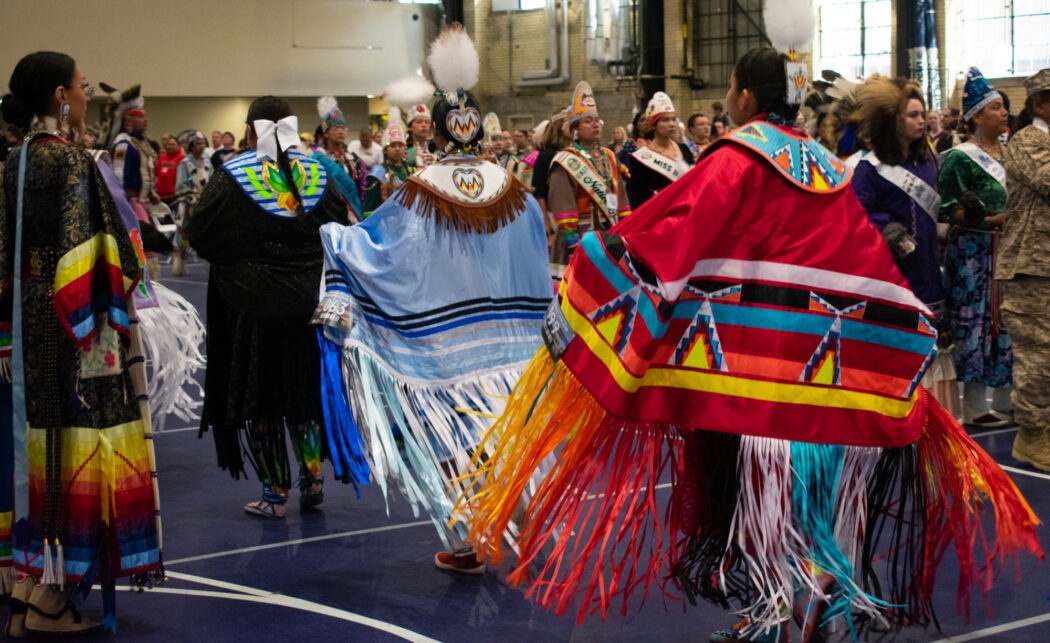
The swelling of drums and the melodic chords of healing songs performed by Scout Society and the sound of metal cones ringing with rhythm gives the jingle dress dance its name. On March 28, several dozen young women from each of Utah’s eight Indigenous tribes and beyond performed in the Teen Girls Jingle Contest, one of over 20 competition dances that made up the core of festivities at this year’s Annual Echoing Traditional Ways Pow Wow.
In between competitions, Kaitlynne Perkins, secretary for USU’s Native American Student Council and First Attendant to this year’s USU Miss Native American, shared the history of Utah State’s Pow Wow, now in its 48th year.
“The Native American Student Council was once called the Many Eagles Indian Council, and that was founded back in the ‘70s. They were able to get a group of students together and host the very first Miss Native pageant in 1971,” Perkins said. “Now here today, we have participants from all of Utah’s tribes. There’s the Navajo Nation, the Goshute, Paiute, the Northwestern Shoshone. We also have a bunch of others from out-of-state. There’s Cree, and one of our other Miss Natives, she’s actually Alaska Native.”
Giana Pugh, the second attendant to the USU Miss Native American, is of Iñupiat descent. Hailing from Fairbanks, Alaska, the pow wow held a great significance for her, as it gave her the opportunity to reconnect with her roots despite being more than 2,000 miles from home.
“My dad got a job here at Utah State — he works at the Space Dynamics Lab. We ended up moving here because there’s not a lot of college opportunities in Alaska. Most of them are community colleges, so he wanted me and my sister to have better opportunities here in the Lower 48,” Pugh said. “I really love the sense of community and how many different tribes there are here, as well as all of the cool regalia that everyone is wearing. It’s so beautiful.”
Now, half a century from its founding, the event thrives with hundreds of attendees. As parents and elders accompanied children aged six and under onto the dance floor for the Tiny Tots category, Cynthia Tsosie, a member of the Navajo Nation and USU’s 2025-26 Miss Native American, watched on as the youngest of her community took their first steps into tradition. As Head Woman of this year’s pow wow, Tsosie sponsored the Tiny Tots dances, which she says is her favorite event to watch.
“I grew up taking care of my nieces and nephew,” Tsosie said. “Seeing Tiny Tots fills my heart with so much joy because I remember seeing my nieces and nephews dancing, especially in their own little outfits, having fun with it. Everything starts off with them and knowing how far they can go if they continue with it — it means a lot.”
Tsosie said the pow wow is important not only for Utah’s Indigenous communities but also for USU and greater Cache County at large, including non-Native students and community members. She said everyone benefits when non-Natives engage with their curiosity, broaden their understanding and continue to attend cultural events.
“So, one word that I would use is K’é, and that term is used for many different things, but what I like to use it for is networking with the people that you meet. Through this pow wow, I got to meet a whole bunch of people. I got to get in touch with my old program — where I got my CDL and an associate’s in general studies,” Tsosie said. “Show up to our events. They’re always open to everyone. We won’t turn you away. And to the future Miss Native American princess, if you’re out there, I would say ‘Turn in your application. You won’t regret it. You’ll make connections with your sisters and meet more people than you thought you could.’”
As Tsosie handed out gift bags to each of the Tiny Tot dancers, Rhonda “Honey” DuVall called the next category up to perform, the evening session’s Golden Age Exhibition. In her duties as this year’s master of ceremonies, DuVall was in charge of introducing categories, adding context and commentary to the stories of the dancers and directing the flow of the event’s energy.
As someone who is both Diné and African American, she represents two different backgrounds, which ties into her belief that the pow wow’s dancing can provide community blessings to everyone in attendance, regardless of ancestry.
“Each and every person that’s here, whether they’re Native or non-Native, can share that culture, can share the traditions of each and every tribe that’s out here,” Honey said. “Incorporating the importance of community — that we can all come together and dance together — it helps us understand the differences between us, being resilient Indigenous individuals that the community supports but also respects.”
Honey said the most effective way non-Native community members can support their Native neighbors is by incorporating an Indigenous presence in education, where presenters and educators can teach about the importance and intricacies of Native cultures.
“We as Indigenous people are very resilient, and we’re still here strong as ever. Understanding the etiquettes of the events that we put on and being respectful of that is essential,” DuVall said. “I am the founder of the Natives Aiming To Succeed Education Resource Center in Salt Lake City, Utah, and we do have the Echoing Spirit Dancers that are incorporated through this organization.”
As this year’s celebration wound to a close during the monumental Grand Exit, the myriad faces that slowly filtered out of the doors emerged from the pow wow closer, imbued by a spirit of collective well-being. In times such as these, it is our sense of community that will make us stronger. It is learning from those who have already survived immense hardship that will make us whole. If this year’s Pow Wow has taught any lesson, it is that we share more in common with one another than we have differences and that we must lift one another up if we are to brave the future together.