
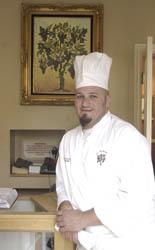
Cooking up a storm
He’s a chef who doesn’t mind cooking dinner for himself after work.
At least, that is what John Simpson said about himself.
To prepare for a catering event, 12 pans that each hold 25 chicken breasts are stacked on the kitchen table at Culinary Concepts. While a surround-sound radio blasts a tune throughout the back kitchen, Simpson, executive chef, along with Robert Sanderson, chef, work together to complete one of many catering events for the week. With over 10 catering events a week, Simpson said “we work till it’s done.”
A day in the life of a chef is full of deadlines. Where an average office worker may have three deadlines per week, Sanderson and Simpson said they both agree that a chef can have at least five deadlines per week, if not more.
“If you are a chef or caterer and you’ve got a wedding at 5 p.m. on Friday, you’re there,” Simpson said while continuing to work. “If your chicken didn’t come in, you go buy some, you drive to SLC. Life as a chef is very stressful.”
Keeping a 9-to-5 schedule is something Simpson said rarely happens in chef world. Since Culinary Concepts is a catering business and not a restaurant, Simpson said his daily routine is not normal and does not have set hours. So although he does not have to worry about lunch rushes or dinner specials, Simpson said his day can be just as busy.
“Working seven days a week is not uncommon,” he said.
After spending 11 years in California going to a culinary academy and working alongside specialty chefs, Simpson said he finally ended up back in Cache Valley where he grew up. Opening Culinary Concepts in Smithfield came shortly after, he said. Simpson and his wife, Michelle, co-own Culinary Concepts and work together on planning and carrying out events. A chef’s day involves more than cooking the food, however. In fact, sometimes cooking can be the smallest portion of the day.
Simpson said each day in the life of a chef can be full of different responsibilities. With his day starting at 7:30 a.m. to either order food or shop for fresh produce, Simpson said he takes a few hours when he can to make ice sculptures to be used for events. Ice sculptures often showcase items, such as glitter or flowers frozen into the ice, he said. A sculpture set to be completed this week even requires Simpson to etch a food menu into the ice.
PierAntonio Micheli, executive chef at Le Nonne, also said his day is made up of other responsibilities besides cooking. Micheli said his job responsibilities differ depending on whether the restaurant is busy or not. Each morning, Micheli said he buys fresh produce and other items used for the day’s cooking, which can take up to a couple or hours. After “dumping the stuff” in the kitchen, he said there are always different things to do for the remainder of the day to help prepare for his customers.
“If it is sauce day, I make sauces,” he said. “Then by 5 I am usually on the line cooking.”
Like Simpson, Micheli said he and his wife, Stephanie, co-own Le Nonne and work together to make sure things are ready in time for customers. Micheli, from Tuscany, Italy, said he went to school for four years to learn the cooking basics and then traveled to Los Angeles where he started opening Italian restaurants.
“It’s really how much you work and how much you apply yourself,” he said.
The hardest part of Micheli’s day, he said, is “waking up” and going to work.
“It is a monotonous life,” he said. “After six years, I got everything down and it’s fun. But fun can turn to dull because I get so set into the routine.”
Simpson, owner of Culinary Concepts, said the hardest part of his day is working the very long hours as well as finally accomplishing the day.
“The best part is going home,” he said. “I like what I do but getting there is very stressful. In one day we had five parties and Baby Animal Days at American West Heritage Center to cater for. You rotate, you stock, clean, load, haul the truck again, five times over – it’s a lot. So after the day is all done, it’s like, whew!”
Another difficult part of being a chef, Simpson said, is dealing with food costs.
“Our labor to make things, our time, energy, all that far outweighs any of those costs,” he said. “So much goes into preparing the food that chefs think about every day that other people don’t think about.”
The most rewarding part of his day, however, is when Simpson said he is done serving an event and he can watch the people enjoy the food and notice their admiration.
Sanderson said his days as a chef are rewarding because he “respects the art of culinary” enough to really put himself into whatever he is doing.
Micheli said the best part of his days is when he talks to newcomers who are pleased with the restaurant atmosphere and with the different dishes that are offered. Finding a new recipe, Micheli said, or creating a new Italian dish to serve is also rewarding. And having customers tell him about positive Le Nonne reviews via Web sites can really help make his day, he said.
Le Nonne is located at 129 N. 100 East in Logan. Culinary Concepts is located at 875 S. Main in Smithfield.
“Being a chef is what I do,” Micheli said. “It’s my way of life.”
-britg@cc.usu.edu