
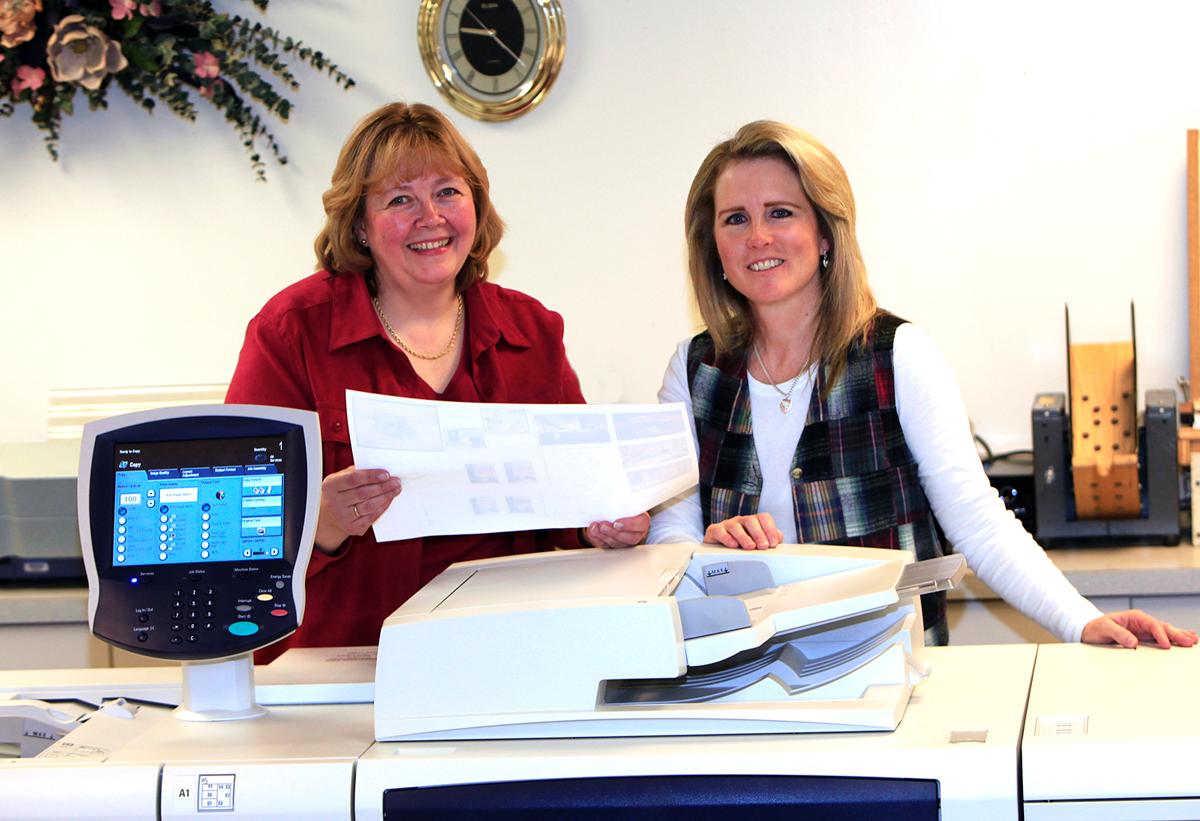
Copy crew evolves with technology
The two full-time workers at the Copy Center in the Taggart Student Center said their goal is to make the best product possible to serve the on-campus community.
The Copy Center used to have a sign that said “We work miracles,” but Louise Monson said she thought of an improved slogan for the Copy Center.
“The impossible we do immediately – the miracles take a little longer,” she said.
The Copy Center is an extension of USU Printing, located behind the softball diamond on 800 East, and used to have many more stores. Due to budget cuts, there is now only one.
Monson has worked at the Copy Center for 33 years, but spent the first 30 of those in a copy center formerly located in the Biology and Natural Resources Building.
“I’ve worked at the copy center for a lifetime,” she said. “Before I worked at the copy center, I worked in the bindery. That was before things were as automated.”
Monson said she has seen the technology change in the Copy Center significantly over the years, from hand collating papers for books and print-offs to having a machine do it for her.
“It was a different time,” she said.
Monson said the change has been mind-boggling for her – in some ways good, in some ways not so positive.
“In some ways it’s fascinating to see how far technology has brought us,” she said.
Before Xerox machines, there were offset printing machines. According to the “How Stuff Works” website, offset printing requires multiple steps where long strips of paper are fed through machines and stamps are used.
Monson said the move from offset printing to Xerox was challenging because the processes different, but in some ways the process is very similar. She said she’s still learning.
“Especially with the younger generation, they are programmed from a very young age to know how to use a computer, whereas for me, I’m still learning,” she said.
Kelly Elbert is the manager of the Copy Center. She said she started in the early 1980s
and has seen many changes since she first started.
“The technology has changed a lot because when I started, we used to do everything from hard copy originals in the machines to now where everything is electronic and digital,” she said.
Monson said she has been amazed at the amount of information that can be stored on a flash drive and it’s a testament to how far technology has come.
“You look at some of these flash drives, and they’re just tiny and they hold so much,” Monson said. “If you lose it, how much of your world comes crashing down?”
Elbert said the Copy Center tries to provide quality customer service in addition to a quality product. She said it is a self-sustaining business and doesn’t receive money from the university, so having happy customers is important.
“I like learning new stuff,” Elbert said. “I like the challenges with trying to figure out how to make the best product possible.”
“It’s a good thing you like challenges, because you get them,” Monson said to Elbert.
Monson and Elbert said the most difficult part of their job at the Copy Center is trying to get the same vision the client has.
“Sometimes you just have to throw your hands up in the air,” Monson said.
Monson said when the vision is caught and the product being printed turns out, it’s the best part of the job and can often make their clients very happy.
“We want that finished product to look the best.” Monson said. “We may not sign it or put our name on it, but we want the product that goes out the door to be the best we can do.”
Monson said when the vision is not caught it’s often due to misunderstanding, be it on the side of the Copy Center or the client.
“The oddest thing we’ve been asked to do is to make double-sided transparencies,” Elbert said.
While the constantly changing technology has taught Monson much about her job, she said she’s also learned an important life lesson – that everyone has different ideas.
“There is no one way to do things,” she said. “There might be a way that works better than another. Trying to figure out what the person wants can be a challenge, but then the rewards come when you go beyond what they anticipate and expect.”
– april.ashland@aggiemail.usu.edu
Twitter: @AprilAsh2012