
CROSSING RACIAL LINES
Robert Hashimoto just wanted to play hockey. A Japanese-American wing in his first year of collegiate hockey, Hashimoto said he was playing a team from a university in Southern California when he was verbally attacked, not for his hockey skills, but his race.
“A guy skated by me and said, ‘Hey, eating a rice bowl there?’ and started laughing,” Hashimoto said. “I talked to this ref Kitano, who’s also Japanese-American, said ‘one of those boys just called me a rice-bowl eater.’ He just laughed and said, ‘I’ve been called worse.’ And I’ve been called worse too, but you know it’s not right.”
Racism often exists in the game of hockey, however, ask a few players and coaches about it, and they will provide drastically different answers as to the extent of the problem, and the best ways of dealing with it. Some coaches will uniformly say all racism should be reported to the authorities. For a player, however, often the choice boils down to being called racist names or being called a snitch.
The Junior Hockey Coach
Salim Raza grew up playing hockey in westside Buffalo, N.Y. Raza, who is of Pakistani descent, has been a junior hockey coach in Valencia, Calif., since moving out west in 1996. He said he adopts a strict no-tolerance attitude toward racism of any kind on his team.
“Some coaches may be oblivious to occurrences of that nature out on the ice,” Raza said. “But it’s still something that is more prevalent now than ever, especially in California because there are so many ethnic boundaries. With kids, if you don’t set your boundary and stop it the minute you hear it, you’re just perpetuating it.”
Raza said he never encountered any racism when he was growing up playing hockey in predominantly white Buffalo, but he found out quickly about the racial tensions that lurk below the surface in diverse areas such as California.
“When I started coaching and having kids playing for me that were African-American, Asian and Filipino, that’s when I started to get kids coming to me on the bench telling me what was going on out there,” he said.
The key, Raza said, is to adopt a hard-line stance early on and never deviate.
“If a kid is playing for me and I hear that he is engaging in that, I have no problem sitting him on the bench and talking with him and his parents and seeing if playing for me is going to be in the equation,” Raza said. “To tolerate it once it makes you part of the problem.”
Racial abuse is outlawed in hockey, as per USA Hockey bylaws: a game misconduct penalty may be assessed for any player who “uses obscene gestures or racial/ethnic slurs on the ice or anywhere in the rink before, during or after a game.” With that in mind, Raza said players and coaches need to be proactive in blowing the whistle on inappropriate behavior whenever they witness it, to help the officials do their jobs.
“I think players and coaches should report that to officials without a doubt,” Raza said. “Even if the official doesn’t hear it, it lets them know there’s something going on.”
Players need to find more conducive ways to express their anger or frustration with how a game is going, Raza said.
“You’d think they would use a solid body check or to score a goal on you, but some of them try to use words,” he said.
The Japanese-American Player
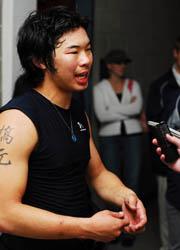
Robert Hashimoto played youth hockey in Southern California and ACHA hockey at USU. He has dealt with racism at every level from other teams and from his own teammates at times. He said he still remembers the first time anyone engaged him in an aggressive, racist manner on the ice: “When I was growing up playing hockey when I was younger I didn’t see any racism. The first time I experienced it I was 13 in Peewees. I got a penalty with a Caucasian guy and we were talking crap in the penalty box. He started saying, ‘Open your eyes chink.’ The refs didn’t hear it.”
Since referees can’t witness every untoward act that takes place during a hockey game, it’s important for coaches to step up for their players when they know renegade behavior is taking place on the ice.
“The cool thing is when the coaches go up to the officials and notify them that they’re hearing a lot of racial slurs,” Hashimoto said.
The realities of being a minority hockey player are often cold, as some referees and coaches, Hashimoto said, simply do not want to hear about racism. It’s convenient to ignore hidden behavior among players jostling for position along the boards, and there is enormous pressure on players to ignore racist abuse.
“In some regions, I’ll tell refs, ‘Dude, they’re talking s***.’ They’re throwing me off my game. I don’t want any trouble.’ Some refs will just be harsh. They’ll just say, ‘Let it go’ and skate off. All they want to do is ref the game and get paid. Some refs are like that and it sucks,” Hashimoto said.
The best defense for a player who is being picked on is to know that he has a hockey team on his side, he said.
“You need support from your teammates. I can’t be on a team where if I get attacked no one steps up for me. I want to hear my teammates say, ‘Don’t worry about him, we’ll take care of him,'” Hashimoto said. “Of course any racial slur is going to hurt someone’s feelings, but it’s always going to help if you’ve got the support of your boys on the team.”
Unfortunately, everyone isn’t an ideal teammate, he said.
“It’s funny because a lot of the guys on the team think we are all cool and we can all make fun of each other,” Hashimoto said, “but sometimes it hurts. I don’t want to name names, but there was this guy I played with for like three years and one day out of nowhere he goes, ‘Dude you need to open your eyes.'”
Hashimoto said he felt like he had no good choices to deal with the racist barb. “I just say, ‘That’s f***ed up,’ and that’s about it.”
Hashimoto attributes much of the racism he has been through to ignorance, not hatred. “I think Midwestern hockey players don’t see enough race, so when they do they try to make a joke that isn’t funny,” he said. “Californians, we face so much racism here because of all the diversity. It sucks being on a hockey team where they make fun of each other even though it’s light-hearted. A lot of California hockey players, even the white people, they grow up with racism and prejudice.”
The NHL Coach
Dealing with professional players at the highest level of the sport, Nashville Predators Associate Coach Brent Peterson said he doesn’t see too much petty racism or immature joking about race.
Peterson said the most important guideline for players is, “Hockey is a game for everybody. Players need to control their emotions yet still play with emotion.”
There is a difference between trash talking in the heat of competition to try and intimidate a person who is mentally weaker, which Peterson said is part of sports, and bringing religion or race into the discussion.
“Trash talking about people’s race or beliefs shouldn’t be tolerated,” Peterson said. “We have to have some sensitivity towards different religions, beliefs, cultures and races. We’re in the 2000s here, we’re not back in the 1950s. We’ve come a long ways, but there’s still people out there who don’t get it. Other people are different races and everybody is equal.”
Peterson said coaches need to educate their players about tolerance and acceptance, but there is a limit after which teaching is no longer an option for dealing with problem players.
“Some people maybe shouldn’t be on teams” if they can’t get their act together, Peterson said.
The African-American Player
Growing up playing hockey for Taylorsville High in Utah, Josh Groves said he didn’t get a lot of racial taunting or harassment, mainly because he played in net. But when he started playing junior hockey, Groves moved to forward. While on a trip to Las Veg
as, Groves said he was playing horribly and wasn’t expecting to make the team after the coach sat him on the bench for an entire game.
Then, “some kid wanted to fight on the other team. He knew a kid on our team and he’s like, ‘Hey number nine wants to fight somebody.’ I wasn’t doing anything else so I was like, ‘Hey coach I’ll go out and fight him.’ Went out and fought him, whupped him, and then I was on the team. So basically I was like the enforcer for that entire year, so I heard a lot of everything. It wasn’t just racist comments, anything anybody could throw at you when you’re fighting people. If any of the little guys started getting picked on they would say, ‘Groves, get out there.’ Go out, drop the gloves. Good time.”
Groves said he, and most other players he has played with, would rather not be known as someone who tells.
“You don’t tell a ref. You just get back,” Groves said.
Not only that, but Groves said, “All the junior coaches I ever had would say drop the gloves instead of, ‘Go tell the referee, that’s bad, he called you a bad word.'”
Groves had to adapt his two-fisted brand of self-reliance when he started playing collegiate hockey for Utah State. Players wear full-face cages and face a one-game suspension for discarding their equipment to fight.
“College is more trash talking than any of the others just because you can’t fight,” Groves said. “I think because you can’t drop the gloves with somebody, it’s easier for them to be a little punk. You can talk trash all day behind a cage. You just take it and if I could get them back later in the game with a good check or maybe a cheap shot or something that’s fine.”
-graham.terry@aggiemail.usu.edu