
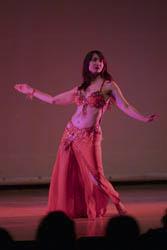
Dancing the night away
Classical and folk belly dancing was the subject of the Middle Eastern Dance Club’s Spring Hafla Friday, with featured performances from beginners to professionals.
The event is one of three the group does annually. Tracy Hanzalik, also known by her stage name, “Sumra,” is the director of the club and has been for the last 10 years.
“It’s a great escape from reality when you’re dancing,” she said.
Beginning next fall, the group will no longer meet as a club but as a studio called Shimmering Sands, which will hold classes for various levels in the Whittier Center. The club caters to all abilities, she said, as will the studio.
Amy Duffy, a first-time performer, started dancing in February and said she was surprised at the difficulty of the art form.
“I took ballet as a little girl and all through high school and this is a lot tougher than ballet,” she said.
For her, she said, dancing has been a lifetime activity, dancing all through childhood and up until she had children 12 years ago. Belly dancing has been her first return to dancing since then. The best part, she said, is that it’s a great workout.
However, practicing belly dancing and performing it are two different things, she said. Friday was her first time dancing in public and she said she was very nervous about going out on stage.
“I’m freaking out,” she said. “My hands are really sweaty.”
Performing gets easier each time but technically harder, said Marie Heniger, who has been taking belly dancing lessons for about one and a half years and performed about six times. As a student improves, she said, the technique takes more muscle and control.
There are different reasons a person might belly dance, she said.
“It’s like my zen, my release, my me time,” she said. “Dancing is my therapy. Some people paint, some people sing. Dancing’s my thing.”
Utah, and specifically Logan, has some very talented dancers, though there isn’t very much work for them, said Rebecca Habtour, or “Shems,” the guest dancer for the evening and former USU student. Now living in the Washington, D.C., area, she said there is a phenomenon among Utah dancers that isn’t quite found anywhere else.
In D.C., she said, belly dancers will be quickly hired when they get to a certain level because of the area’s high ethnic diversity and large Arabic population. However, once they are hired, they don’t usually feel the need to improve their skills further, she said. In Utah, though, there are very few jobs available for dancers, she said, so dancers will continue to learn and improve their skills. As a result, she said, Utah dancers are frequently better dancers than some professional dancers in other areas.
“It has made me appreciate our dancers a lot more,” she said. “We have great dancers here.”
As difficult as belly dancing might look or seem, Hanzalik said it’s important to remember that anyone can belly dance.
“There is no age limit, no body type needed, just come and have fun,” she said. “We’ll teach you how.”
-lisa.m.christensen@aggiemail.usu.edu

USU’s Middle Eastern Dance club, Hafla, held their annual spring performance Friday night. (Cameron Peterson)