
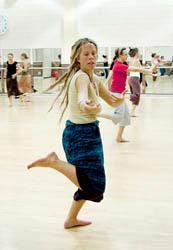
Dancing to the beat of an African drum
Rhythmic beats of the drum, bright clothing, and dancers performing a healing dance do not make up a scene from the latest National Geographic documentary on African cultural rituals on campus. They are part of PE 1910.
The activity course, African Dance, gives students and community members the opportunity to immerse themselves in African culture through music and dance every Tuesday night.
“The drums and body movements make it so organic and so deep, and then you have the vibrations,” instructor Jaynan Chancellor said. “I don’t know how people can hear that and not dance.”
Each class begins with a series of warm-up exercises, which gradually progress to specific dances. As the warm-up moves along, the accompanying drums get louder and the music more intense, coinciding with the gradual loosening of the body and muscles as the dancers prepare themselves for larger movements.
In a typical class, once the beginning exercises are over, the instructor leads the class through a dance inspired by traditional African ceremonies and events, like a healing dance.
Chancellor, who has taught the class for the past three years, first demonstrates the dance. African dance embodies its own, distinct technique, Chancellor said. The entire body is involved in the movement-the head, arms, legs, neck, center, feet and even the fingers.
Chancellor said this style of dance takes some getting used to for most people.
“As Americans, we don’t know our bodies or how to move our butts because we’re tight, so it’s like relearning your body,” Chancellor said.
And unlike some forms of dance, like classical ballet, African dance isn’t so strict, she said.
Valorie Reit, senior in English teaching, said students can just “go with it.”
“If you don’t know the steps, you’re fine, you can do no wrong. It’s all in the hips,” Reit said.
Amanda Rudd, community resident, said because the movement isn’t very dictated, it allows for flexibility and the opportunity for dancers to create their own flair.
“It is not a matter of getting the steps right, it is just getting into your body and about the movement,” Rudd said.
Community resident Jenny Wolfgram said, “The movement is just so natural and earthy, and when the drummers start playing, it is grounding.”
The five drummers play three sizes of djunjun and djembes, and each drum creates a different rhythm.
Chancellor said although someone can become a good drummer after doing it every day for six months, it takes about six years to become an expert drummer.
“We have incredible drummers this year,” Chancellor said. “We now have two drummers who have been doing it for more than six years.”
One of the drummers, Ryan Russell, said he has played the drums for 16 years and African rhythms for the past couple of years.
“I have just been delving into it and diving deeper into ancient rhythms,” Russell said, who is playing for the class for the first time this year.
Becoming a skilled African dancer takes more than knowing the steps, Chancellor said. Students need to be familiar with the music as well.
“Each rhythm and each movement is set, and you don’t dance a movement to the wrong rhythm,” Chancellor said.
At the end of each class, every dancer bows to each individual drummer, offering thanks.
African Dance is a credited course, yet some students return year after year. Katie Hein, fourth-year graduate student in aquatic ecology, said she is taking the class for the fourth time because she said it is the highlight of her week.
Rudd said having newcomers in the class creates degrees of aptitude.
“There are different ability levels, so there is always someone to watch. So if you’re falling behind and not understanding the steps, people are always willing to help you,” Rudd said.
Reit said, “I took (the class) because it sounded like the most fun, most exotic dance offered on campus.”
Hein said she continues taking it because she loves the energy and the synergism between the drummers and dancers.
In eight years, Chancellor said she has gone from being a student of African dance to a teacher. After taking her first workshop at the University of Utah, she has continued working with the art form, she said.
“I’ve done modern dance for 15 years (as well as) the Graham method, but it seems a lot more structured, whereas African dance is what your body does. It is training the body to relax into its natural environment,” she said.
The class performs at least once a semester. This fall they performed at the Gardener’s Market and on campus during Diversity Week.