
Dark Metropolis brings new light to museum
Dark Metropolis, the latest exhibit at the Nora Eccles Harrison Museum of Art, showcases artist Irving Norman, “an artist we’ve believed in for a very long time,” said Victoria Roe, director and curator of the museum.
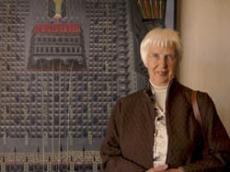
Norman’s wife, Hela Norman, along with curator of the Irving Norman pieces, Scott Shields, spoke to USU students Friday morning about Irving Norman’s life and work.
It took Irving Norman, a mostly self-taught artist, according to Hela Norman, two years on average to finish a painting.
Irving Norman would first draft the painting in his mind, then pencil the image onto the canvas. He would then outline the design in ink. For the final step, “he would do a wash of complimentary color and decided it would be more wise with a green underneath, and then he would start on the top layer,” Hela Norman said.
“When he came to the end, he would probably prepare for the next one but would take a little time off between paintings, and during this time he was not too easy to live with,” Hela Norman said. “That’s when things would go on in his head, and he would have to plan for the next one. But once that was settled, he was sweet as pie.”
Art historians often describe Irving Norman as a social surrealist, but Shields said he doesn’t think Irving Norman would have called himself a social surrealist, as he didn’t really like the term. However, the exhibit is classified as social surrealism because “you can’t look at his work and not think of social causes,” Shields said.
Hela Norman said Irving Norman’s works reflect social issues because he was “very bothered by what was happening to people in the world. His intense caring for human beings made him paint these works.”
When Roe asked Hela Norman what life experience influenced Irving Norman to paint these pieces, Hela Norman said, “I think it was his war experience.”
Irving Norman fought in the Spanish Civil War with the Abraham Lincoln Brigade, and because of his experience with war, “he felt the need to show what war was so people would understand,” Hela Norman said. “He came to the conclusion that our society was based on war.
“He was a visual person. He just saw everything, and he was never bored. He knew his work was great.”
“It feels like he has been ignored,” Roe said. “Because of the magnitude of his work, he hasn’t received the critical acclaim that he should have earlier on.”
Irving Norman’s work has only recently begun to be recognized; people never knew what to think of his work because it didn’t fit with his time, Shields said.
“There are a whole generation of artists who are starting to work like Irving Norman. He just did it 40 years earlier,” Shields said. “I think people are catching up now, he was just a bit ahead. I don’t think he is ever going to be obscure again. When you’re really talented, you have a sense that people are going to catch up.”
When asked what she felt the paintings conveyed, Hela Norman said, “I think he was trying to say, ‘Look folks, can’t we do a little better?’ He had that hope that we actually could.”
Roe said, “At first glance, you realize how powerful and how much impact this artwork has. You will have to come back. The first time is not enough; it is somewhat overwhelming.”
Dark Metropolis will be showcased at USU through Oct. 6 at the museum.