
Digging for Geology
Geology is a fairly small major at Utah State University – about 40 undergraduate and 20 graduate students – but it is no small field of study.
Think volcanoes, tsunamis, petroleum, minerals, mountains, glaciers, springs, fossils and Earth.
Digging into geology offers students an opportunity to hike in foreign places, explore caves, land jobs in government, oil and gas, environmental agencies and more.
The USU Department of Geology, located on the Quad is showing students another world.
“My theory is that if everybody was doing what they wanted to do, they’d all be geology majors,” Kristi Rider, a senior majoring in geology, said. She recently switched her major.
“I was a biology major and I hated it,” she said.
After she finishes her bachelor’s degree at USU she plans to head to Hawaii for a master’s in geology.
“I want to study volcanoes,” she said.
What exactly is geology?
Yes, geologist study rocks, but talk to anyone in the department and they’ll assure you that’s just a piece of the puzzle.
“Geology is basically the study of the earth, the entire earth as a system, how it came into being, how it evolved and, to a certain extent, our interaction with earth,” said John Shervais, geology professor and department head.
It’s also studying the very old.
“The thing that distinguishes geology from a lot of other disciplines is that we look at deep time in the Earth,” Shervais said. “Sums of a couple millions of years old – that’s nothing. That’s the recent past. That’s like yesterday. We typically work on things hundreds to thousands of million years old.”
Earth is 4.6 billion years old, he said.
More than rocks
Shervais said many people do not make the connection of the link between the study of geology and evolution.
“The basic observations of evolution are in the rock record,” he said. “We see rocks that are old have certain life forms. And, these life forms become progressively more complicated through time.”
“The great thing about geology is it’s like the mother of all sciences,” he said.
Shervais switched his studies in his early college years from physics to geology for several reasons.
“If you’re an experimental physicists, you spend your life in the basement and that’s no fun,” he said. “It’s better to be outside.”
“What I liked about geology was the fact that it did involve a broad spectrum of science,” he said. “It involves physics, it involves chemistry, it involves biology and it involves things that are very specific to geology. It lot less narrow. It’s got a lot broader points of views than the other sciences, which makes it fun, because you get to interact on different levels.”
Why study geology?
Geology students tend to be interested in science and enjoy doing activities outdoors, Shervais said.
“If you’re studying problems, you’ve got to go where that problem is well exposed to view – a good place to look at it,” he said. Those places often in other places around the world. So you get to travel.”
The study has taken USU students all across the world to China, Taiwan, Tibet and Southern California. Shervais said it has taken him to Pakistan, New Zealand, Russia, the Alps Mountain Range in Europe and more.
Jim Evans, geology professor, who studies specifically the formation of structures, said the discipline of geology is good for everyone. He has seen students become lawyers after finishing an undergraduate in geology. He said it will give anyone an understanding of how the earth works.
“It’s kind of like the liberal arts degree of science,” he said.
For many students in geology, they are just studying what they love.
“I’ve pretty much been fascinated with volcanoes since I was kid,” said Ruth Hobson, a geology graduate student. “There’s lots of other parts of geology that are really interesting. You get look at really neat things.”
She received her undergraduate degree in geology at the University of Colorado and later landed a government lab job in Boulder, Colo., where she analyzed forest fires with satellite data. That job sent her to 12 different countries, she said.
“There are a lot of good jobs in geology, especially if for people who don’t want to work in an office all day,” Evans said. “It is one of the few degrees that allows you to work outside.”
Perfect location
USU lies just below a mountain range full of caves, canyons and rock cliffs and not far south lies plenty more, such as the Wasatch Mountains and Colorado Plateau – a strategic location for those studying land formations.
“I love it here. There are very, very, very few places in the world that are better to do geology than here,” Evans said. “Undergrads can do research projects and they don’t have to go far. It’s great because you can take so many field trips for classes.”
Geology requirements
“To succeed in geology, what you need is a core of the basic sciences,” Shervais said.
In the geology major there is the general geology option, which is a mix of science courses requiring 77-79 credits in the major.
Then, there are other emphasises, such as hydrogeology, engineering geology, geoarchaeology and a composite teaching major in earth science. These range from around 80 to 100 credits required from the major.
Geology students must plan on taking hefty courses such as calculus, statistics for scientist and geographic information analysis. They will be required to take physics, chemistry classes and certain emphasises require computer skills classes.
But students will also be outside on field trips and in laboratories dealing with the elements hands on.
“It’s an active physical occupation,” Shervais said. “It’s scientifically challenging but at the same time it’s way fun.”
Kyle Andreason, who is a geology graduate student, has been studying an area called the Farmington Complex where he is analyzing the rocks and formations in the mountains near Farmington and on to Ogden.
“The coolest thing is just doing the hands-on stuff and actually getting results. It’s not all book work,” he said.
His love for geology began at an early age, he said, where he grew up hunting for crystals and rocks.
He said he hopes to land a job either in environmental geology or teaching when he finishes his masters degree.
-joelfeathers@cc.usu.edu
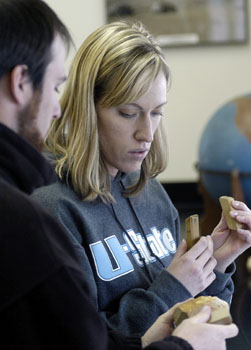
Two Geology students, Isaac Westfeild and Kristi Rider, examine molds of various crystal formations during their mineralogy lab on the morning of Feb. 8. (Photo by Ryan Talbot)