
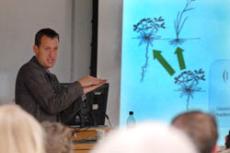
Ecologist discusses biological invasions, exotic species in U.S.
The number of exotic species entering the United States through trade will increase by about 20 percent within the next decade, said Jonathan Levine, a leading scientist in the fields of community and invasion ecology.
During Wednesday’s seminar, Understanding Biological Invasions From Introduction Through Spread, held at USU’s Ecology Center, Levine said exotic plants and animals entering the U.S. are merely “hitchhikers on trade activity.”
These “hitchhikers” aren’t necessarily a new species with every journey. He said if the country were to double trade with a region, it would simply be introducing the same species that were previously introduced into the U.S. The majority of exotic species entering the U.S. include insects, mollusks and plant pathogens. According to Levine, once these exotic species enter the country, it takes a variety of factors to ensure the growth, reproduction and life of the species. Frequent disturbances in nature, severe stresses on the plant or animal, pollution and lack of food and water can lead to the decline of that specie’s diversity.
“This is about a cause and an effect,” he said.
If the landscape in which the species live is patchy and contains little or no water, the exotic organism will be unable to survive and reproduce, he said. If the area is fertile and contains a wide variety of other species, the exotic organism will be able to live longer and reproduce. Seeds from the exotic plant will be able to attach themselves to animals or other plants in order to travel.
“More seeds are able to disperse closer to the plant. The denser the population becomes, the more seeds are (produced), the more likely the seeds will travel further ensuring increased diversity for the species,” Levine said.
Levine discussed his different methods to discover his findings. He flagged 65 caritas tussocks, a native plant, then added exotic seeds to the plants to see how well they reproduced throughout the year. Another method he said he used was pouring 40 pounds of glitter downstream to observe if rivers helped in the transport of seeds. He was only able to find a small percentage of the glitter. This, he said, proved some seeds could still travel via water and make it to a desirable location.
Levine has won many awards, including the George Mercer Award for best paper by a scientist under the age of 40 and the David and Lucile Packard Foundation Fellowship for Science and Engineering Award. He is also an avid member of the Ecological Society of America.
He is currently a professor in the department of ecology, evolution, and marine biology at the University of California Santa Barbara. He received his doctorate in integrative biology from the University of California Berkley.
-melissa.mcroberts@aggiemail.usu.edu