
Ex-polygamists speak out against practice and speak up for support group
Utah has turned a blind eye to those who practice polygamy, prosecutor Doug White said Friday afternoon.
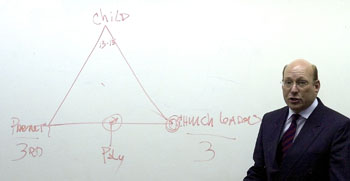
Accompanied by two ex-polygamists, Vicky Prunty and Rowenna Erickson, White spoke to a Utah State University criminal law and justice class, one that his son, Rick, attends. The guest lecturers spoke about Tapestry Against Polygamy, the support group Prunty and Erickson began in 1998 to help those who leave polygamist communities.
“Their individual stories in and of polygamy is why this group exists,” White said.
Erickson, who grew up in the Kingston polygamist clan, spoke about what polygamy does to its follower’s mental health and hardships she endured for the first half of her life.
Erickson said she was taught “how to be brainwashed and go along with the flow” by the Kingstons, who preach that their family line can be traces back to Jesus Christ. The family intermarries, she said, in order “to keep this line pure.” However, during her time with the Kingstons, Erickson said she questioned the reasoning and practices of the community.
“I always felt like they were trying to break my spirit,” she said, “and I wasn’t going to let them.”
Married to her brother-in-law at the age of 20, Erickson said she was taught not to fall in love.
“Polygamy is not love, it is power and control,” she said.
Erickson had children soon after her marriage, six girls and two boys. However, the father was not much involved because he didn’t know how to be, she said.
“So I did it all, and it was a good thing,” she said. A few phases popular during World War II inspired her to remain courageous and take action against the lifestyle she was brought up in, she said. One such phrase was “real evil is when good people stand by and do nothing.”
“I was the only one who took interest in the hygiene of my children,” Erickson said as she talked about how many of the children would go to church without wearing shoes.
As she began to question herself, and the teachings of the Kingstons, Erickson said she couldn’t see the difference between Soviet Union communism and polygamy. She said she feared that what she had been taught her entire life was a sham.
“What if I died and went to heaven and they said ‘April Fools?'” Erickson said.
Determined not to procrastinate the feelings of uncertainty, Erickson said, “One of my New Year’s resolutions was ‘OK, God, I want the truth.'” Shortly after, Erickson said she began to pursue schooling as a hypnotherapist.
From her research as a hypnotherapist, Erickson said she realized that isolation, depravation, desolation, torture and lack of education are the fundamentals used to brainwash any individual – elements that defined her childhood.
After Erickson became a certified hypnotherapist, she said, “I uncovered sexual abuse I had never heard of in my life.” Shortly after, Erickson said she couldn’t “just do nothing” and made a statement at the Attorney General’s office, appeared on KSL TV and spoke with the FBI.
“It scared the daylights out of the Kingstons,” she said.
Erickson said she realized that she was a victim and wrote a letter to the Kingstons on April 1, 1992, and shortly after she was excommunicated.
Often polygamist communities do not encourage or permit the women to pursue an education, White said. Before a girl reaches the age of 16 she is pulled out of school and marries soon after, usually to a much older man, he said.
Prunty, a victim of this reality, said she started advocating against polygamy and the human rights violations made by this practice in 1998.
“There was little education about polygamy in the state of Utah,” she said. “We are unraveling the tapestry and creating a choice for women and children.”
However, Prunty said she has encountered obstacles when helping women who want to leave polygamist communities. Usually the women who do leave have no financial means for security, don’t have an educational background and do not own property. With these obstacles, many women retreat back to polygamy as a means of security.
“At least they get their bread, at least they get their shelter there,” she said.
Many women, for fear of survival, do not seek help to leave polygamy.
“Until we deal with that fear, we can’t move forward,” Prunty said. “You cannot help people that don’t want to be helped.”
Tapestry Against Polygamy is advocating for polygamy to be illegal, not decriminalized or legalized as a means to resolve this perpetual problem, she said. Polygamy is an extremely unsafe environment for women and children, Prunty said.
“This is a wonderful place for a pedophile to be,” she said, among vulnerable children and women.
“Some kids are really waking up, but don’t know how to get out,” Erickson said.
This organization will continue to offer help to the estimated 50,000 polygamists in Utah, White said. This group has attracted national and international attention, White said, from BBC, “Dateline,” “48 Hours,” “20/20,” “A&E,” “Good Housekeeping,” New York Times, Washington Post and 14 different countries have sent reporter’s to interview them as well.
“Believe me, Vicky and I, we’re going to change history,” Erickson said.
-kcashton@cc.usu.edu
(Photo by Michael Sharp)
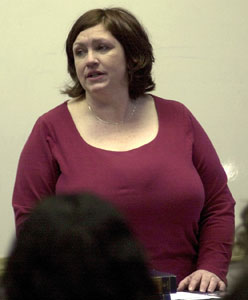
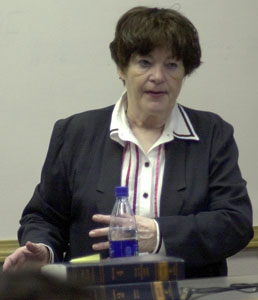
Rowenna Erickson (above) and Vicky Prunty (below) lectured to a criminal law and justice class about their experiences in polygamy. Prunty and Erickson started the advocate group Tapestry Against Polygamy to help others escape polygamist communities and provide support once they´ve left. (Photo by Michael Sharp)