Extracting wisdom with an oral surgeon
He could “fix” Jay Leno’s chin.
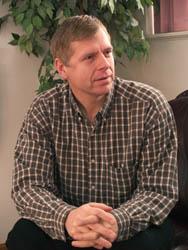
Dr. Gregory E. Anderson, oral surgeon in Logan, said celebrities or movie stars who want a bigger or smaller chin often use reconstruction surgeries like osteotomies.
“We actually go in and it is kind of like cutting the face apart,” Anderson said. “It is kind of gross sounding, but it is a fun surgery.”
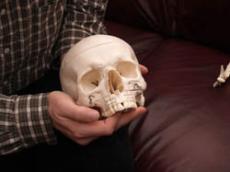
With a skull that has removable parts, Anderson demonstrated the surgery by separating and removing the jaw from the maxilla and moving the mandible forward or backward. Anderson said the procedure is often used to aid a neurosurgeon in accessing the pituitary gland, but he has never done it for that purpose due to the fact that there is not a neurosurgeon in the valley.
“It is like the Jay Leno thing,” he said, “Jay Leno has this big old chin that comes out. I could fix him you know, if he would let me.”
Anderson, a USU alumnus, said he had two uncles who were dentists, and despite his father’s desires that he become a physician after he finished his undergraduate studies, he decided to pursue dental school after doing better on the DAT than the MCAT.
“He was kind of mad I didn’t go the physician route,” Anderson said. “I still like the medical side of things, (but) oral surgery is kind of the bridge between medicine and dentistry.”
Anderson said he enjoyed dental school and decided in the second or third year he wanted to specialize in oral and maxillofacial surgery.
“You have to go in with the idea that you are going to specialize,” Anderson said. “In dental training, a specialty isn’t required, and only about the top 10 percent are able to specialize because it is so competitive.”
The procedure Anderson said he does the most in Cache Valley is wisdom tooth extraction, but he does many more procedures. Anderson said he performs 14 to 20 osteotomy surgeries a year and used to do more until insurance companies became less likely to pay for them.
“It is like a service project almost, which is OK,” he said. “I feel bad for the patients and I want to help them out, and I like doing them, so I still do quite a few.”
As an oral surgeon, Anderson is self-employed and said it gives him the freedom to make his own schedule. Anderson said he likes to schedule himself four days a week, and on a normal day, he goes to the office from 8 a.m. to 5 p.m.. Anderson said he likes to save Wednesdays as his surgical days, and oftentimes he will get trauma calls from the hospital. Many surgeons in big cities, however, choose not to do trauma patients.
“I’ve committed myself to the hospital, and I don’t regret that, “Anderson said, “It is fun for me to help people in that situation, in that scenario, and so I have continued that part of my practice. Because of my personality, I like helping people out.”
One of the procedures he does a lot that not many oral surgeons do is implants, he said. He handles 300 to 350 implants per year and said they are helpful to older people who have been missing their teeth for many years.
“It is neat how the technology has given people a lot more options and a lot better ability to maintain their oral health and their ability to function,” he said. “My dad is a good example. My dad had Parkinson’s disease, and before he got real bad, when he was still healthy, I put implants in him. Because of implants, he was able to function better. “
Tooth implants are a more modern way to help people and are a rewarding thing to see, Anderson said.
He said if “I wanted to make money, I wouldn’t be here.”
Anderson said the typical process to become an oral surgeon is to complete an undergraduate and then attend dental school. Dental school usually lasts four years and is followed by four to six years of training during a residency.
Balancing family life during his residency was brutal, he said, because he would work 100 hours a week, but as his practice became more established and self-sufficient, he was able to spend more time with family.
After residency, oral surgeons spend six months as an anesthesia resident and then have two-and-a-half years training of deep conscious sedations, like the ones he performs in his office.
Anderson said 95 percent of his patients choose to have anesthesia, and he does 10 to 12 anesthetics a day. He hasn’t experienced any major problems while putting people under anesthesia, he said, and the old defibrillator sitting in his office has never been used. But people react to the drugs differently, he said.
“It kind of reminds me of drunks,” Anderson said, “Most are teary or emotional while others are happy and singing. I probably couldn’t disclose what people say when they are asleep,” Anderson said, laughing.
The busiest time for him is whenever school is out, he said. Most people procrastinate until the end of summer or wait for Christmas break, Spring Break or even Thanksgiving break to have procedures done.
Young, healthy people are who Anderson said he works on the most.
Most of Anderson’s patients are patients of general dentists and other professionals who diagnose a problem and then refer patients to him.
“One of the challenges I have in this valley – in Utah in general – there are a lot of general dentists, and so a lot of them do the things that I would traditionally do,” Anderson said. “It’s a little frustrating, but I can’t really step on their toes ’cause they are my bread and butter too.”
Anderson said some people are timid to go to an oral surgeon because they are scared of surgery or fear that it will cost them more. Anderson said he extracts 8,000 to 9,000 teeth a year, while a general dentist will only do 60 or 70.
“The advantage is I do it quicker and so there is less exposure in the area,” he said. “I see all the complications because I do so many surgeries, and I tend to have less complications because I get better at it. I’m not saying I’m better than these guys, just what you do, you become more expert at.”
Working with insurances companies, paperwork, and keeping and maintaining staff is the hardest part of his job, he said.
Anderson said one of the problems with insurance companies is that although the rates for dental procedures have gone up over the years, the amount of coverage by insurance companies has remained the same.
“If you are buying your own dental insurance, you’ll end up paying $800 to $850 a year – somewhere in that ballpark – for the $1,500 coverage, and so it is almost not worth it,” he said.
Dealing with insurance companies for the medical procedures and traumas is more difficult because they will often consider several procedures as one. Anderson said for procedures that cost $5,000, the insurances companies will only pay $1,500.
“It’s OK. I don’t do it for the money, but it is frustrating,” Anderson said. “In any other field, that would not be acceptable. I know that they are in it for the money and they will reject so many things and you have to appeal, and it is just a big hassle. It doesn’t happen all the time, but it happens regularly enough that it’s frustrating.”
Anderson said he feels insurance companies don’t give the benefits they promise or he thinks they should, but he admitted he may have a bias. Anderson said when insurance companies started, they had a pool of money and a vast amount of resources, and they paid out for the people who needed it.
“You paid in, you had a problem, they paid out, ” Anderson said. ” But because of those resources, and in my opinion because of greed, they try to cut back and don’t live up to their end.”
Professional providers like him are restricted from discussing with one another what they charge for their services. Anderson said because of the anti-collusion laws, some providers have tried to unionize, and doing so would make it more competitive against the insurance
companies and better for the patient. If professionals could unionize, he said they could refuse to join with insurance companies who don’t live up to contracts or treat patients and customers appropriately.
“If they would go back to the way when they first started it, and they (could) have more of a client mentality rather than a money mentality,” he said. “They talk about socialized medicine and nationalized health care, and the sad part is if they wanted to fix it, I think they could.”
-n.laursen@aggiemail.usu.edu