
Fighting back with words
Hundreds of students crowded into the Taggart Student Center Ballroom Thursday afternoon, some setting up their own chairs and some standing in the front or back of the room when space for chairs ran out.
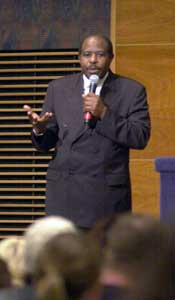
After a brief introduction, Paul Rusesabagina walked onto the podium, and the entire room erupted in applause.
“History keeps on repeating itself and never teaches us a lesson,” he said.
Two years after the genocide in Rwanda, a war broke out in the Congo which has killed 4 million people since 1996. Nobody, not even the media, wants to talk about that, he said.
World leaders gathered in January 2005 at a memorial commemorating 60 years since the Jewish Holocaust, Rusesabagina said.
“The two most repeated words were never and again,” he said.
However, genocides have occurred and continue to occur, Rusesabagina said, mostly because Western nations are fairly ignorant of what is happening in Africa.
Rusesabagina’s story unfolded much as portrayed in the movie “Hotel Rwanda.” He said the night of April 6, 1994, the president of Rwanda was assassinated, igniting a war between Tutsi rebels and Hutus in the central African nation.
This night set into motion a chain of events that left more than 800,000 people dead, many of them civilians.
“That was the beginning of a kind of endless hell,” Rusesabagina said.
Rusesabagina was a Hutu, according to distinctions originally made by German, and later, Belgian colonizers. His wife was a Tutsi. There are not huge classifications between the two groups, he said.
When Germany colonized Rwanda, they essentially told 14 percent of the population – the Tutsis – that they were superior, closer to Europeans, he said. The Tutsis were put in charge.
By 1994, tensions between Hutus and Tutsis were high. Then, as Hutu extremists blamed Tutsis for the death of president Juvenal Habyarimana, the situation escalated.
After 10 Belgian soldiers were killed, Belgium pulled out, followed by the rest of the world, he said. The world turned its back on Rwanda, Rusesabagina said, leaving it to the hands of killers.
Rusesabagina began sheltering refugees shortly after, when his neighbors began coming to his home for protection.
“So far, I have never understood why those people came to my house,” he said.
Three days later, Rusesabagina said he saw soldiers climbing his gate, and he went out to try to open up a dialogue with them. The soldiers wanted Rusesabagina, a hotel manager for the Hotel Diplomat, because he had some keys in his office. In the end, the soldiers agreed that Rusesabagina could take
his family with him.
The soldiers wanted Rusesabagina, a hotel manager for the Hotel Diplomat, because he had some keys in his office.
Rusesabagina and those in his van ended up at the Hotel Mille Collines, where he had worked previously.
For 76 days, they were able to hold off militia and enemy fighters, living with no electricity or water, except what could be taken from the hotel swimming pool.
After a while for the refugees living in the Mille Collines, Rusesabagina said, it wasn’t really a question of whether they would live or die. They knew they were going to die, he said, it was just a question of how.
However, Rusesabagina was able to hold off the militias time and again, preserving the lives of 1,200 people.
Finally, early in the morning of June 18, all the refugees at the Mille Collines were evacuated. Rusesabagina, his wife, and their children, were all able to escape the hotel safely, along with two of Rusesabagina’s nieces, whom he has adopted.
Rusesabagina now lives in Belgium, but he traveled to the Sudan in January of 2005.
A genocide similar to the one that occurred in Rwanda in 1994 is currently occurring there.
Two million people are displaced in their own country, Rusesabagina said. Many of these refugees are children.
He said one night as he toured the refugee camps in the Sudan, 2,000 children gathered and demonstrated. The main thrust of their demonstration was their need for education.
“The basic need in life to make men and women is education,” he said.
Western nations could be more educated about happenings in Africa as well, he said.
“Behind every African dictator is a Western superpower,” he said. “Now is the time to fight against many apartheids in Africa.
Jackie Lambert, a junior majoring in English and history education who attended the speech, said the movie, and the story that inspired it, makes her sick.
“It just makes me feel disgusted thinking that something this horrific and appalling happened in my lifetime, and I only learned about it a few months ago,” she said.
Kim Brown, an undeclared sophomore, agreed.
“‘Hotel Rwanda’ makes me feel guilty to be white,” she said.
The TSC ballroom was filled with students for the event, including students sitting on the floor.
-dmaxfield@cc.usu.edu