
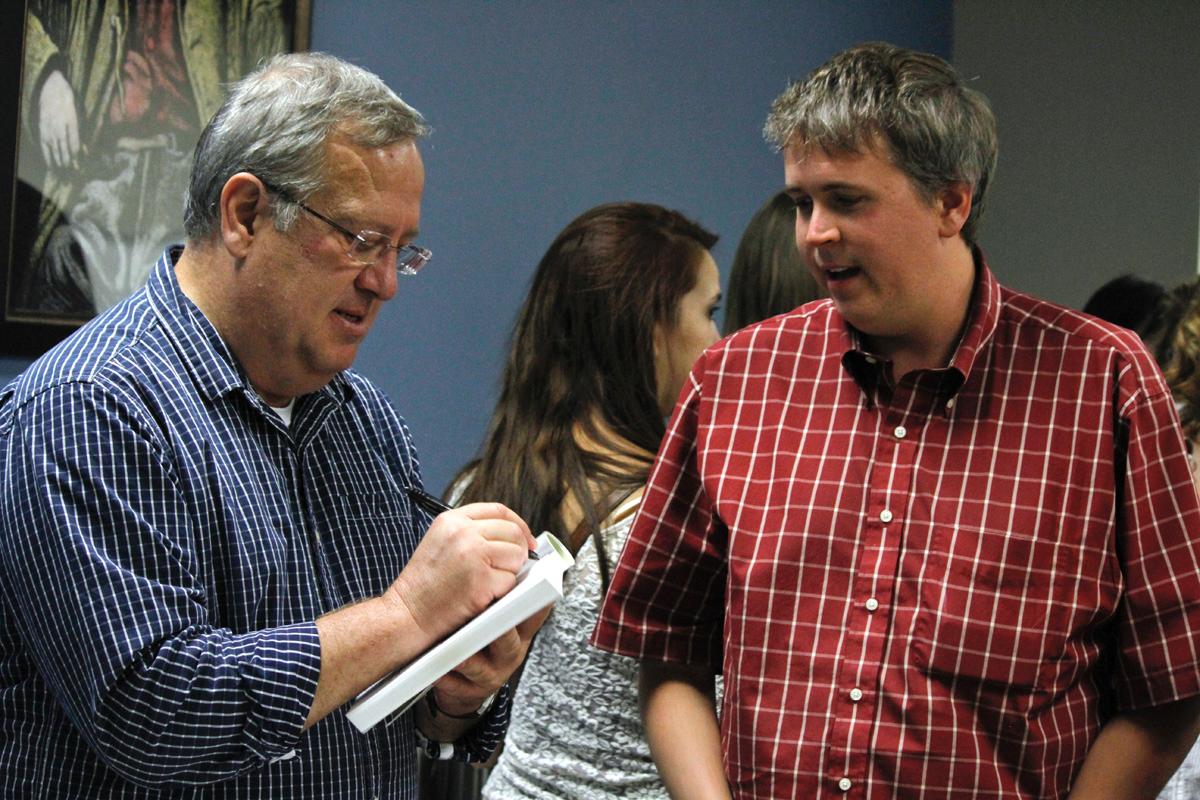
Find a spiritual path, Ohio professor tells students
With a room packed to capacity, students sat on and even under tables to listen to Dinty Moore, director of the creative writing program at Ohio University, speak in the Merrill-Cazier Library auditorium Thursday afternoon.
“He talked about Buddhism, but he was very even handed with all religions,” said Kendall Pack, a senior majoring in in English. “He just very much wants people to find a spiritual path. As long as you find a spiritual path and you have compassion for other people, then you can be a great artist.”
Moore, who converted to Buddhism as an adult, said as long as students find their spiritual purpose in life, other decisions they have to make will fall into places.
“I don’t care if you watch Adventure Time on the Cartoon Network, as long as you find a spiritual path to follow,” he said.
Moore said people have often asked him how his Buddhist beliefs have affected his writing and he has never had a good answer. One day, he realized he couldn’t give a straight answer because he had been looking at his situation backwards.
“My lifelong pursuit of writing and creativity has helped to open me to the path of Buddhism,” he said.
During his lecture, Moore introduced his new book, “The Mindful Writer: Noble Truths of the Writing Life.”
“Mindfulness begins with an awareness of the simplest action,” Moore said. “Breathing in, know that you are breathing in, breathing out know that you are breathing out.”
In the context of writing, mindfulness means that people are able to remain attentive to the task at hand, he said. They see the words that are before them and hear the possibilities in their minds, he said.
“More than that, mindfulness in writing means being aware of why you want to write, who you are writing for, and how to balance your desires for recognition with the demands of clear-headedness and honesty,” he said.
Moore said writer’s block is simply worrying about critical responses or negative reaction. Worrying about these critical responses and negative reactions while you’re trying to form your thoughts will eventually, inevitably, dry up whatever creative flow you managed to bring forth.
He came to understand the importance of examining his motives for writing – of rooting out insincerity.
“Dishonest motives, such as writing to get back at someone who wronged you or pretending to be more decent or more devout on the page than you are in real life, are as dangerous to a writer as just about anything I can name,” he said.
Although the fourth noble truth of Buddhism says to dispel ego, it is difficult to separate it entirely from your writing, he said.
“You can’t ride a bike without being attached to the idea of the bike not falling over,” Moore said.
Moore also read selections of his writing at Helicon West.
“He takes something that people commonly have reserved to ac
ademia and put it in a much more fun light,” said Caitlin Erickson, an English graduate student. “It was poignant but it was also very creative.”
USU English professor Russ Beck, who used Moore’s book “Crafting the Personal Essay” to teach his creative non-fiction class, was involved in bringing Moore to USU.
“He’s both good and important, and that doesn’t always happen.” said Beck
Pack read Moore’s writing before and said he was very amiable and friendly.
“I wish USU could host authors every week,” Pack said. “I think having these kinds of things is exactly what creative writers on the campus need and artists in general.”
– abhendrix@pentaracorp.com