
Finding comfort in the presence of pets
BY NATASHA BODILY
features editor
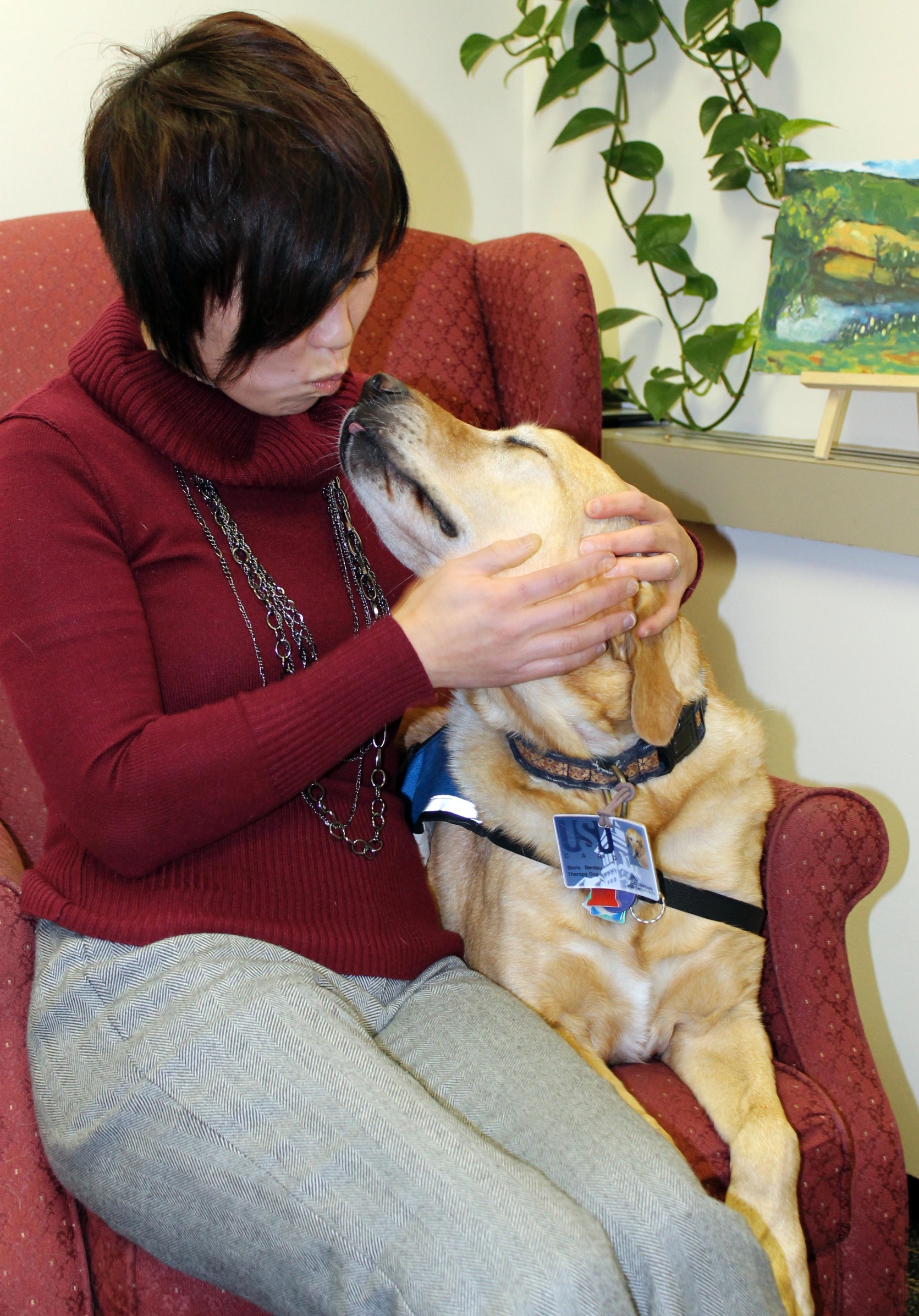
Three hug-friendly dogs can be found on the 3rd floor of the Taggart Student Center.
Remy, Lucky and Boris are the three certified therapy dogs who help assist the counselors and doctoral interns at Counseling and Psychological Services.
Courtney Henry, doctoral intern and Ph.D. candidate, has had Lucky since he was a puppy. For her dissertation, she has been completing sessions of mindfulness training and observing the difference between working with the assistance of the therapy animal and without one, comparing to see if clients respond differently to when a therapy dog is there.
Henry said so far the therapy dog has gotten really good ratings.
“I think at the very least, what I’ll start to see is people are interested in showing up because they want to see him,” she said. “We see that at times, students pop in just to see the dogs, which is awesome.”
She said it’s nice to have people coming into the office and reducing the stigma about the counseling center.
According to the CAPS website, the use of therapeutic animals began in 1997 as part of a predoctoral intern’s outreach project. After the animals left with the intern, Mary Doty, the center’s director at the time, decided to continue the program.
“Dogs just do funny things, so to have them out in the waiting room can relax someone if they’re nervous and it gives you something to talk about,” Henry said.
The results CAPS has seen regarding client satisfaction has indicated most clients find the dogs to be very helpful. Each client is surveyed at different stages of therapy and according to their research, each year between 60 and 70 percent of clients felt the presence of the dogs was helpful.
It was noted that it is likely those who marked “not applicable” had little to no interaction with Remy, Boris or Lucky.
Henry said there are several ways to utilize a therapy dog during counseling sessions.
“There is animal visitation when the animals are just roaming around and there isn’t really a plan of how they will help,” she said. “It might help distract them, make them laugh or lower their anxiety by attracting their attention.”
The process when she or the other counselors are intentionally using the dogs to promote therapy goals is called AAT. In those cases, she said there is a trained professional and some documentation.
“When I do work with Lucky in session, I always document that and note that AAT was done with this goal and this is what happened,” Henry said.
The utilization of therapy dogs in the more intended settings has a wide range.
“I think a good example is effective communication and assertiveness,” she said. “When the client is dealing with the dog, they can practice asserting commands and setting boundaries.”
Henry said most of the time, therapists don’t have a lot of physical contact with their clients, but when there is an animal they can pet and hug, it can be helpful emotionally.
“Other studies have shown that having the dog working with therapists helps the client view the therapist as more friendly by seeing the interaction between the therapist and the dog,” she said.
In initial sessions with clients, she has found Lucky to be a great icebreaker.
Henry became interested in this field due to her love for horseback riding.
“I think what I started to realize was the power of animals and nature and the unconditional love they provide, the attention they grab,” she said.
When she is upset, she said animals help distract her.
Henry said after realizing the benefits for herself, she soon witnessed these results with those she began working with.
“I worked with some children with autism with
therapeutic horseback riding,” Henry said. “I saw some really great results with some of those kids.”
Henry said occasionally she was able to bring Lucky to work with some of those families and many of the kids responded well to him.
“One kid would never say ‘hi’ to me, but he would say ‘hi’ to my dog,” she said. “He was a naturally great therapy dog.”
In order to become a therapy dog, the handler must have the Canine Good Citizen certification through the American Kennel Club and a no-bite statement.
“Basically that says he’s got good manners, he’s a nice dog, knows all his basic commands, is not aggressive and is good around other people and other dogs,” Henry said.
The potential therapy dog should be able to meet people without being overly friendly.
After Lucky was certified through the American Kennel Club, he and Henry went through the Delta Society, an organization for therapy animals.
“They do a lot of policy development for what standards they need to have for the therapy animals for people visiting other school and hospitals with their dogs and other animals,” she said.
Though dogs are the most common therapy animals, Henry said on rare occasions people will see a therapy llama, chicken and sometimes cats.
Students interested in experiencing the animal-assisted therapy can email Henry at courtney.henry@gmail.com. In order to participate, students must have some level of distress, are not currently in therapy and don’t have any dog phobias or allergies.
AAT is offered in many settings. One former student, Kendra Jensen, said she has both received and seen the benefits.
Her mom works as a physical therapist, and Jensen said she has taken her own dogs in to help the patients.
“I think it’s really important because when we take the dogs in, it really distracts the patients from the pain and worry,” Jensen said.
She said one woman patient was very anxious and couldn’t stay balanced until one day when they brought in her dog Bella.
“She had to pick up and throw the ball and she was able to balance and stand up the whole time,” she said.
Jensen, who suffers from Crohn’s disease, has had three major surgeries. During her recovery time at the Doernbecher Hospital in Portland, Ore., she was able to pet and snuggle with a little poodle.
She said as an owner of many animals including dogs, horses and chickens, having an animal to hold helped appease her homesickness.
“My longest stay was 20 days, and I was so homesick and was kind of getting depressed,” Jensen said. “Having the dogs come in made it easier.”
– natashabodily@gmail.com
Twitter: @Natasha62